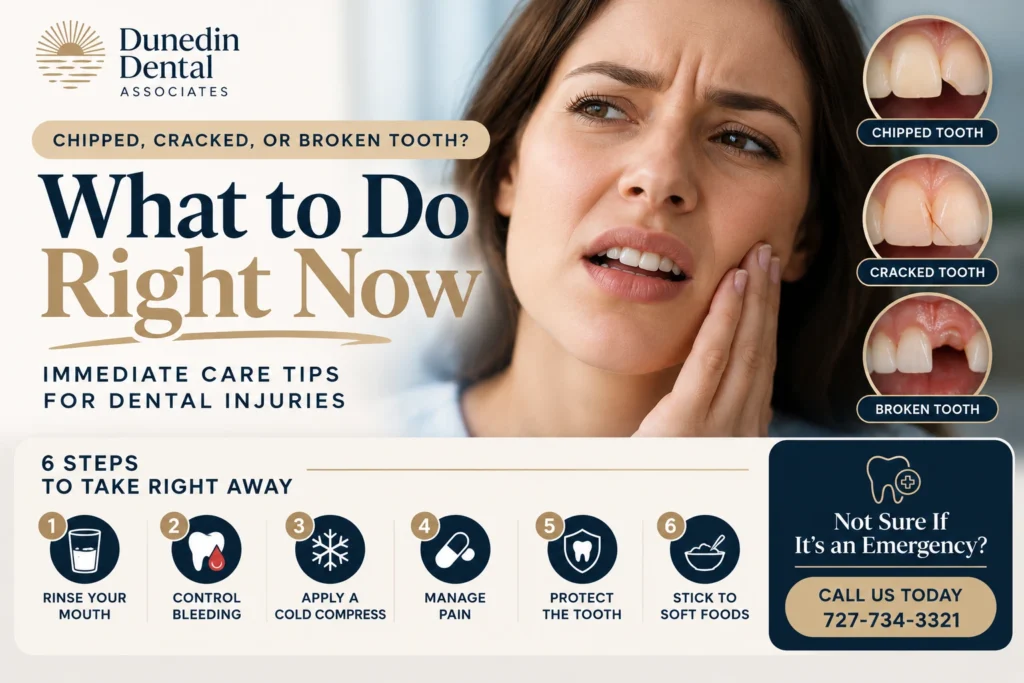
Chips happen fast. One bad bite into a hard piece of food, an unexpected fall, or a minor impact is all it takes, and suddenly you are running your tongue over a jagged edge where a smooth tooth used to be. Knowing what to do in the first few minutes and hours after you chip a tooth makes a real difference in how quickly and easily it can be repaired.
Not every chipped or broken tooth is the same. A minor chip on the corner of a tooth may be painless and non-urgent. A deeper crack or a broken tooth that exposes the inner nerve is a dental emergency that needs same-day care. This guide explains where your situation likely falls and gives you clear steps to take right now.
At Dunedin Dental Associates, we treat chipped and cracked tooth cases regularly and offer same-day appointments for dental emergencies in Dunedin and North Pinellas County. If you are dealing with this right now, call us at 727-734-3321.
Is a Chipped Tooth a Dental Emergency?
The answer depends on the extent of the damage to the tooth. A tooth is injured in many ways, from a hairline chip on the outer enamel to a full break that exposes the pulp inside. Understanding where your situation falls helps you decide how quickly to seek professional care.
Not always an emergency, but always worth a call within 24 to 48 hours:
A minor chip that removes a small piece of the tooth enamel and causes no pain or bleeding is not a dental emergency in the strict sense. Even so, call your dentist promptly. A minor chip leaves a rough edge that can cut the inside of your cheek or tongue, and exposed enamel is more vulnerable to cavity formation and further damage if left unprotected.
Seek emergency dental care right away if any of the following apply:
- A large portion of the tooth has broken off or the tooth is broken at the gumline
- You are experiencing significant tooth pain or sharp sensitivity that does not ease
- There is bleeding from the gum tissue that does not slow with gentle pressure
- The tooth is loose or has shifted position
- There is visible damage to the root of your tooth
- Your face, jaw, or neck is swollen, which can indicate infection
- A child has chipped or knocked out a permanent tooth
If any of these apply, call our office at 727-734-3321 immediately. We will do our best to see you the same day. You can also review what to expect on our emergency dentistry page.
What to Do Immediately After You Chip a Tooth
The immediate care steps you take after a dental injury occurs can reduce pain, prevent further damage to the tooth, and make your dentist’s job easier when you come in. Follow these steps in order.
Step 1: Rinse Your Mouth
Rinse your mouth with warm salt water right away. Mix roughly half a teaspoon of salt into a glass of warm water and rinse gently for 30 seconds. This rinse your mouth with warm water approach cleans bacteria away from the chipped or broken tooth and reduces the risk of infection in the soft tissue around it.
Step 2: Control Any Bleeding
If the gums or soft tissue around the tooth are bleeding, fold a piece of gauze and hold it against the area with gentle, steady pressure for 10 to 15 minutes. If bleeding does not slow within that window, seek emergency dental care.
Step 3: Apply a Cold Compress
Apply a cold compress to the outside of your cheek near the damaged tooth to reduce swelling and manage tooth pain. Place a cloth between the ice and your skin and apply it for 10 to 20 minutes at a time.
Step 4: Manage Pain Carefully
Over-the-counter pain medication such as ibuprofen or acetaminophen helps with discomfort while you wait for your dental appointment. Do not place aspirin directly on the tooth or gum tissue; placing aspirin directly on the tooth can cause a chemical burn to the soft tissue and makes the problem worse.
Step 5: Protect the Tooth
If the broken edge is sharp and cutting your tongue or cheek, use dental wax or temporary dental cement from a pharmacy to cover the broken edge and protect the remaining tooth from further damage. Both are inexpensive and available without a prescription. If you have recovered a tooth fragment, keep it moist by placing it in a small container with milk or your own saliva. Do not store the piece of the tooth in plain water and do not let it dry out.
Step 6: Stick to Soft Foods
Stick to soft foods and avoid chewing on the side of the mouth with the chipped or broken tooth until you see your dentist. Avoid hard, crunchy, very hot, or very cold foods that could cause pain or damage to the tooth structure still in place.
When to Seek Emergency Dental Care Right Away
Most chipped or cracked tooth situations are urgent but manageable until the next available dental appointment. However, some dental injuries require you to get to the dentist immediately, or to visit an emergency dental office if your regular dentist is unavailable.
Seek emergency dental care right away in the following situations:
A knocked-out tooth.
When a tooth completely displaces from its socket, this is a tooth avulsion and time is critical. Keep the natural tooth moist, handle the tooth fragment by the crown not the root, and call a dentist immediately. A dentist might be able to replant the tooth if you act within an hour. This is the most time-sensitive dental injury you can experience.
A tooth that is broken to the root.
If the tooth has broken at or below the gumline, or if you can see that the root of your tooth is exposed, do not wait. Damage at this level requires immediate professional care to save the tooth or to manage the extraction cleanly.
Pulp exposure.
If the broken tooth reveals a pink or reddish center, the inner pulp containing the nerve and blood supply is exposed. This typically causes severe tooth pain and is a direct route for infection to enter. Get to a dentist immediately.
Swelling in the face, jaw, or neck.
Swelling in these areas after a dental injury can indicate that an infection is spreading into the surrounding tissue. This requires emergency dental care right away and possibly same-day treatment.
Dental emergencies in children.
A chipped or knocked-out permanent tooth in a child should always be treated as an emergency. Get to the dentist immediately. If the tooth that moves or falls out is a baby tooth, your dentist will assess whether the permanent tooth developing underneath has been affected.
Treatment Options for a Chipped or Cracked Tooth
The right treatment to restore a chipped or broken tooth depends on the extent of the damage, which part of the tooth structure is affected, and your overall dental health. Here are the most common treatment options your dentist may recommend, depending on the severity.
Dental Bonding
For a minor chip that has not reached the inner dentin layer, dental bonding is typically the fastest and most affordable fix. Your dentist applies a tooth-colored composite resin to the chipped area, shapes it to match the natural tooth, and cures it with a light. Dental bonding usually takes one appointment and works well for small to moderate chips on any tooth. Learn more about this option on our cosmetic bonding page.
Dental Crown
When a tooth has broken significantly or the damage has weakened the tooth structure to the point it can no longer hold a filling, a dental crown is typically recommended. A dental crown fits over the remaining tooth and restores its shape, strength, and function. Crowns are also used after root canal treatment to protect and seal the tooth. See our dental crowns page for more on what this treatment involves at DDA.
Veneers
For chips on the front surfaces of the upper or lower front teeth that are primarily cosmetic in nature, porcelain veneers can restore the tooth’s appearance with a long-lasting result. A veneer covers the front face of the tooth and is permanently bonded in place. Veneers are suited for patients with otherwise healthy tooth structure underneath the chip.
Root Canal Treatment
If a chip or crack has reached the pulp of the tooth, a root canal may be needed before the tooth can be restored with a crown. A root canal removes the damaged pulp tissue from the root of your tooth, disinfects the canal, and seals it. The procedure allows the dentist to save the tooth rather than extract it. Left untreated, an exposed pulp will become infected.
Dental Implants
When a tooth has broken beyond what can reasonably be saved, or when the damage to the root of your tooth is too extensive to support a restoration, extraction followed by a dental implant may be the best long-term path. An implant replaces the missing tooth with a titanium post and a custom crown, restoring both the look and function of the natural tooth. Learn more on our dental implants page.
For complex fractures and cases where the crack extends below the gumline, our team at Dunedin Dental Associates will evaluate the full extent of the damage and recommend the right care. Visit our cracked tooth repair page to see how we handle these specific cases.
Chipped Teeth in Children: What Parents Should Know
Chipped teeth in children are among the most common dental injuries seen in active kids. The right response depends significantly on the tooth involved.
Baby Teeth
A chipped or cracked baby tooth may not always require immediate treatment, depending on the extent of the chip and the child’s age. If the chip is minor and the tooth is not loose or causing pain, your dentist may simply smooth the rough edge and monitor it. If the chip is more significant and has damaged teeth with exposed pulp, treatment or extraction may be necessary to prevent infection and protect the permanent tooth developing underneath.
Permanent Teeth
A chipped or broken permanent tooth in a child should always be treated as an urgent dental situation. Get to the dentist as soon as possible. Permanent teeth are the natural teeth your child will rely on for life, and fast professional care gives the best chance of a complete restoration. If you can find the tooth fragment, bring it to the appointment. In some cases, a dentist might be able to reattach it.
A Note on Tooth Avulsion in Children
If a child’s permanent tooth completely displaces from the socket during a dental injury, keep the tooth moist, handle it by the crown only (never by the root), and call a dentist immediately. Do not replant the tooth yourself in a young child without professional guidance, as the timing and placement matter. A knocked-out baby tooth is generally not replanted, but the permanent tooth underneath needs to be assessed for damage.
How to Prevent Chipping Your Teeth
Not every dental injury is preventable, but several habits meaningfully reduce the risk of chipping or cracking a tooth.
- Wear a custom mouthguard during contact sports. A properly fitted mouthguard absorbs impact and protect the tooth from direct force. Store-bought versions offer some protection, but a custom appliance made by your dentist provides significantly better coverage and comfort.
- Avoid chewing hard objects. Chewing ice, hard candies, popcorn kernels, and using your teeth to open packaging or bite off thread are among the most common ways patients chip a tooth. Your tooth enamel is strong, but repeated impact on hard objects creates small fractures over time.
- Ask about a nightguard if you grind your teeth. Bruxism puts sustained stress on tooth enamel and is a leading cause of cracked teeth over time. A nightguard prevents direct tooth-on-tooth grinding and distributes the force to protect the natural teeth.
- Treat cavities promptly. A cavity weakens tooth structure from within. A tooth with active decay is far more likely to chip or break under chewing pressure than a healthy tooth. Regular dental care appointments let your dentist find and treat cavities before they undermine the tooth.
- Stay current on regular dental check-ups. Your dentist can identify teeth that show early signs of cracking or wear before they break. Early detection keeps your dental needs simple and your treatment costs lower.
Frequently Asked Questions
Can a chipped tooth heal on its own?
No. Tooth enamel does not regenerate. A chipped or broken tooth requires professional dental care to fix. Leaving a chip untreated leaves the tooth open to further damage, cavity formation, and, if the chip is deep enough, infection.
How do I fix a chipped tooth at home temporarily?
You can use dental wax or temporary dental cement to cover the broken edge and protect the tooth at home between now and your dental appointment. Rinse your mouth with warm salt water to keep the area clean. Take over-the-counter pain medication as needed. These steps manage discomfort and prevent further damage to the tooth, but they do not restore your tooth and should never replace professional care.
Is a cracked tooth the same as a chipped tooth?
Not exactly. A chipped or broken tooth involves a piece of the tooth breaking away, while a cracked tooth has a fracture line running through the tooth structure that may or may not be visible. Cracks can be more serious because they sometimes extend down to the root of your tooth. Some cracks are only detectable through a dental examination and digital X-rays, which is another reason not to skip regular dental appointments after any dental injury.
Will a chipped tooth cause pain?
Not always. A minor chip that stays within the enamel may cause no tooth pain at all. Deeper chips that reach the dentin layer typically cause sensitivity to hot, cold, or sweet foods and drinks. If the damage reaches the pulp, severe or throbbing tooth pain is likely. Any level of pain after chipping a tooth signals that you should call your dentist promptly, since pain means the tooth may need more than cosmetic treatment.
What if my child chips a baby tooth?
Call your dentist for guidance. A minor chip on a baby tooth may need no immediate treatment beyond smoothing the edge, but a larger break or a tooth that moves needs professional evaluation. The concern with any injury to a baby tooth is whether the impact has affected the permanent tooth underneath, which requires the dentist to examine and may require dental X-rays.
How much does it cost to fix a chipped tooth?
The cost to restore a chipped tooth depends on the treatment needed. Dental bonding is typically the most affordable option for minor chips. A dental crown, root canal, or dental implant each carry higher costs. Many insurance plans cover treatment for chipped teeth when the damage is functional rather than purely cosmetic. Contact our dental office and we can discuss your dental needs and any insurance questions before your appointment.
When in doubt about your specific situation, the safest call is always to ring your dentist and describe what happened. Most dental offices can advise over the phone on how urgent your case is and how soon you need to be seen.
Ready to Fix Your Chipped Tooth?
Do not wait to see if it gets better on its own. A chip that seems minor today can develop into a crack, expose the inner pulp, or invite decay into the damaged area over time. Earlier treatment is almost always simpler and less costly than treating the same tooth after a delay.
At Dunedin Dental Associates, we offer same-day appointments for dental emergencies and prompt scheduling for chipped and cracked tooth repair in Dunedin, Palm Harbor, Tarpon Springs, and throughout North Pinellas County. Our team handles everything from dental bonding for minor chips to full cracked tooth repair, root canal treatment, and dental implants for severe cases.
Call 727-734-3321 or request your appointment online.