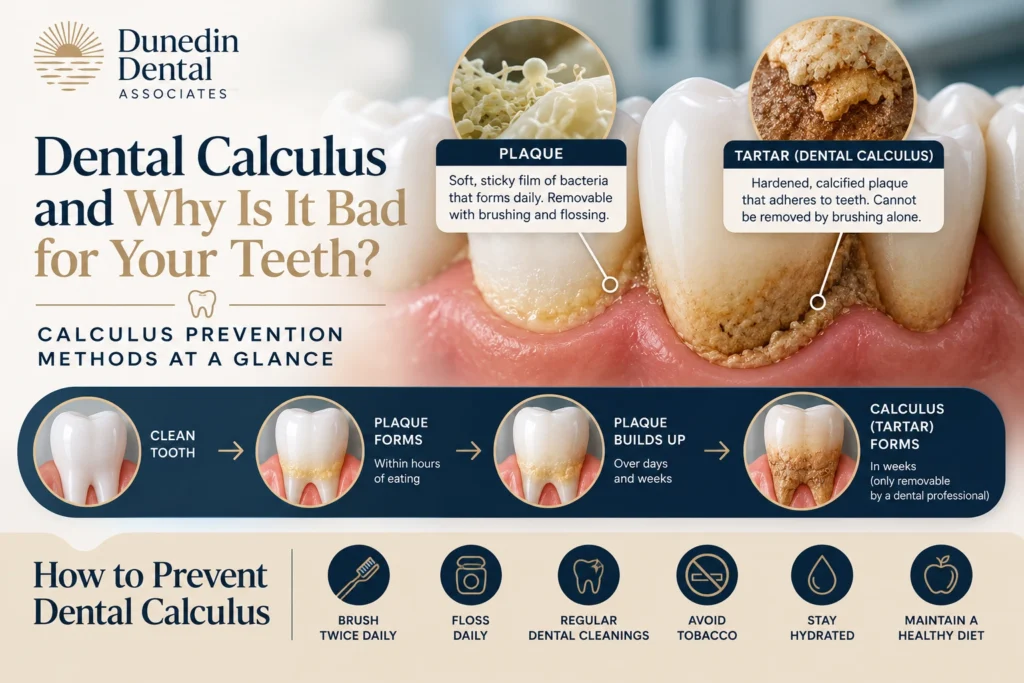
If you’ve ever noticed hard, yellowish or brownish deposits on your teeth, you’ve encountered dental calculus. Also known as tartar, this buildup is one of the most common dental problems affecting millions of people. Understanding what dental calculus actually is, why it’s bad for you, and how to prevent it are essential steps in protecting your oral health for life.
At Dunedin Dental Associates, we see calculus-related problems every day. In this guide, we’ll explain what dental calculus is, the real harm it causes, and what you can do about it.
Quick Answer: What Is Dental Calculus and Why Is It Bad?
| Dental calculus (tartar) is hardened plaque that forms when plaque isn’t removed within 2-3 weeks. Once calculus forms, you cannot remove it by brushing alone—only a dental professional can remove it through scaling. Calculus is bad because it harbors bacteria that cause gum disease, accelerates cavity formation, creates bad breath, stains your teeth, and contributes to serious systemic health problems including cardiovascular disease and diabetes complications. The best strategy is preventing calculus by removing plaque daily through proper brushing, flossing, and professional cleanings every 6 months. |
Calculus Prevention Methods at a Glance
| Prevention Method | Frequency | Effectiveness | Cost |
| Brushing (proper technique) | Twice daily, 2 minutes | High for plaque; no effect on existing calculus | Low |
| Flossing | Once daily | High for plaque in tight spaces | Low |
| Professional scaling | Every 6 months (or 3-4 for high-risk) | Only way to remove existing calculus | Moderate |
| Antimicrobial mouthwash | Once daily (supplement only) | Supports plaque reduction; cannot prevent calculus | Low |
| Important: Only professional scaling can remove tartar once it has formed. No home care routine can remove existing calculus. | |||
What Is Dental Calculus? Understanding Plaque and Tartar
The terms plaque and tartar are often used interchangeably, but understanding the difference between plaque and tartar is crucial to your oral health strategy.
Plaque is a soft, sticky film of bacteria that forms on your teeth and gums daily. This plaque on teeth contains millions of bacteria that feed on sugars and starches from the food you eat. When bacteria in plaque consume these carbohydrates, they produce acids that attack your tooth enamel and irritate your gum tissue. This is where cavity prevention becomes essential.
Dental calculus—also known as tartar—is what happens when plaque hardens. If plaque is not removed regularly through brushing and flossing, it mineralizes and hardens into calculus, a cement-like substance that adheres firmly to your teeth. Once this transformation happens and tartar buildup forms, you cannot remove it by brushing alone.
The difference between plaque and tartar is one of composition and permanence. Plaque is soft and removable; tartar is hard and calcified. Calculus formation occurs gradually when plaque isn’t properly cleaned. Once calculus has formed on your teeth, only professional instruments can remove it. This is why regular dental cleanings are non-negotiable for maintaining good oral health.
How Does Calculus Form? The Science Behind Tartar Buildup
Calculus formation is a natural but preventable process that begins with bacterial plaque. Understanding how this happens helps explain why tartar buildup is so serious.
Plaque begins forming within hours of eating. If you don’t brush and floss regularly, plaque accumulates on your teeth. The bacteria living in this plaque feed on sugars and starches, producing acids as a byproduct. These acids attack your tooth enamel and irritate your gums. Over time, minerals in your saliva interact with the bacteria and compounds in plaque. This chemical process hardens the plaque, transforming it into dental calculus.
Tartar buildup typically takes weeks to fully mineralize, depending on your oral hygiene habits and saliva chemistry. Once calculus has formed, it creates a rough surface that allows even more plaque to stick to your teeth. This means calculus breeds more calculus—a vicious cycle that worsens without intervention.
Several factors increase your risk of heavy tartar buildup:
Poor oral hygiene (not brushing daily or flossing regularly) | Smoking or tobacco use | High mineral content in saliva | Dry mouth conditions | Certain medications | Age (tartar accumulation increases with age) | Genetics (some people are simply more prone to calculus formation)
Why Is Dental Calculus Bad for Your Teeth? The Real Health Impact
Dental calculus causes multiple serious problems for your teeth and gums. Understanding why tartar is bad for you motivates taking action to prevent it.
Calculus and Gum Disease
The most significant danger of dental calculus is its direct connection to gum disease. Tartar buildup provides an ideal environment for harmful bacteria to thrive. The rough surface of calculus traps bacteria and plaque, making it impossible to clean with your toothbrush.
When calculus accumulates along your gum line, the bacteria it harbors irritate and infect your gums. This irritation causes gingivitis, the earliest stage of gum disease. If left untreated, gingivitis progresses to periodontitis, a serious condition that damages the bone holding your teeth in place.
Plaque and tartar buildup around your teeth and gums initiates a chronic inflammatory response. Your immune system constantly fights the bacterial infection, but it cannot fully eliminate the problem as long as the calculus remains. This ongoing inflammation leads to gum recession, pocket formation, and eventually tooth loss.
Calculus Accelerates Tooth Decay
Dental calculus doesn’t just threaten your gums—it dramatically accelerates cavity formation. The bacteria living in tartar produce acids that eat through tooth enamel. Calculus also traps plaque against your tooth surface, concentrating bacterial acids directly on the enamel.
When you have a history of plaque buildup on your teeth, your cavity risk increases significantly. The calcified plaque provides a scaffold for new plaque formation, creating persistent problem areas. Tooth decay often begins where tartar meets the gum line, an area already vulnerable to decay.
Bad Breath from Calculus and Bacteria
Oral calculus creates bad breath in multiple ways. The bacteria colonizing the tartar produce sulfur compounds and volatile organic compounds that cause halitosis. Additionally, the chronic inflammation of gums infected by calculus-harbored bacteria produces additional odor-causing compounds.
If you struggle with bad breath despite regular brushing, calculus may be the culprit. No amount of mouthwash will solve the problem—you need professional removal.
Esthetic Problems: Staining and Visible Buildup
Beyond health concerns, tartar buildup stains your teeth. The minerals in calculus attract extrinsic stains from coffee, tea, red wine, and tobacco. Calculus itself appears as brown or yellow deposits on your teeth, especially along the gum line.
Calculus stains are permanent and won’t respond to whitening treatments or aggressive brushing. Only professional scaling removes these stains, returning your teeth to their natural appearance.
Systemic Health Risks
Recent research reveals that the bacteria associated with calculus and gum disease contribute to serious systemic health problems:
Cardiovascular disease occurs when bacteria from periodontal disease enter the bloodstream and trigger inflammation in blood vessels. Diabetes worsens when gum disease is untreated, as infection impairs blood sugar control. Stroke risk increases through the inflammation and bacterial load from calculus-driven gum disease. Respiratory infections develop when oral bacteria migrate to the lungs, causing pneumonia. Pregnancy complications including premature birth and low birth weight are associated with gum disease.
These connections demonstrate that dental calculus isn’t just a cosmetic or oral health issue—it’s a systemic health threat.
Prevention: How to Keep Tartar Buildup Off Your Teeth
While you cannot completely prevent calculus formation, you can dramatically reduce it through aggressive oral hygiene.
Brush Your Teeth Properly
Effective brushing means more than just running a toothbrush over your teeth. You need the right technique and timing:
Brush twice daily for at least two minutes each time. Use a soft-bristled toothbrush or electric toothbrush, as electric brushes are often more effective. Angle your brush at 45 degrees toward the gum line, where calculus most commonly forms. Use gentle, circular motions rather than aggressive scrubbing. Don’t forget the back surfaces of your teeth, where much plaque and tartar accumulate.
Electric toothbrushes are particularly effective at removing plaque and preventing calculus formation. The rapid vibrations dislodge plaque more effectively than manual brushing.
Floss Daily
Flossing removes plaque from areas your toothbrush cannot reach—exactly where calculus most often begins. Flossing your teeth daily is essential for calculus prevention.
Options for cleaning between your teeth include traditional dental floss, water flossers (oral irrigators) which are especially useful if you have bridgework or implants, interdental brushes for larger gaps, and floss picks for convenience.
Choose whatever method you’ll actually use consistently. The best floss is the one you use every day.
Professional Dental Care Is Essential
Even with perfect home oral hygiene, some calculus will inevitably form. This is where regular professional dental cleanings become essential. Most people need professional dental cleanings every six months. Those with a history of heavy calculus buildup or gum disease may need cleanings every three to four months.
During a professional cleaning, a dental hygienist uses specialized instruments to remove tartar from above and below the gum line. This process, called scaling, is the only way to eliminate calculus. Some patients with significant calculus and gum disease may need a deeper cleaning called scaling and root planing, which removes calculus from the root surfaces of teeth.
Regular dental check-ups also allow your dentist to monitor your teeth for early signs of calculus-related problems. Catching gum disease in its early stages means simpler treatment and better outcomes.
| Schedule Your Professional Calculus Removal Today Call Dunedin Dental Associates at (727) 734-3321 to book your professional cleaning and remove existing tartar before it causes damage. |
Calculus Removal: What to Expect at Your Dental Appointment
When you visit Dunedin Dental Associates with calculus buildup, we perform a thorough evaluation and professional cleaning.
The Scaling Process
Scaling removes tartar from your teeth using specialized instruments. Modern scaling uses ultrasonic scalers that vibrate at high frequencies to break apart calculus, along with hand instruments for precise removal. The process is safe and effective, though some patients experience mild sensitivity during and after treatment.
Your dental hygienist will systematically work around your mouth, removing calculus from all tooth surfaces. If significant calculus has accumulated under your gums, the process may take longer or require multiple appointments.
Post-Cleaning Care
After professional scaling, your teeth may feel smooth and look brighter. Your gums may be slightly sore for a few days. You may experience temporary sensitivity to hot, cold, or sweet stimuli.
To support healing and prevent rapid calculus reformation:
Avoid hard and crunchy foods for 24 hours. Use a soft-bristled toothbrush. Rinse with salt water to promote gum healing. Take over-the-counter pain relievers if needed. Avoid smoking for at least 48 hours. Resume normal oral hygiene after 24 hours.
The Professional Difference
Why choose professional removal over DIY scraping? Dental professionals have the training, equipment, and knowledge to remove tartar safely without damaging your tooth enamel or gums. Attempting to remove calculus yourself with sharp instruments risks serious injury to gum tissue and permanent damage to tooth enamel.
Our team at Dunedin Dental Associates is trained to remove all visible and subgingival calculus, address any underlying gum disease, and establish a prevention plan to keep calculus from returning. Dr. Matthew P. Burton and Dr. William P. Spencer have decades of experience treating calculus-related problems.