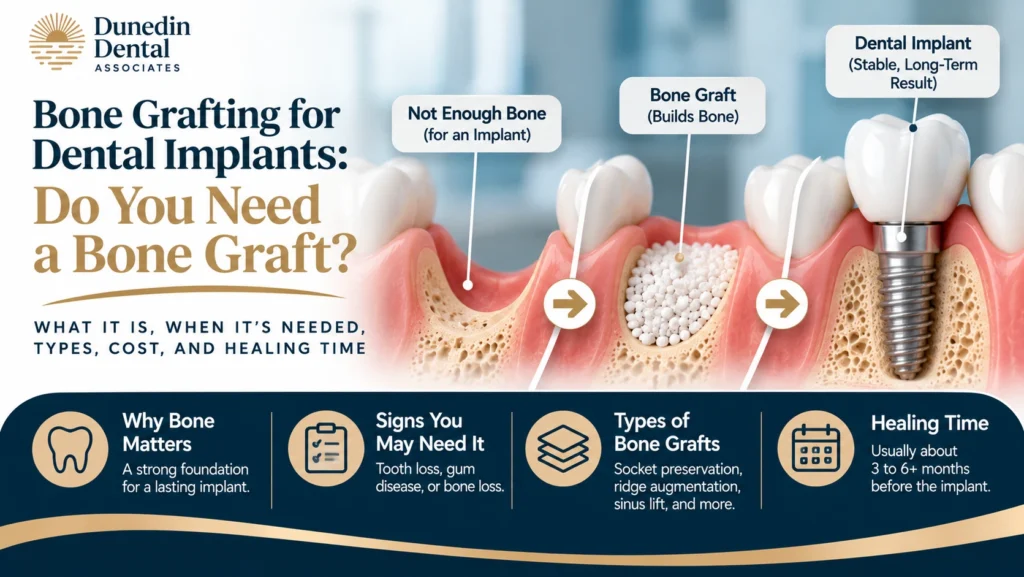
If you’re considering dental implants, your dentist may mention bone grafting. It sounds like a big deal, but it’s one of the most common steps in dental implant treatment, and for many patients it happens in the same visit as a tooth extraction.
This guide explains why bone matters, how your dental team decides if you need it, the types of bone grafts used, what they cost, and the dental bone graft healing timeline before your implant goes in.
Quick Answer: Is a Bone Graft Before Dental Implants Always Needed?
You need bone grafting if your jaw is too thin, too short, or too soft to hold an implant securely. That usually happens after a tooth has been missing for a while, after gum disease, or in the upper back jaw under the sinus. If you still have adequate bone, especially when the implant goes in soon after the tooth is removed, you may not need it at all.
The only way to know is to measure bone with a 3D scan. At Dunedin Dental Associates, we use Planmeca 3D imaging to check bone height, width, and bone density before any implant is planned.
Why Bone Matters for Dental Implants
An implant is a titanium post that acts as a new tooth root. To stay stable for decades, it needs enough healthy bone around it on every side. Bone volume and bone quality are two of the biggest factors in implant success.
The problem is bone shrinkage after tooth loss. A natural root stimulates the jaw every time you chew. When the tooth is gone, that stimulation stops and bone loss occurs, fastest in the first year. The ridge where the tooth used to be gets narrower and shorter, and the bone starts to lose the shape an implant needs.
Signs You May Need Bone Grafting
- The tooth has been missing for more than a few months
- You’ve had periodontal disease, which can affect bone around the teeth
- You’ve worn a denture or partial for years
- The missing tooth is in the upper back jaw, where the sinus sits just above the bone
- A tooth had a large infection or was removed after an injury
Understanding Dental Bone Grafting
A dental bone graft adds bone or bone-like material to the jaw where you’ve lost bone. The graft acts as a scaffold. Your own bone cells grow into it, and the body replaces it with new bone over time. This bone regeneration builds a solid base, so the implant can be placed safely.
The bone grafting procedure is usually short and done under local anesthesia in the dental chair. Larger cases may use IV sedation. Graft surgery is routine dental work, not a hospital procedure.
Types of Bone Grafts Used for Dental Implants
| Type | When it’s used | Typical U.S. cost (2026) | Wait before the implant |
| Socket preservation | Immediately after a tooth extraction | $300 to $800 | About 3 to 4 months |
| Ridge augmentation | Jaw is too thin or too short | $800 to $2,000 | 4 to 6+ months |
| Sinus lift | Upper back teeth with little bone under the sinus | $1,500 to $3,000 per side | 4 to 6+ months |
| Block bone grafting | Larger areas of lost bone | $2,000 to $3,000 | 4 to 6+ months |
Socket Preservation
This small procedure fills the empty socket right after a tooth comes out, so the bone doesn’t collapse while it heals. It’s the simplest way to protect the site for a future implant.
Ridge Augmentation
When the ridge is too narrow or short, material is added to rebuild its width or height. A thin membrane often covers the area while new bone tissue forms.
Sinus Lift
The upper back jaw often lacks bone because the sinus sits just above it. This procedure gently raises the sinus floor and places material underneath to make room for the implant.
Block Bone Grafting
For significant bone loss, a small piece of bone is secured to the jaw with tiny screws. This is used less often and takes the longest to heal.
Bone Graft Material: Where It Comes From
There are four main sources:
- Your own bone (autograft): bone taken from another spot in your mouth, such as the chin or back of the jaw. It contains living cells but needs a second surgical site.
- Donor bone (allograft): human bone from a tissue bank, cleaned, sterilized, and screened. This is one of the most common choices.
- Animal bone (xenograft): usually purified bovine bone, which can act as a scaffold for months while new bone growth forms around it.
- Synthetic bone: lab-made minerals that mimic natural bone, which the body replaces with new bone.
Some dentists also add growth factors made from a small sample of your own blood to support proper healing. Your dental specialist picks the graft type based on how much bone you need and where. Which bone graft is right for you depends on your scan. At Dunedin Dental Associates, we choose the material case by case and explain the reason for our choice at your consultation, so you know exactly what’s being placed.
Can You Get Bone Grafting and an Implant at the Same Time?
Often, yes. If there’s enough existing bone to hold the post steady, a small amount of material can be added around it during the same visit. This saves a surgery and several months.
If you don’t have enough bone, bone grafting comes first. The bone must heal until the bone is strong enough, usually three to six months before implants can go in.
Sometimes you can avoid a separate procedure entirely. Placing an implant soon after an extraction, or using angled implants like All-on-4 for a full arch, makes the most of the available bone.
The Dental Bone Graft Healing Timeline
| Stage | Small socket procedure | Larger case (ridge, sinus, block) |
| Back to normal activities | 1 to 2 days | 2 to 4 days |
| Soreness and swelling | 3 to 5 days | 3 to 7 days |
| Gum closed over the site | 2 to 4 weeks | 3 to 6 weeks |
| Ready for the implant | About 3 to 4 months | 4 to 6+ months |
After graft placement, the bone gradually replaces the material during the healing process, and the bone becomes dense enough to hold a post. Your dentist checks with an X-ray or 3D scan before the implant is placed.
Recovery Process: Tips for Optimal Healing
- Avoid chewing on that side for the first week and eat soft foods
- Don’t smoke, one of the biggest causes of graft failure
- Don’t use a straw or spit forcefully for a few days
- Keep the graft site clean and rinse gently with salt water or the rinse your dentist gives you
- Take medications exactly as prescribed
- Skip hard exercise for two to three days
Is Bone Grafting Painful?
Most patients say it feels similar to a tooth extraction. The area is fully numb during treatment. Mild soreness and swelling for a few days is normal and usually managed with over-the-counter pain relievers.
Signs of Graft Failure
Failure is uncommon, but contact your dental team if you notice:
- Severe pain that gets worse after the first three days
- Swelling that increases after day three
- Pus, a bad taste, or fever
- Material or the membrane becoming exposed
A few small, sand-like granules in your mouth during the first days can be normal. If the membrane is coming out or the site looks open, call us.
How Much Does a Bone Graft for Dental Implants Cost?
A dental bone graft typically costs $300 to $3,000 per site in 2026, depending on the type and graft size. Socket preservation at the time of an extraction sits at the low end. Sinus and block procedures sit at the high end.
At Dunedin Dental Associates, grafting is planned as part of your implant treatment, and your written estimate lists it as its own line item before any work begins. If your case needs a sinus lift or a larger rebuild, we’ll explain the steps, the timeline, and the cost up front.
Many dental plans cover part of bone grafting when it’s needed for an implant or after an extraction. Our team checks your benefits before treatment.
For the full cost of an implant with bone grafting included, see our dental implant cost guide.
Your Consultation at Dunedin Dental Associates
At your visit, we:
- Review your dental health and medical history
- Take a Planmeca 3D scan of your jaw
- Tell you if you need bone grafting, and which type fits your case
- Give you a written estimate for everything, including bone grafting and the implant
Our dental services cover extractions, grafting, and implant placement in our Dunedin office, so your dental care stays with one team from start to finish.
Questions About Bone Grafting for Dental Implants
Does everyone need bone grafting before implants?
No. Many patients have enough healthy bone. It’s most common when a tooth has been missing for a long time, after gum disease, or in the upper back jaw.
How long after a bone graft can I get an implant?
Usually three to four months before an implant after socket preservation and four to six months or more after larger cases. Sometimes both are done in one visit.
What can you not do after a dental bone graft?
Avoid smoking, straws, chewing on the treated side, and hard exercise for the first few days. Follow your dentist’s instructions for brushing near the site.
Where does the material come from?
It can come from your own body, a screened human donor, purified animal bone, or synthetic minerals. Your dentist picks the best type of graft for your case.
Is bone grafting safe?
Yes. It’s routine and well studied. The main risks are infection and failure, and both are lowered by not smoking and following aftercare instructions.
Will my face look different afterward?
You may have mild swelling for a few days. Long term, rebuilding bone helps protect the bone structure that supports your lips and cheeks.
Talk to Us About Your Implant Options
Thinking about getting dental implants but not sure you have enough bone? Book a consultation and get a clear answer from a 3D scan, plus a written estimate.
Book a Consultation or call or text (727) 734-3321.
Medically reviewed by Dr. Matthew P. Burton, Dunedin Dental Associates. Prices and healing times are typical 2026 U.S. ranges for general information and are not a quote or medical advice.