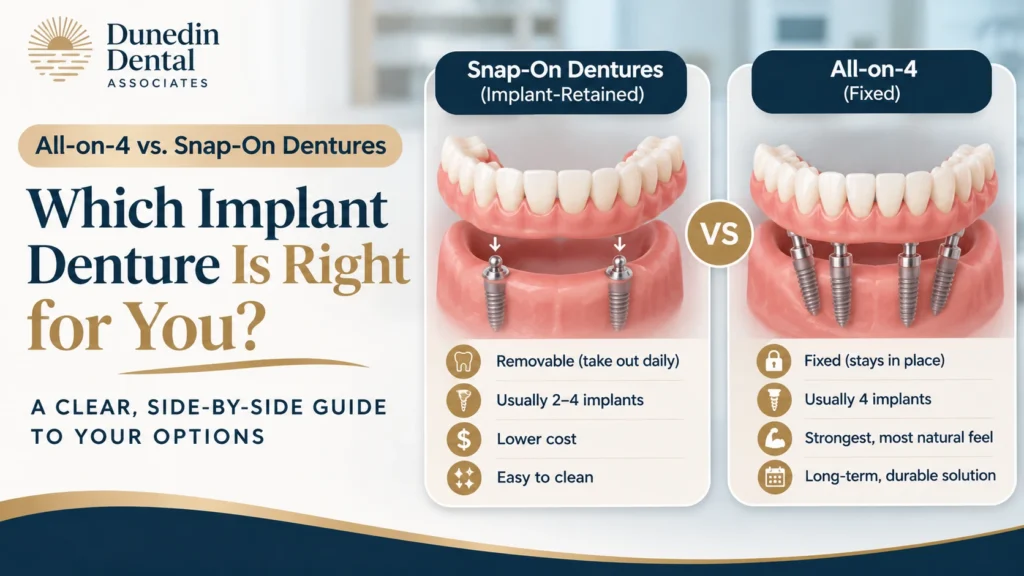
If you’re living with loose dentures or facing the loss of most of your teeth, two dental implant options usually come up: snap-on dentures and All-on-4 dental implants. Both treatments use dental implants to hold a full arch of teeth in place, and both give far greater stability than traditional dentures. But one is fixed and one is removable, and that single difference changes the cost, comfort, cleaning, and how your new teeth feel every day.
This guide explains how the two compare, what each costs, the honest drawbacks of each, and how to choose. At Dunedin Dental Associates, we plan both options with Planmeca 3D imaging, so you can compare snap-in dentures and fixed teeth side by side for your own mouth.
Quick Answer: Snap-On Dentures vs. All-on-4 at a Glance
| Snap-on dentures | All-on-4 (fixed) | |
| How it’s held in | Snaps onto attachments | Screwed onto posts in the jaw |
| Fixed or removable | Removable, you take it out daily | Fixed, only your dentist removes it |
| Posts per arch | Usually 2 to 4 | Usually 4, sometimes 5 or 6 |
| Roof of the mouth (upper jaw) | Often covered by a plate | Open, no plate |
| Chewing strength | Much better than a conventional denture | Closest to natural teeth |
| Daily care | Remove, brush, and soak nightly | Brush in place and use a water flosser |
| Typical cost per arch (2026) | About $7,600 to $13,300 | $15,000 to $38,000 |
| Best for | Lower budget, loose lower dentures, easy cleaning | Fixed teeth, no plate, strongest bite |
What Are Snap-On Dentures?
Snap-on dentures, also called snap-in dentures, implant-retained dentures, or an overdenture, are removable dentures that attach to dental implants. A few posts are placed in the jawbone, and each one gets a low-profile attachment. The denture has matching nylon inserts that click onto those attachments.
The result is a denture that stays put when you eat, talk, and laugh, with no adhesive. You still take it out at night to clean it and give your gums a rest. On the upper jaw, snap-on dentures may cover the roof of your mouth, though with enough support a slimmer, horseshoe-shaped design is sometimes possible.
Most snap-on cases use two implants on the lower jaw (the mandible) and four on the upper jaw, because upper bone is softer and needs more implant support. At Dunedin Dental Associates, your 3D scan decides the final number, and we explain the reason at your consultation.
How Snap-In Dentures Fix Loose Dentures
A conventional denture rests on your gums and is held by suction and adhesive. Over time, the jawbone under it shrinks, the fit gets worse, and the denture starts to rock and slip. Snap-in dentures are supported by implants, so they offer much more stability than traditional dentures. The implants also stimulate the bone they sit in, which slows the shrinking that makes regular dentures loose.
Compared to traditional dentures, most patients notice the difference at the first meal: they can bite into a sandwich without the denture lifting.
Can you keep your dentures? Sometimes. If your current denture fits well and is in good condition, a dentist may be able to add attachments to it. If not, a new denture is made. We check the fit and condition of your current set at your consultation and tell you which route makes sense.
What Are All-on-4 Dental Implants?
All-on-4 is a fixed full-arch implant restoration. Four posts are placed in the upper or lower arch, with the back two angled to make the most of the available jawbone. A full bridge of replacement teeth is then screwed onto them. It doesn’t come out at home; only your dentist removes it for cleaning or repair.
Because the angled posts reach denser bone, All-on-4 dental implants can often be placed without bone grafting, even in patients who have worn dentures for years. Some cases use five or six posts instead of four for extra support, which is sometimes called All-on-6.
Many patients get temporary fixed teeth the same day as implant placement, then a stronger final bridge in acrylic or zirconia once the implants heal. At Dunedin Dental Associates, qualifying patients can leave with a fixed temporary arch the same day, and the full arch is planned, placed, and restored in our office.
What’s the Difference Between All-on-4 and Snap-On Dentures?
Both are full-arch dental implants, and both treatments use dental implants to replace an arch of missing teeth. Here is how they compare day to day.
Fixed or Removable
This is the biggest difference between the two. Snap-on dentures come out: you take them out every night. A fixed bridge stays in like natural teeth, which is why many people call it permanent dentures on permanent implants. Some people like being able to remove their teeth for cleaning. Others want teeth that never come out.
Stability and Chewing
Both give greater stability than traditional dentures. Implant-supported dentures may still move slightly when you bite hard, because part of the denture also rests on your gums. A fixed bridge is held entirely by the implants, so it gives the strongest bite. Most patients can eat steak, apples, and corn on the cob again.
Comfort, Taste, and Speech
On the upper arch, a snap-on set often covers the palate, which can dull taste and take a few weeks to get used to when speaking. A fixed bridge has no plate, so food tastes normal and speech usually feels natural within a few weeks.
Implants and Bone
The snap-on option uses fewer implants, usually two to four. A fixed bridge needs four or more, because it relies on implants for support with no help from the gums. A single implant is rarely enough to hold a full denture, so multiple implants are placed for either option. Less surgery means a lower cost, but the right number depends on your bone and your bite. Your 3D scan shows what your bone can hold.
Appearance
| Option | Typical U.S. cost per arch (2026) |
| Snap-on implant dentures | About $7,600 to $13,300 |
| Fixed arch, acrylic bridge | $15,000 to $25,000 |
| Fixed arch, zirconia bridge | $25,000 to $38,000 |
Your final cost depends on your bone, any extractions or grafting, sedation, and the material of your final teeth. At Dunedin Dental Associates, you get a written estimate for both options before treatment.
Treating both arches costs roughly double. The gap comes from the number of implants, the custom-milled fixed bridge, and the temporary teeth you wear while healing. The removable option uses two to four implants and a denture-style prosthesis, so it costs less up front.
Over 15 to 20 years the gap narrows a little. Implant-retained dentures need new inserts and eventually a replacement, while a fixed bridge needs professional maintenance and sometimes repairs. Snap-on still usually stays the lower-cost option.
For insurance and financing options, see our dental implant cost guide.
Drawbacks of Each Option
Drawbacks of Snap-In Dentures
- The nylon inserts wear out and usually need replacing every 6 to 12 months
- It may move slightly when chewing hard or sticky foods
- Upper overdentures often cover the roof of the mouth
- Food can collect under the denture
- You remove, clean, and soak them every night
Drawbacks of a Fixed Full Arch
- Higher upfront cost
- A longer surgery, often done with IV sedation
- It can’t be removed at home, so cleaning under the bridge takes a water flosser
- Implants may occasionally fail; if one does, the bridge may need a new implant or a repair
- Acrylic teeth can chip or wear over time; zirconia lasts longer but costs more
Care and Maintenance: Which Is Easier to Clean?
Snap-in dentures win on cleaning in one way: you take them out and brush them like a regular denture, then brush the attachments and your gums. A fixed bridge stays in, so you brush it like natural teeth and use a water flosser underneath.
Both options need regular dental visits for professional cleanings and checks. Implants need the same care as natural teeth to protect your oral health and prevent gum infection around the implant sites, called peri-implantitis. With good home care and regular dental visits, the posts can last for decades.
The snap-on set itself typically lasts 5 to 10 years before it needs relining or replacing. Fixed acrylic bridges often last 10 years or more, and zirconia bridges longer.
Recovery After Each Implant Procedure
Both treatments start with dental implant placement, so the first week feels similar: a few days of soreness and swelling, soft foods, and gentle rinsing.
- Snap-on option: the implants usually heal for three to six months before the denture is attached. Many patients wear a softened, adjusted denture in the meantime.
- All-on-4: most patients go home with temporary fixed teeth the same day. You follow a soft-food diet for about three months while the implants fuse with the jawbone.
All-on-4 or Snap-On Dentures: Which Is Right for You?
Choosing between snap-in dentures and a fixed bridge comes down to your goals, your bone, and your budget.
Choose snap-on dentures if:
- Your main goal is to stop loose dentures from slipping
- Budget matters most
- You like being able to take your teeth out to clean them
- You have limited bone and want less surgery
- You already have a good-fitting lower denture
Choose All-on-4 if:
- You want teeth that stay in day and night
- You don’t want a plate covering the roof of your mouth
- You want the strongest, most natural bite
- Your remaining teeth are failing and you want them replaced in one surgery
- You’d rather not take your teeth out each night
Can You Upgrade from Snap-On Dentures to a Fixed Bridge Later?
Often, yes. Patients can start with snap-in dentures and add additional implants later for a fixed bridge, as long as the first implants placed are positioned with that plan in mind. Tell us at your consultation if you’re thinking about it, so we can plan the implant sites for both options.
Your Full-Arch Consultation at Dunedin Dental Associates
At your consultation, we:
- Talk through your goals, your current dentures, and your budget
- Take a Planmeca 3D scan to measure bone height, width, and density in your jaw
- Show which options your bone supports and how many implants each one would need
- Give you a written estimate for both options side by side
We place implants and restore them here in our Dunedin office, a short drive from Palm Harbor, so there’s no referral to a separate oral and maxillofacial surgery practice. Dr. William Spencer has advanced training in dental implants and IV sedation for patients who want to be fully relaxed during surgery.
Questions About Full-Arch Implant Options
Is All-on-4 better than snap-on dentures?
Neither is better for everyone. All-on-4 is fixed and gives the strongest bite. Implant-retained dentures cost less, use fewer implants, and come out for cleaning. The right choice depends on your bone, your budget, and your goals.
Are full mouth dental implants removable?
It depends on the type. A fixed full arch like All-on-4 stays in your mouth and only your dentist can remove it. Snap-on dentures are removable, so you take them out each night to clean them.
Are snap-on dentures the same as dental implants?
No. They’re removable dentures that attach to dental implants. The implants stay in your jaw, and the denture snaps on and off.
Can you sleep with snap-on dentures?
Most dentists recommend taking them out at night. This lets you clean the denture and gives your gums a rest.
How many implants are needed for snap-on dentures?
Usually two implants on the lower jaw and four on the upper jaw. Your bone density and bite decide the final number.
How long do snap-on dentures last?
The denture typically lasts 5 to 10 years, and the nylon inserts are replaced every 6 to 12 months. The implants themselves can last for decades with good care.
Can All-on-4 be done without bone grafting?
Often, yes. The back implants are angled into denser bone, which helps many patients avoid grafting. A 3D scan confirms what’s possible in your jaw.
Can my existing denture be converted to a snap-on denture?
Sometimes, if it fits well and is in good condition. We’ll check it at your consultation and let you know.
Can snap-in dentures be converted to All-on-4 later?
Often, yes, if the original implants are positioned with a fixed bridge in mind. Mention it at your consultation.
Which denture is hardest to get used to?
A conventional upper denture, because it relies on suction and covers the palate. Snap-on dentures are easier, and a fixed bridge feels the most like natural teeth.
Talk Through Your Options with Us
Not sure which full-arch option fits you? Book a consultation and leave with a 3D scan, a clear answer on what your bone supports, and a written estimate for both options.
Book a Full-Arch Consultation or call or text (727) 734-3321.