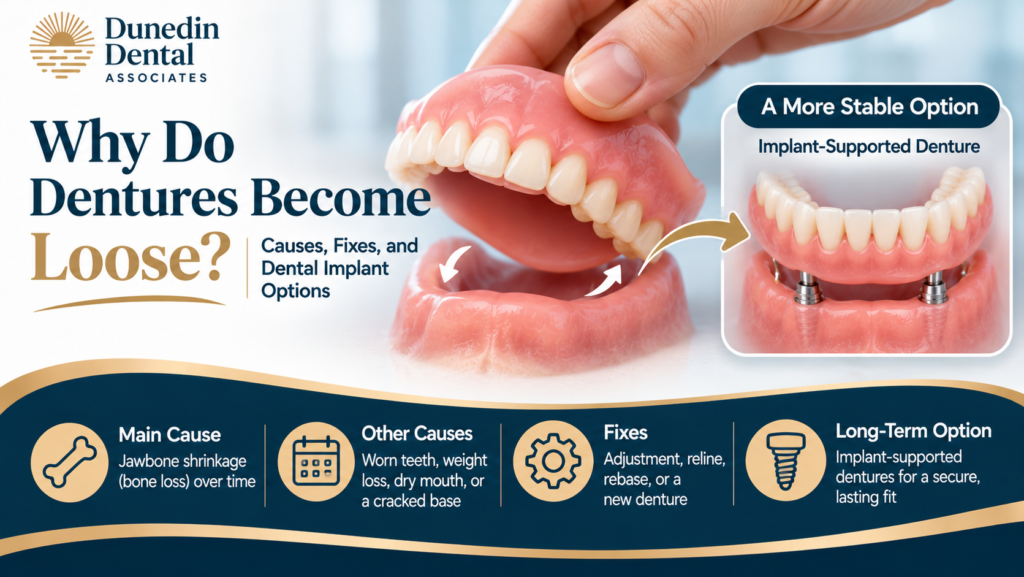
If your dentures used to fit and now slip when you talk or eat, you’re not imagining it. Dentures can become loose even when they once fit perfectly, and it’s one of the most common problems denture wearers face
The good news is that a loose denture can almost always be fixed. This guide explains why dentures stop fitting, the signs it’s time to see your dentist, what you can do about it, and when a permanent fix makes more sense.
Quick Answer: Why a Denture Feels Loose
The main reason is bone loss. After teeth are lost, the jawbone that held them slowly shrinks, a process called resorption. Your mouth changes over time. Your plate stays the same, but resorption keeps changing the shape of the gums and jawbone underneath. Over months and years, a denture that once fit well starts to rock, slip, and rub.
Other causes include worn teeth on the plate, weight loss, dry mouth, and a cracked or warped base. Most sets also have a lifespan of about five to eight years before they need replacing.
What Happens in Your Mouth When Teeth Are Gone
Natural tooth roots stimulate the jawbone every time you chew. After tooth loss, when teeth are removed, that stimulation stops, and the bone starts to shrink. Dentists call this residual ridge resorption. It’s fastest in the first year after teeth are lost, and it continues for life.
Unlike natural teeth, a conventional denture rests on the gum tissue, not on the bone itself. As the bone and gum shrink, gaps open between the plate and the ridge, and suction weakens. That’s why people with conventional dentures often notice their teeth feel loose a few years after getting them, even if nothing seems wrong with the set itself.
Why Lower Dentures Are Harder to Keep in Place
Lower sets tend to come loose more often than upper ones. An upper plate covers the roof of the mouth, which creates strong suction. A lower one sits on a narrow horseshoe-shaped ridge, and your tongue and cheeks move it every time you talk or eat. As the lower jaw shrinks, there’s less ridge left to hold onto.
Signs Your Dentures No Longer Fit
- Your teeth slip or click when eating or speaking
- You’re using more and more denture adhesive
- New sore spots or red, irritated tissue
- Food keeps getting trapped beneath the denture
- Trouble chewing tougher foods
- A tooth on the plate feels uneven, your bite feels off, or your face looks more sunken around the mouth
- The plate feels loose when you open wide or laugh
If your set no longer fits, it’s time for a check. A change in fit rarely fixes itself.
Problems a Poor Fit Can Cause
A loose set is more than annoying. It can rub tissue raw, cause mouth sores and infections, and make eating hard. Many people start avoiding healthy foods like fresh fruit, vegetables, and meat, which can affect nutrition and oral health. Constant movement can also speed up bone loss and make speaking less clear.
How to Fix Loose Dentures
1. An Adjustment
Sometimes the problem is a small pressure spot or a worn edge. Your dentist can reshape the plate in one visit to relieve sore spots and improve the fit.
2. A Reline
A reline changes the tissue-facing surface of the denture so it matches the current shape of the mouth supporting it. It’s the most common fix, and most sets need a reline every one to two years.
- Hard version: a durable acrylic layer, often done by a lab
- Soft version: a cushioned layer for patients who are sensitive or sore
It typically costs $200 to $500 in 2026. At Dunedin Dental Associates, we offer same-day relines, so most patients walk out with a better fit in a single visit. A lab-processed version is also available; it usually takes one to two days and lasts longer. Most dental insurance plans cover part of the cost, usually once every few years.
3. A Rebase
Rebasing replaces the entire pink base while keeping each existing tooth. It’s an option when the base is worn or cracked but the teeth are still in good shape.
4. A New Denture
If your current denture is more than five to eight years old, has a worn bite, or has been relined several times, a new set often fits better than another repair. It’s also a chance to improve the cosmetic look of your smile and replace each worn tooth. Standard complete sets typically cost $1,500 to $2,500 per arch. Your final cost depends on the materials, the number of fittings, and any extractions needed. At Dunedin Dental Associates, you get a written estimate before treatment, and our in-house membership plan and financing options can help spread the cost.
What About Denture Adhesive?
Adhesive helps temporarily, and a small amount is fine for extra confidence. But if you need more adhesive use every month, it’s covering up the underlying cause, not fixing it. A well-fitting upper plate should stay in place by suction alone. Using adhesive heavily can also trap bacteria against the tissue.
What Not to Do at Home
- Don’t use DIY reline kits. They can change your bite and damage the tissue.
- Don’t bend clasps or try to file the plate yourself.
- Don’t keep wearing a set that causes sores. Remove it and call your dentist.
How to Keep Dentures in Place Day to Day
- Clean the plate and your gums every day, and stick to nightly removal so your mouth can recover
- Use a small amount of adhesive only if needed
- Cut food into smaller pieces and chew on both sides
- Drink water to help with dry mouth
- Keep up with dental care and regular checkups so small fit problems are caught early
When You Need a Permanent Fix
Relines and new sets solve the fit for a while, but they can’t stop the jaw from shrinking. If you’re tired of the cycle, implant-supported dentures are the permanent alternative to dentures that sit on the gums.
With implants placed in the jaw, the teeth are anchored instead of floating on the gums. There are two main types:
- Snap-on overdentures: your teeth click onto two to four implants and come out at night
- Fixed full arch, such as All-on-4: four implants hold a set of replacement teeth that stays in
Implant-supported dentures don’t come loose, and the implants stimulate the bone the way each natural tooth root did, which helps slow further bone change. Many patients who have worn traditional dentures for years still qualify, though some need bone grafting first.
Getting Help at Dunedin Dental Associates
At your visit, we check your fit, your gums, and the mouth underneath with a 3D scan. Then we explain your options, from a quick adjustment or reline to a new set or implant-supported teeth, with a written estimate for each. Our dental practice offers relines, new upper and lower sets, and implant dentistry under one roof as part of our tooth replacement services.
Questions About Loose Dentures
Why are my dentures loose all of a sudden?
Your denture may change fit quickly. A sudden change often comes from weight loss, illness, dry mouth, a crack in the base, or a worn area. Gradual looseness usually comes from bone shrinking under the plate.
Should new dentures fit without adhesive?
A new upper set should usually hold by suction alone. Lower sets are often less stable, and a little adhesive is normal during the adjustment period.
Is it normal for a new set to feel loose?
Some movement is normal in the first few weeks while your mouth adjusts. If it doesn’t improve, your dentist can make small adjustments.
Can a slipping set be relined?
Yes. Most sets can be refitted this way to match the current shape of your mouth, as long as the base and teeth are in good condition.
How often should dentures be relined?
Usually every one to two years, or sooner if you notice a change in fit or new sore spots.
Can weight loss make dentures loose?
Yes. Losing weight can change the soft tissue in your mouth and make your teeth feel loose. Sometimes a reline fixes it.
What are the three types of dentures?
Complete dentures replace every tooth in an arch, partial dentures replace some missing teeth, and implant-supported dentures attach to implants for extra stability. The first two are removable.
Talk to Us About Your Fit
Tired of slipping teeth? Book a visit and we’ll find the fix that fits your mouth and budget.
Book an Appointment or call or text (727) 734-3321.