If you’ve been told you need conscious sedation for a dental procedure, one of the first questions that comes to mind is how long it lasts. Whether it’s anxiety about the sedation itself, concerns about getting back to your normal day, or simply wanting to plan around the appointment, understanding the timeline matters.
Dr. Spencer at DDA Dental in Dunedin use conscious sedation regularly to help patients receive essential dental treatment comfortably, including those with dental anxiety, complex procedures, or medical conditions that make standard dental care more challenging. This guide covers what conscious sedation actually is, how long different types last, and what recovery looks like.
What Is Conscious Sedation in Dentistry?
Conscious sedation in dentistry refers to a medically controlled state in which a patient is deeply relaxed and free from anxiety but remains awake and able to respond to verbal cues throughout the procedure. Unlike general anesthesia, conscious sedation does not render the patient fully unconscious. You stay awake in the technical sense, though many patients feel sleepy, deeply relaxed, and may not remember the procedure clearly afterward.
This distinction matters because it’s what makes conscious sedation appropriate for dental settings. It provides significant comfort and anxiety relief without the risks associated with full general anesthesia, and it can be administered safely in a dental office rather than requiring a hospital or surgical center.
The medication used varies depending on the level of sedation required, the procedure being performed, and the patient’s medical history and overall dental health.
Types of Dental Sedation and How Long Each Lasts
Different types of dental sedation produce different depths of relaxation and have different recovery timelines. Understanding the form of sedation being recommended helps you plan your day and set accurate expectations.
Nitrous Oxide (Laughing Gas)
Nitrous oxide, commonly known as laughing gas, is the mildest form of sedation used in dentistry. It’s inhaled through a small mask placed over the nose and produces a pleasant sense of relaxation and mild euphoria within a few minutes.
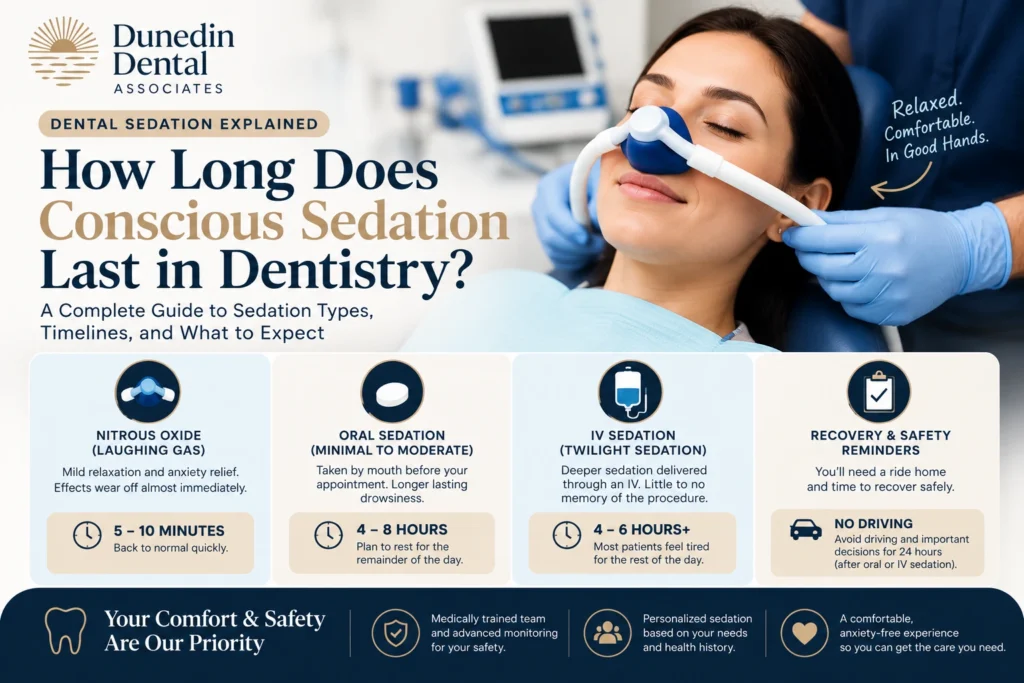
How long it lasts: Nitrous oxide is unique among dental sedation options in that its effects wear off almost immediately once the gas is turned off and you breathe regular oxygen for a few minutes. Most patients feel completely normal within 5-10 minutes of the mask being removed.
Because recovery is so rapid, nitrous oxide is the only type of sedation after which patients can generally drive themselves home and return to regular activities the same day without restriction.
What patients experience: A warm, tingling feeling, mild drowsiness, and reduced anxiety during the procedure. Some patients feel slightly lightheaded briefly after the gas is removed, but this passes quickly. It reduces pain perception but is typically used alongside a local anesthetic for actual dental procedures.
Oral Sedation (Minimal or Moderate Sedation)
Oral conscious sedation involves taking a sedative medication by mouth, typically a benzodiazepine such as triazolam or diazepam, usually about an hour before the appointment. The type of sedation produced ranges from minimal to moderate depending on the dose prescribed.
How long it lasts: This is where patients are often surprised. Oral sedation produces effects that last significantly longer than the dental procedure itself. Depending on the specific medication used and the individual patient’s metabolism, you may feel drowsy for anywhere from four to eight hours after taking the medication. Some patients feel residual grogginess well into the evening following a morning appointment.
The deeper sedation effects, meaning the reduced anxiety and relaxed state during the procedure, typically persist for two to four hours. The milder drowsy feeling that follows can last considerably longer.
What patients experience: Oral sedation produces moderate sedation in most patients. You remain conscious and able to respond to verbal cues from your dentist, but you’re deeply relaxed and unlikely to feel distressed. Many patients have limited memory of the procedure afterward, which is a therapeutic benefit for those with significant dental anxiety. You will feel drowsy and may not feel like yourself for the remainder of the day.
Recovery requirements: A friend or family member must drive you home after oral sedation. You should avoid driving, operating machinery, and making important decisions or sign legal documents for at least 24 hours after taking the medication. Plan to rest at home for the remainder of the day.
IV Sedation (Intravenous Sedation)
IV sedation delivers sedative drugs directly into the bloodstream through a vein, typically in the arm or hand. This produces a deeper and more controllable level of sedation than oral options. The health care provider or anesthesiologist administering IV sedation can adjust the dose in real time throughout the procedure, making it highly precise.
IV sedation in dentistry is often called twilight sedation because it produces a state somewhere between full consciousness and sleep. Patients receiving IV sedation remain technically conscious and able to respond to verbal cues, but most have little to no memory of the procedure afterward.
How long it lasts: The sedation effects of IV sedation are felt almost immediately once the medication enters the bloodstream, within a minute or two. The active effects during the procedure last as long as the medication is being administered.
After the IV is stopped, most patients begin emerging from deeper sedation within 15-30 minutes. However, you will continue to feel drowsy and impaired for several hours afterward. Most patients are advised to plan for the remainder of the day to be spent resting, and full mental clarity typically returns within four to six hours, though this varies depending on the medication used and individual factors.
Oxygen levels and monitoring: During IV sedation, pulse oximetry monitors oxygen levels continuously throughout the procedure. Blood pressure and heart rate are also monitored to ensure patient safety. This level of monitoring distinguishes professional dental sedation from anything that could be replicated at home.
Recovery requirements: A responsible adult must accompany you to your appointment and family member drive you home afterward. You should avoid driving, operating machinery, alcohol consumption, and any complex decisions for at least 24 hours after the procedure. This isn’t simply a precaution, the sedative drugs remain in your system and impair your judgment and reaction time even when you feel relatively alert.
General Anesthesia
General anesthesia renders the patient fully unconscious and is fundamentally different from conscious sedation in that patients are not able to stay awake or respond to verbal cues. For routine and even moderately complex dental procedures, conscious sedation is preferred because it carries fewer risks.
General anesthesia in a dental context is typically reserved for patients who are unable to cooperate with treatment under conscious sedation due to age, cognitive disability, severe dental anxiety, or specific medical conditions. It requires an anesthesiologist and is administered in a hospital or surgical center rather than a standard dental office.
How long it lasts: Active sedation and general anesthesia effects end when the medications are stopped, but recovery varies considerably based on the agents used and the length of the procedure. Patients typically need 24 hours after the procedure before returning to normal daily activity, and some feel effects for longer.
Sedation Effects: What to Expect After Your Appointment
Regardless of the type of sedation used, there are common sedation effects patients should be prepared for in the hours following their appointment.
Drowsiness and mental fogginess
The most universal effect is feeling drowsy and mentally slow for several hours. This is normal and expected. Don’t try to push through it or return to activities soon after the procedure.
Impaired coordination
Your physical coordination and reaction time will be impaired even if you feel relatively alert. This is why avoiding driving and operating machinery is non-negotiable for at least 24 hours following anything beyond nitrous oxide.
Memory gaps
With oral sedation and IV sedation especially, you may not remember the procedure itself or portions of the recovery period. Some patients don’t remember the drive home. This is an intended effect of the medication used and not cause for concern.
Nausea
Some patients experience mild nausea after sedation, particularly with IV sedation. Your dental team will advise you on eating and drinking beforehand to reduce this risk.
Headache
A mild headache is possible after some forms of sedation, particularly nitrous oxide in some patients. It typically resolves within a few hours and responds to standard pain medicine.
Who Benefits Most from Conscious Sedation Dentistry?
Patients feel calm and far more willing to receive dental care when sedation removes the anxiety and discomfort barrier. Sedation dentistry serves a specific group of patients particularly well:
Patients with dental anxiety
Patients with dental anxiety often avoid dental care for years or decades, allowing dental problems to compound until they require significantly more complex treatment. Conscious sedation allows these patients to receive essential dental treatment that would otherwise feel impossible.
Patients requiring complex procedures
Long or multi-step procedures are more comfortable with sedation. Rather than multiple shorter appointments, sedation allows the dental team to complete more work in a single visit while the patient remains relaxed throughout the procedure.
Patients with sensitive gag reflexes
A strong gag reflex makes many dental procedures difficult or impossible without some form of sedation. Even moderate sedation significantly reduces this response.
Patients with medical conditions
Certain medical conditions make it important to reduce patient stress during dental procedures. Sedation keeps patients calm and physically still, which can be medically significant for patients with cardiovascular or other health conditions.
Before Your Sedation Appointment: What to Know
Your dentist will provide specific instructions before your appointment, but these general principles apply to most forms of conscious sedation:
Fasting requirements: Most sedation protocols require you to avoid eating for a period before the appointment, typically at least six hours. This reduces the risk of nausea and ensures the medication works as intended.
Medications and medical conditions: Disclose all medications you’re currently taking to your dental team before the appointment. Some medications interact with sedative drugs and require adjustment or substitution. Medical conditions affecting your heart, kidneys, or liver can affect how your body processes sedation medications.
Arrange transport in advance: For anything beyond nitrous oxide, arrange for a responsible adult to drive you home before the day of the appointment. It’s not safe to assume you’ll be able to drive afterward, and some patients feel more impaired than they anticipated.
Plan your recovery: Clear your schedule for the remainder of the day following an oral or IV sedation appointment. Don’t plan work commitments, childcare responsibilities, or anything requiring mental or physical coordination for that afternoon and evening.
How We Use Sedation at Dunedin Dental Associates ( DDA)
At DDA Dental in Dunedin, conscious sedation is available as part of our comprehensive dental care to ensure patients who need it can receive comfortable, stress-free treatment.
Our Sedation Dentist at Dunedin Dental Associates work closely with each patient to determine the appropriate type of sedation based on their dental anxiety level, the complexity of the procedure, their medical history, and their personal preferences. Every sedation appointment includes continuous monitoring of oxygen levels, blood pressure, and patient comfort throughout the procedure.
Our goal is that every patient who walks in anxious about dental work leaves having had a genuinely comfortable experience, and that conscious sedation is the tool that makes that possible when standard local anesthetic alone isn’t enough.
If you have questions about whether sedation dentistry is right for you, or want to discuss which type of sedation might be most appropriate for your upcoming dental work, contact our team to schedule a consultation. We’re happy to walk through your options and make sure you feel fully informed before any procedure.