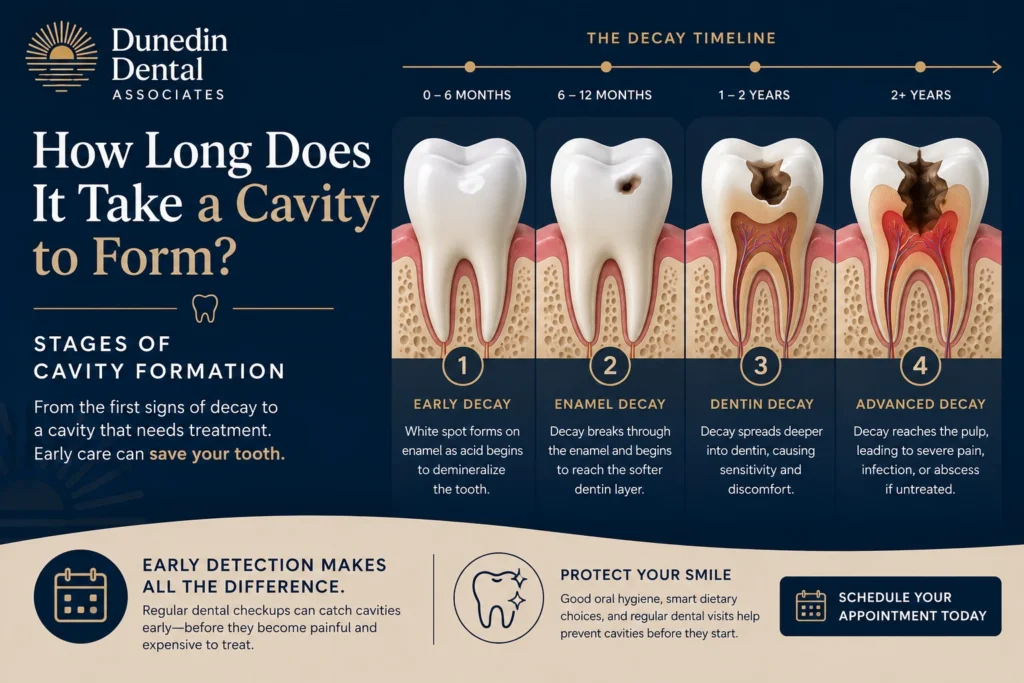
Cavities are a common dental problem that affects patients of almost every age, yet most people have no idea a cavity is forming until they’re already sitting in the dentist’s chair. Dr. Burton at DDA Dental in Dunedin hear some version of the same question almost every week: how long does it take for a cavity to form, and why didn’t I feel it sooner?
The honest answer is that cavity formation doesn’t happen overnight. A cavity is a hole in the tooth that develops gradually through a process involving bacteria, acid, and time. Understanding how cavities develop helps explain why early detection matters so much, and why skipping dental visits even for a year or two can turn a small, simple problem into something far more involved.
What Is a Cavity and How Does Cavity Formation Begin?
A cavity is a hole in the tooth structure caused by tooth decay. It begins when bacteria in your mouth feed on sugars and starches left behind after eating. These bacteria produce acid as a byproduct, and that acid is what starts breaking down your tooth enamel.
Enamel is the hard outer layer of your tooth and your first line of defense against decay. When acid attacks enamel repeatedly without enough time to recover, the minerals that keep enamel strong begin to leach away. This process is called demineralization, and it’s the true beginning of cavity formation long before any visible hole appears.
Saliva plays a protective role here, naturally remineralizing enamel between acid attacks. Fluoride in toothpaste and water helps support this process. But when acid attacks happen too frequently, the balance tips toward decay and a cavity begins to form.
How Long Does It Take for a Cavity to Form?
There’s no single answer because the speed of cavity formation varies considerably from person to person. In general, cavities take months to years to develop fully, though under certain conditions a cavity can develop much faster.
Most cavities in adults take anywhere from several months to several years to progress from early demineralization to a noticeable hole requiring treatment. In children, whose enamel is thinner and still developing, cavities can form faster, sometimes in as little as a few months under poor dietary and hygiene conditions.
Long it takes a cavity to develop depends on several factors including diet, oral hygiene habits, fluoride exposure, and individual tooth anatomy. Understanding these factors helps explain why two patients with similar habits can have very different cavity experiences.
How Tooth Decay Leads to Cavity Formation
Tooth decay and cavity formation are directly connected — one causes the other. Tooth decay is the broader process of bacterial acid attacking and breaking down tooth structure, while a cavity is the physical hole that results when that decay progresses far enough.
When bacteria in your mouth digest sugars and starches, they produce acid that lowers the pH in your mouth. This acidic environment begins dissolving the minerals in your enamel through demineralization. At first, this damage is microscopic and completely reversible. The problem is that this process repeats every time you eat or drink anything other than water.
Over time, without consistent oral hygiene and regular dental care to interrupt this cycle, tooth decay progresses layer by layer through your tooth structure. What starts as invisible mineral loss eventually becomes a cavity that requires treatment. The longer tooth decay goes undetected or untreated, the deeper the resulting cavity and the more complex the treatment required to fix it.
This is why dentists in Dunedin and across the country emphasize that cavities don’t develop in isolation. They’re the end result of an ongoing process of tooth decay that can be slowed, stopped, or even partially reversed if caught early enough.
The Five Stages of Tooth Decay and Stages of Cavity Formation
Understanding the stages of cavity formation explains why some cavities are caught easily and others require significant treatment. Each stage of tooth decay represents a deeper level of damage with increasingly limited options for conservative treatment.
Stage 1: White Spot Lesion (Early Demineralization)
This is the earliest stage of tooth decay and the most reversible. Before any hole forms, demineralization creates a chalky white spot on the tooth enamel. These white spots are areas where minerals have been lost and enamel has weakened, but the surface of the tooth is technically still intact.
At this stage, a cavity hasn’t fully formed yet. With improved oral hygiene, fluoride treatment, and dietary changes, early demineralization can often be reversed through remineralization without any drilling or filling required. This is why catching problems early at dental check-ups matters so much.
Most patients have no idea this stage is happening because there’s no pain and no visible hole. Only a dentist examining your teeth closely will notice these early changes.
Stage 2: Enamel Decay
When demineralization continues without intervention, it progresses through the enamel layer and a cavity begins to form in earnest. At this point, the surface of the enamel has broken down and a small hole has developed in the layer of your tooth.
Enamel itself contains no nerves, which means enamel cavities are typically painless. Patients are often surprised to learn they have a cavity because they’ve felt nothing wrong. This is one of the most important reasons for regular dental visits, because enamel decay is straightforward to treat with a dental filling but impossible to detect by feel alone.
A cavity at this stage can usually be treated with a simple composite filling. Left untreated, tooth decay progresses deeper into the tooth structure.
Stage 3: Dentin Decay
Once decay reaches the dentin, the layer beneath enamel, the situation becomes more serious. Dentin is softer than enamel and tooth decay progresses through it more quickly. Dentin also contains microscopic tubules that connect to the nerve of the tooth, which is why patients often begin to notice sensitivity to hot, cold, or sweet foods when decay reaches this layer.
Reach the dentin and you’ve lost the window for a simple filling in many cases. Treatment at this stage typically still involves a filling, but it may be larger and more involved. In some cases, particularly if decay has progressed significantly through the dentin layer of the tooth, a dental crown may be necessary to restore the tooth properly.
Stage 4: Pulp Involvement
The pulp is the innermost layer of the tooth. Pulp is the innermost part of the tooth containing nerves and blood vessels. When decay reaches the pulp of the tooth, the situation has escalated significantly. Pulp involvement typically causes noticeable toothache, spontaneous pain, and significant sensitivity because the nerves and blood vessels inside the tooth are now directly affected by bacterial infection.
When decay reaches the pulp, a simple filling is no longer sufficient (compare diffrent types of fillings). Root canal treatment becomes necessary to remove the infected pulp, clean the canals inside the tooth root, and seal the tooth to prevent further infection. A dental crown is then typically placed to restore function and protect the treated tooth from fracture.
Root canal therapy has an unfair reputation for being painful. In practice, it relieves the significant pain that comes with pulp infection and saves teeth that would otherwise require extraction.
Stage 5: Abscess Formation
If a cavity that has reached the pulp goes untreated, infection spreads beyond the tooth into the surrounding bone and tissue, forming a dental abscess. A tooth infection that turns into abscess is a serious infection that causes severe pain, swelling, and in some cases fever. Left untreated, a dental abscess can spread and become a genuine health risk.
At this stage, root canal treatment may still be possible, but extraction becomes more likely depending on how extensively the infection has spread. An abscess requires prompt dental attention and often antibiotics to manage the infection before definitive treatment can be completed.
Types of Cavities and Where They Form
Not all cavities develop in the same location, and where a cavity forms affects how quickly it progresses and how it’s detected.
Pit and Fissure Cavities: These form in the deep grooves on the chewing surfaces of molars and premolars. They’re among the most common type, particularly in children, because food and bacteria become trapped in these grooves. Regular brushing often can’t reach into deep fissures, making these teeth especially vulnerable to faster cavity development.
Smooth Surface Cavities: These develop on the flat sides of teeth, usually between teeth where flossing would make contact. They tend to progress more slowly than pit and fissure cavities and are often caught at dental visits through X-rays before they cause symptoms.
Root Cavities: These form on the exposed root surfaces of teeth, typically in patients with gum recession or periodontal disease. Root surfaces lack the protective enamel layer covering the crown of the tooth, making them particularly susceptible to rapid decay once exposed.
How Plaque Causes Cavities to Develop and Form Faster
Plaque is the direct link between bacteria in your mouth and cavity formation. When you eat, bacteria in your mouth immediately begin feeding on leftover sugars and starches, producing acid as a waste product. These bacteria don’t float freely in your saliva — they organize into a sticky film called plaque that clings to tooth surfaces and concentrates acid directly against your enamel.
Plaque that isn’t removed through consistent brushing and flossing hardens into tartar, also called dental calculus. Once plaque hardens into tartar, it can no longer be removed with a toothbrush. Tartar creates a rough surface that makes it even easier for more plaque to accumulate, compounding the problem over time.
This is why plaque removal is the foundation of cavity prevention. Every day that plaque stays on your teeth is another day of concentrated acid exposure working against your enamel. Patients who go extended periods without brushing and flossing, or who skip regular dental cleanings where tartar is professionally removed, give plaque far more opportunity to drive faster cavity formation.
Several factors allow plaque to cause cavities to develop faster than they otherwise would:
Frequent eating and drinking: Every meal or snack creates a new round of acid production. The more frequently you eat, the less time your saliva has to neutralize acid and allow remineralization between exposures.
Dry mouth: Saliva naturally washes plaque from tooth surfaces and neutralizes acid. Patients with reduced saliva flow lose this protection, giving plaque longer contact time against enamel.
Poor toothbrush technique: Brushing for less than two minutes or missing areas near the gumline leaves significant plaque behind even with daily brushing.
Infrequent dental visits: Professional cleanings remove the tartar buildup that creates ideal conditions for accelerated plaque accumulation and faster cavity development.
Can You Stop a Cavity Once It Starts?
The answer depends entirely on what stage of cavity development you’re in when you catch it.
At the white spot stage, yes. Early demineralization is genuinely reversible with consistent oral hygiene, fluoride treatments, and reduced sugar exposure. This is the only stage where stopping a cavity without any restorative treatment is realistic.
Once the enamel surface has broken down and a true hole has formed, the cavity cannot heal on its own. The damaged tooth structure doesn’t regenerate. From that point forward, treatment involves stopping further progression and restoring what’s been lost, not reversing what’s already happened.
This is why the framing of catching it early isn’t just dental office advice. There’s a genuine clinical difference between catching a cavity at stage one versus stage three, both in terms of treatment complexity and cost.
The Role of Dental Care, Oral Hygiene, and Dentistry in Preventing Cavities
The fundamentals of cavity prevention in dental care haven’t changed, but they work best when applied consistently rather than occasionally. Good oral hygiene combined with regular dental visits creates two separate lines of defense against cavity formation.
Brush properly and consistently: Brush at least twice daily for two full minutes using fluoride toothpaste. Pay particular attention to the gumline and the back molars where plaque accumulates most heavily. Brushing and flossing together removes the vast majority of the plaque responsible for cavity formation.
Floss every day: Flossing removes plaque from between teeth where your toothbrush cannot reach. Smooth surface cavities between teeth are among the most commonly missed until they’re visible on X-rays, and consistent flossing is the most effective prevention for this cavity type.
Watch your diet: Reducing the frequency of sugar and starch consumption matters more than total quantity. A single dessert with dinner is far less damaging than sipping a sweet drink throughout the afternoon. Rinsing your mouth with water after meals helps clear food particles and reduces acid exposure time.
Use fluoride consistently: Fluoride strengthens enamel and supports remineralization. Fluoride toothpaste, fluoride mouthwash, and professional fluoride treatments all contribute to a more resilient tooth surface that resists acid attack and slows cavity formation.
Keep regular dental visits: Visiting your dentist at least every six months allows for early detection of cavities at their most treatable stage. Modern dentistry provides tools including digital X-rays and detailed clinical examination that identify cavities long before they cause symptoms. Professional cleanings remove tartar that daily brushing and flossing cannot address on their own.
When to See a Dentist About Tooth Pain or Sensitivity
Cavities don’t always cause pain until they’ve progressed significantly. By the time you feel a toothache or notice sensitivity that wasn’t there before, the cavity has usually reached at least the dentin layer and may have gone further.

Don’t Wait for a Cavity to Get Worse
Contact DDA Dental if you notice any of these warning signs. Getting the tooth evaluated early can mean simpler treatment and more options for preserving your natural tooth.
These symptoms don’t always mean you need a root canal or extraction. They do mean you should get evaluated promptly, because cavity treatment options become fewer and more involved the longer decay is allowed to progress unchecked.
Sensitivity to hot, cold, or sweet foods that lingers after the stimulus is gone
A visible dark spot or hole on a tooth
Spontaneous tooth pain without an obvious trigger
Pain when biting or chewing
A persistent bad taste that doesn’t resolve with brushing
The Bottom Line on How Long Cavity Formation Takes
Cavities are a common dental problem, but they’re also one of the most preventable. A cavity takes months to years to develop from early demineralization to a serious problem, which means there are multiple opportunities along the way to catch and address it with minimal intervention.
The challenge is that the most treatable stages produce no symptoms. You won’t feel a white spot lesion. You won’t feel early enamel decay. By the time you feel something, the cavity has usually progressed past the point of simple treatment.
Regular dental care is how you catch cavities when they’re still small. Dr. Burton and Dr. Spencer at DDA Dental serve patients throughout Dunedin, Palm Harbor, and the greater Tampa Bay area for routine exams, cleanings, and cavity treatment at every stage. If you’re overdue for a checkup or concerned about tooth sensitivity or pain, now is the right time to schedule an appointment. The earlier a cavity is found, the simpler the fix.