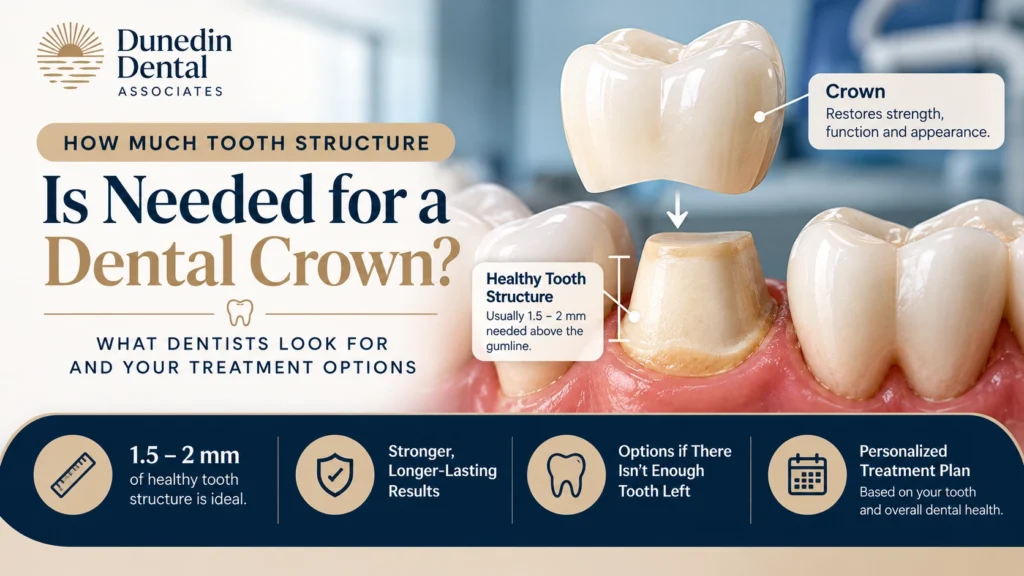
If you have a damaged or heavily decayed tooth, you may be wondering if there is enough left to support a dental crown. It is a reasonable concern and the answer depends less on how the tooth looks on the surface than on what exists at its base, where the crown actually grips the underlying tooth structure.
Understanding how much natural tooth structure is necessary for a successful crown is essential for effective treatment planning. Learning how much natural tooth is truly needed helps you make informed decisions about your dental care. This guide explains the minimum amount of tooth structure dentists look for before placing a crown, what your options are if your tooth falls below that threshold, and how the clinical decision gets made when additional work is needed first. If you have been told your tooth may need a build-up, crown lengthening or some other preparatory procedure, you will find a clear explanation of each below.
How Much Tooth Does a Crown Actually Need?
Dentists generally recommend at least 1.5 to 2 millimeters of healthy tooth structure above the gumline before placing a crown. This measurement applies all the way around the circumference of the tooth — not just on one wall — and represents the minimum solid foundation the crown needs to grip and function reliably under daily chewing forces.
This range reflects decades of research in restorative dentistry examining how crowns perform over time and what structural conditions support or undermine that performance. The number is not arbitrary during crown preparation, your dentist removes a uniform layer of tooth material to create an accurately shaped seat for the crown. If that removal leaves too little natural tooth beneath, the restoration lacks a secure mechanical grip, and long-term failure becomes significantly more likely, especially if there isn’t enough healthy structure remaining.
What Is the Ferrule Effect and Why Does It Matter?
The clinical concept behind this requirement has a name: the ferrule effect. It describes the band of sound tooth structure that a dental crown encircles just above the point where the crown meets the tooth — essentially, a collar of natural tooth that the crown can lock onto.
A useful analogy: the metal collar at the end of a pencil, where the eraser attaches to the barrel. That ring distributes pressure evenly and prevents the eraser from splitting away. The ferrule works the same way — it distributes biting forces around the base of the crown and protects the natural tooth root below it.
For the ferrule to function as intended, the tooth structure in this band must be sound natural tooth — healthy dentin and enamel capable of withstanding preparation and long-term function. Restorative material placed during a core build-up creates a stable platform for crown preparation, but it does not replicate the mechanical role of natural tooth in the ferrule. That distinction matters clinically: a core build-up and a ferrule are not the same thing, even when both are present.
For root-canal-treated teeth especially, research has shown that an adequate ferrule changes the pattern of failure, preserving much natural tooth structure. A landmark literature review found that teeth with a ferrule tend to fracture in a repairable, oblique pattern, while teeth without one are far more prone to vertical root fracture, a type of failure that is generally not salvageable. A 2023 finite element study confirmed that a 2mm ferrule substantially outperforms 1mm or no ferrule in fracture resistance, and that increasing ferrule height to 2mm provides the most significant improvement in tooth fracture resistance.
The practical takeaway: the more sound, healthy tooth structure remains above the gumline, evenly distributed around the tooth, the more predictable the crown outcome. Greater circumferential coverage is generally preferable to a single intact wall.
How Bad Can a Tooth Be and Still Get a Crown?
Many natural teeth that appear significantly damaged can still receive a crown — but candidacy is determined by what remains below and around the damage, not just what is visible on the surface of the tooth. Your dentist will evaluate remaining tooth walls, root health, bone support, gum position, and the amount of healthy tooth structure above the gums before drawing any conclusions about whether a crown may be your best option.
A good candidate for a crown has enough tooth structure to support the restoration and enough healthy tooth extending above the gumline to create that critical ferrule. However, being a good candidate isn’t only about what you can see. The visible portion of the tooth tells part of the story, but your dentist looks deeper to assess whether the underlying structure can support a crown long-term.
Common Scenarios — and When a Crown Is Still Possible
| Your Situation | What Typically Remains | What Usually Comes Next |
|---|---|---|
| Large cavity with most walls still intact, but not enough natural tooth structure to support a crown initially | Adequate tooth structure above the gumline; much natural tooth is preserved | Crown prep and placement; may need a core build-up first to create the necessary foundation for a crown |
| Chipped or cracked tooth | Depends on the depth and location of the fracture; much of the tooth may remain intact | Shallow chip: crown is often possible; deep crack into the root: thorough evaluation needed to decide whether a crown is your best option |
| Tooth broken at or near the gumline | Minimal structure visible above the gumline; tooth structure exists below the surface | Crown lengthening or post and core may be needed before the crown can be placed to establish enough tooth above the gumline |
| Root-canal-treated tooth with little remaining crown | Root intact; minimal coronal walls; part of your tooth remains viable for restoration | Post and core build-up, followed by crown placement to preserve your natural tooth root |
These scenarios represent common clinical paths, not a diagnosis for your specific tooth. Your dentist’s examination is the only reliable guide for determining whether you are a good candidate for a crown in your situation.
When a Tooth Is No Longer a Candidate for a Crown
A tooth may no longer be restorable when the root itself is fractured, when bone support is too compromised to anchor the remaining structure, or when no restorative pathway can predictably stabilize what remains. In those situations, extraction followed by a dental implant or dental bridge is often the most appropriate path for preserving long-term oral health. Your dentist will give you a direct assessment if that point has been reached regarding whether your tooth can support a crown.
Root-Canal Treated Teeth: Why Extra Steps Are Often Needed
Teeth that have undergone root canal treatment present a distinct structural challenge that is worth understanding before discussing the specific options available.
Root-canal-treated teeth are often more vulnerable to fracture — not because of some inherent brittleness, but because of the cumulative structural loss from the original decay, any prior restorations, and the access preparation the root canal procedure itself requires. All of that combined removal significantly reduces the amount of coronal tooth structure that remains above the gumline, and often leaves less healthy tooth extending above where the crown margin will sit.
For this reason, a definitive crown is strongly recommended after root canal treatment, particularly for back teeth that bear heavier chewing forces. The crown provides the fracture protection that a structurally compromised tooth needs. How quickly you can move to crown placement — and whether additional preparatory steps like a post and core or crown lengthening are needed first — depends on how much natural tooth structure remains after the root canal is completed and how much healthy tooth extending upward is available.
In many cases, the access cavity preparation leaves minimal intact coronal walls, making a core build-up a routine part of the crown placement process. When very little usable coronal structure remains, a post may also be indicated to retain the build-up material adequately and provide structure to support the crown, ensuring the affected tooth remains stable and that you maintain as much natural tooth structure as possible.
What If There Isn’t Enough Tooth Structure for a Crown?
Falling short of the minimum does not automatically mean losing the tooth. Dentists have several well-established ways to restore the necessary foundation before placing a crown and rebuild enough tooth structure to support a crown long-term. The right approach depends on the specific reason for the structural loss and what the examination reveals about the remaining tooth structure and surrounding tissue, particularly the amount of healthy tooth left available for restoration.
1 – Core Build-Up (Rebuilding Lost Tooth Walls)
A core build-up is the most common preparatory procedure when a tooth lacks sufficient remaining structure to support a crown, particularly if there is not enough natural tooth structure left. The American Dental Association (ADA) classifies this as dental code D2950, defined as a procedure indicated when “loss of coronal tooth structure due to caries or trauma” leaves insufficient material to adequately retain an indirect restoration like a crown.
In practice, your dentist removes any remaining decay, applies a bonding agent to the remaining natural tooth walls, and bonds composite resin to rebuild them, ensuring there is enough natural tooth structure for a crown. The rebuilt form creates a solid foundation for crown preparation — though, as noted above, the restorative material in the build-up does not substitute for sound natural tooth in the ferrule. The crown still relies on whatever natural tooth remains encircling the preparation above the crown margin and on how much healthy tooth structure extends around the base of the crown.
The procedure is typically completed under local anesthetic and is well-tolerated, ensuring a healthy structure for the crown. In many cases, a core build-up is completed in the same appointment as crown preparation to establish enough tooth structure above the gumline. When the structural loss is more extensive, or when the tooth requires a separate assessment before proceeding, your dentist may schedule it as a distinct appointment. The extent of the damage and the clinical complexity of the case determine the timing.
2 – Crown Lengthening (Exposing More Tooth)
Crown lengthening is recommended when adequate tooth structure exists below the gumline — due to subgingival decay or a fracture near the bone — but not enough is visible above it to support a crown. The procedure involves carefully removing a small amount of gum tissue and, in most cases, a thin layer of supporting bone to expose more of the natural tooth and create a viable foundation for the crown margin.
Initial healing occurs over the first several weeks, but when bone has been reshaped, dentists typically allow several months for the gum margin to stabilize before placing the final crown — particularly in esthetic areas. A provisional crown is often placed during this healing period to protect the tooth. Your dentist will advise when you are ready to proceed based on the tissue response and the condition of the affected tooth.
Crown lengthening is a periodontal procedure. Depending on your clinical situation, your dentist may complete it in-office or refer you to a periodontist. At Dunedin Dental Associates, we focus on preserving as much of the affected tooth as possible during the crown preparation process, ensuring you retain the maximum amount of healthy tooth structure extending above the gumline. Periodontal procedures are essential for maintaining the healthy structure necessary for a successful crown. Crown lengthening and procedures to support a crown are among the regular dental services provided to preserve your natural tooth.
3 – Post and Core (For Root-Canal-Treated Teeth)
When a tooth has undergone root canal treatment and very little natural crown structure remains, a post and core may be placed before the crown.
A post — typically a small fiber or metal rod — is inserted into the cleaned root canal space to anchor the build-up material. Composite resin is then layered around the post, creating the core foundation for crown preparation, ensuring enough healthy structure is present and that you have adequate tooth structure to support a crown. Fiber posts are commonly used because their flexibility more closely approximates natural dentin; metal posts may be selected in certain clinical situations based on root geometry and the forces the tooth will bear.
Once the post and core are stable, the tooth is prepared for the crown in the standard way. Research from a large retrospective study found that timely placement of the crown after root canal treatment is strongly associated with better long-term tooth survival. Delays between root canal completion and final crown placement were linked to lower survival rates in the studied population, indicating the need for prompt restoration of adequate tooth structure.
When Extraction Becomes the Right Choice
Extraction becomes the recommended path when the root is fractured, when bone support is inadequate, or when no restorative pathway offers a predictable outcome. Removing a tooth that cannot be reliably restored and replacing it with an implant or bridge is sometimes the better long-term decision for overall oral health. Your dentist will be straightforward with you about when that point has been reached.
How Your Dentist Decides Which Option Is Right for You
Listing the available options is only part of the picture. What most patients actually want to know is how a dentist chooses between a dental bridge and other options for a missing tooth, including whether a crown may be a suitable alternative or whether extracting a damaged tooth is the best path forward.
That decision comes down to a careful clinical evaluation completed during an examination that combines dental X-rays, gum probing, and visual assessment — sometimes including transillumination to detect fracture lines not visible on radiographs. The factors evaluated include the amount of healthy tooth structure remaining and whether a crown can save your natural tooth.
Key evaluation factors include:
Remaining tooth walls — how much structure exists above the gumline, on how many surfaces, and whether it is evenly distributed around the circumference. This includes assessing whether enough tooth structure to support a crown is present.
Root integrity — a fractured root changes the picture entirely; a healthy root means restorative options remain on the table and much natural tooth structure can potentially be preserved.
Position relative to the gumline — this is crucial for ensuring adequate tooth structure above the gumline is available. Tooth structure that sits below the gumline may still be accessible and usable with crown lengthening, allowing you to maintain as much natural tooth structure as possible.
History of root canal treatment — teeth that have undergone root canal treatment with minimal remaining coronal structure typically need a post and core before a crown can be placed. Much natural tooth may already be lost to the initial decay and the root canal procedure itself.
Location and bite forces — molars bear significantly more chewing force than front teeth, which influences how much structural integrity is required, how much tooth above the gumline matters, and what crown materials are appropriate. Front teeth allow for more esthetic options but still require enough tooth structure to support a crown.
Quality of remaining tissue — sound dentin and enamel behave very differently from decay-softened or erosion-thinned tooth material. The quantity visible on X-ray and quality confirmed by probing are both part of the assessment to determine if enough tooth structure exists for a successful crown.
No single measurement or visual appearance tells the full story. An examination — including dental X-rays — is the only reliable way to determine whether you are a good candidate for a crown and to identify the right path for your specific tooth.
What Happens to Your Tooth During Crown Preparation?
Understanding crown preparation also clarifies why the minimum structure requirement matters so much and why enough tooth structure to support a crown must be present before the process begins.
During crown prep, your dentist removes a uniform layer of tooth material from all surfaces to shape the tooth accurately for the crown to fit over. For porcelain and ceramic crowns, this typically involves removing approximately 1.5 to 2 millimeters of tooth surface, depending on the crown material and the tooth’s position in the mouth. Gold crowns require less reduction.
This is why starting tooth structure matters: preparation removes material from what is already there. If a tooth begins with only 2mm of healthy tooth structure above the gumline and preparation removes 1.5mm, the resulting foundation becomes critically thin. The minimum threshold exists precisely because crown prep is part of the process that follows — not a step that can be skipped if you want to preserve your natural tooth.
A temporary crown is placed after preparation to protect the tooth while your permanent crown is being fabricated in a dental laboratory. Most crown placements at Dunedin Dental Associates involve two appointments: one to prepare the tooth and one to seat the final restoration.
Frequently Asked Questions About Dental Crown Candidacy
What is a core build-up, and do I always need one before a crown?
A core build-up is a dental procedure in which composite resin is bonded to a damaged tooth to rebuild its walls and create a stable platform for a crown. Not every tooth requires one — it is indicated specifically when insufficient natural tooth structure remains to hold the crown securely on its own. Your dentist will assess this as part of your examination to determine how much tooth is needed for a crown.
Can I get a crown if my tooth has already had a root canal?
Yes — and a crown is generally recommended after root canal treatment, particularly for back teeth, because the procedure can leave the tooth more vulnerable to fracture under chewing forces due to the loss of coronal structure. If very little natural crown structure remains, a post and core may be placed first to give the tooth for a crown a stable anchor and support a crown effectively. Together, these steps are designed to preserve the natural tooth root and ensure the crown can restore full function, maintaining much natural tooth structure.
How long does the crown process take if extra procedures are needed first?
It depends on which procedure is required. A core build-up is often completed in the same appointment as crown preparation to ensure there is enough remaining tooth structure. Crown lengthening requires a healing period before the final crown can be placed — when bone has been adjusted, dentists often allow several months for the tissue margin to stabilize, particularly for front teeth or esthetic cases. Your dentist will outline a clear timeline at your evaluation.
Does the location of the tooth affect how much structure is needed?
Yes, to some extent. Molars and premolars are subject to significantly greater chewing forces than front teeth, which means structural integrity requirements are more demanding in the back of the mouth. The crown material selected also varies by position — back teeth typically use more durable materials such as full zirconia or metal-based crowns, while front teeth prioritize esthetic properties. Both the structural threshold and the material choice are influenced by where the tooth sits in the arch, which may affect the decision to recommend a procedure called crown lengthening.
What happens if I delay getting a crown after a root canal?
Root-canal-treated teeth with little remaining coronal structure are particularly vulnerable to fracture between root canal completion and crown placement. Research has associated delays in final crown placement with lower long-term tooth survival rates.5 A tooth that fractures during this period — particularly if the fracture extends into the root — may no longer be restorable, making it crucial to assess the mm of healthy tooth remaining. Completing the crown as promptly as the clinical situation allows is an important step in protecting the investment of root canal treatment.
Ready to Find Out If Your Tooth Can Be Saved?
At Dunedin Dental Associates, we assess every crown case thoroughly — evaluating the amount of remaining tooth structure, the quality of that structure, and your long-term options before recommending a successful crown treatment path. If your tooth needs additional preparation before a crown can be placed, we will explain the options clearly and give you a realistic picture of what the process involves.
To learn more about dental crowns in Dunedin, FL, or to schedule your evaluation for a procedure called crown lengthening, contact us today to discuss how we can help you retain enough tooth structure for a successful crown..