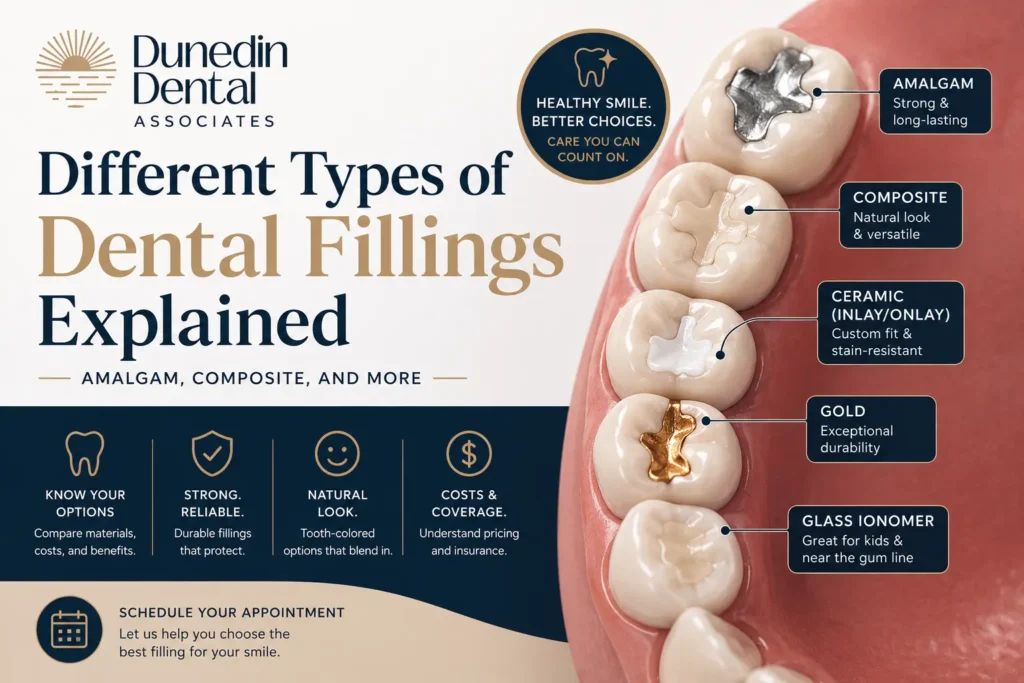
A cavity doesn’t wait for a convenient time. One day your tooth feels fine, and the next your dentist is pointing at an X-ray and using words like “amalgam” or “composite” like you already know what they mean. A filling is used to treat a cavity caused by tooth decay, and today there are more material choices than most patients realize.
Modern dentistry offers five main types of dental fillings, and each one does a different job. Some are built to survive decades of chewing. Others are made to disappear into your smile. Every filling material comes with its own pros and cons, and the type of filling your dentist recommends will depend on where the cavity sits, how big it is, and what matters most to you: cost, looks, or long-term strength.
Below, we’ll walk through each option in plain terms, what they cost, how long they last, and how to think through the decision with your dentist.
Quick answer: For back teeth doing the heavy chewing, amalgam or composite fillings are usually the practical pick. For front teeth, or anywhere visible when you smile, composite filling or ceramic fillings blend in best. Gold fillings last the longest but cost the most. Glass ionomer fillings mostly show up in kids’ teeth or small fillings near the gum line.
Types of Dental Fillings at a Glance
Dental fillings cost, look, and last differently depending on the material. Here’s how the five main options compare side by side.
| Material | Look | Avg. Cost (per tooth)* | Lifespan | Best For | Insurance |
| Amalgam (Silver) | Metallic silver-gray | $108 – $256 | 10–15 years | Back molars, large cavities, tight budgets | Standard coverage |
| Composite (Tooth-Colored) | Matches tooth color | $173 – $439 | 5–7 years | Front teeth, visible areas, most everyday cavities | Usually same rate as amalgam |
| Ceramic / Porcelain (Inlay/Onlay) | Matches tooth color, resists stains | $755 – $1,774 | Up to 10 years | Larger cavities where appearance matters | Partial — patient pays the difference |
| Gold | Gold-colored metal | $361 – $817 (up to $2,500 larger) | 15–30 years | Molars, longest-lifespan preference | Partial — patient pays the difference |
| Glass Ionomer | Tooth-colored, less glossy | $75 – $200 | ~5 years | Kids’ teeth, small fillings near the gum line | Varies by plan |
*National averages compiled from published payer and provider fee data. Ask our team for the specific cost for your plan and cavity.
Direct vs. Indirect Fillings: What’s the Difference
Before comparing materials, it helps to understand the two broad categories every filling falls into. Direct fillings, like amalgam and composite, go into the tooth in a single visit. Your dentist removes the decayed portion, shapes the filling material right there in your mouth, and hardens it in place, so there’s no lab step and no second appointment.
Indirect fillings, like gold and most ceramic restorations, work differently. An impression or digital scan of the prepared tooth gets sent to a dental laboratory, where the restoration is custom-made to fit precisely. A temporary filling protects the tooth in the meantime, and you come back for a second visit to have the permanent piece bonded or cemented into place. Some offices shortcut this with same-day CEREC milling, which builds a ceramic restoration on-site instead of sending the case out. Neither approach is inherently better. Direct fillings are faster and less expensive; indirect fillings tend to fit more precisely and often last longer, especially for larger cavities.
A Closer Look at Each Type of Dental Filling
Here’s how each of the five materials stacks up in practice, including what they’re made from, what they’re best at, and where they fall short.
Amalgam Fillings (Silver Fillings)
Amalgam fillings, sometimes called silver amalgam fillings, are made from a blend of silver, tin, copper and other metals, bound together with mercury. Dental amalgam has been used for well over a century, and the American Dental Association maintains that amalgam fillings are safe for the vast majority of patients. What amalgam does best is hold up under pressure. It survives the heavy chewing forces a molar deals with every day, and it costs less than almost any other material on this list. The tradeoff is that amalgam doesn’t match tooth structure color, and placing it requires removing slightly more healthy tooth than a composite filling would.
Composite Filling (Tooth-Colored Fillings)
Composite fillings, often just called composite resin, are made from a mix of plastic and glass particles tinted to match your natural tooth color. This tooth-colored composite is the material most people picture when they hear “white filling.” It bonds directly to what’s left of the tooth, and the material bonds well enough to help reinforce the remaining structure. It’s a popular, aesthetically pleasing choice for visible areas of the mouth, though it isn’t quite as tough as amalgam or gold under heavy bite pressure. Most patients end up choosing between amalgam or composite for everyday cavities, since both are typically covered at the same insurance rate.
Ceramic Fillings (Porcelain Inlays and Onlays)
Ceramic fillings are made from porcelain, which is why you’ll often see them described as fillings are made from porcelain in patient guides. They blend in almost perfectly with the surrounding tooth. Larger ceramic restorations are known as inlays or onlays, depending on how much of the chewing surface they cover, and these dental inlays are custom-made in a lab, where a dental laboratory builds the piece to fit your exact tooth before your dentist bonds it into place. Some dental offices use same-day CEREC technology to mill a ceramic filling on-site instead of sending the case out. Ceramic fillings tend to be more expensive than composite or amalgam and may require multiple visits unless same-day milling is available, but they hold their color well and resist staining better than composite.
Gold Fillings
Gold fillings are the longest-lasting option covered here, often holding up for 15 to 30 years. Gold is a biocompatible material that’s gentle on the opposing teeth during chewing, and it doesn’t corrode over time. The obvious downside is the color and the price. If you want a filling that will outlast almost everything else and the cost isn’t a dealbreaker, gold or ceramic are worth the extra investment. If budget matters more, amalgam or composite make more practical sense.
Glass Ionomer Fillings
Glass ionomer fillings are made from a mix of acrylic and fluoride-releasing glass powder. The fluoride release is the standout feature, since it can help protect the surrounding tooth from further decay. That’s one reason glass ionomer fillings show up often in children’s teeth and in small fillings near the gum line. They’re not as strong as composite or amalgam, so we mostly reserve them for areas that don’t take much chewing pressure.
Which Type of Filling Is Right for You?
Finding the right type of filling comes down to a few practical questions:
- Is it a back molar or a front tooth? Back teeth that take heavy chewing pressure usually do well with amalgam or composite, since both hold up under repeated bite force. Front teeth, or anywhere visible when you smile, look best with composite or ceramic, since a metal filling would stand out every time you talk or laugh.
- Do you want a mercury-free filling? Composite, ceramic, and glass ionomer are all mercury-free options, since amalgam is the only material here that contains it. If you have a documented metal allergy or simply prefer to avoid mercury, say so up front and we’ll plan around it.
- How long do you want it to last? Gold and ceramic are the most durable, often stretching well past a decade. Composite and amalgam sit in the middle, typically 5 to 15 years depending on the material. Glass ionomer is meant for smaller, shorter-term use, usually around 5 years.
- What’s your budget? Amalgam and composite cost less than gold or ceramic and are usually covered by insurance at the same rate, which makes them the default choice for most everyday cavities.
- How large is the cavity? Small to medium cavities are usually fine with a direct filling. Larger cavities, or teeth with more structural damage, often do better with an indirect ceramic or gold restoration that can be shaped precisely in a lab before it’s placed.
Every metal filling vs. tooth-colored filling debate really comes down to those five questions. Your dentist can walk you through which biocompatible dental material fits your specific tooth and situation before anything is placed, and there’s rarely only one right answer. Two patients with a similar cavity might reasonably choose different materials based on what they each value most.
Getting a Filling at Our Dental Office: What to Expect
Getting a filling is usually a single, straightforward visit at our dental office, aside from gold and some ceramic restorations that need a lab step. The filling procedure starts with local anesthesia to numb the area, so you shouldn’t feel anything beyond some pressure. From there, your dentist removes the decayed portion of the tooth, cleans out the cavity, and places the filling material, shaping it to match your bite. Most patients are back to eating and talking normally within a couple of hours, once the numbness wears off.
Sometimes a temporary filling goes in first, often after a root canal, or when a tooth needs time to settle before a permanent restoration is placed. If you’re currently living with a temporary filling, don’t skip the follow-up appointment. Temporary material isn’t built to last and needs to be swapped for a permanent one.
Dental Fillings Cost: What Affects the Price
Dental fillings cost varies mainly by filling material, not by which dentist is doing the work. As a general guide:
- Amalgam: roughly $108 – $256 per tooth
- Composite: roughly $173 – $439 per tooth
- Ceramic (inlay/onlay): roughly $755 – $1,774 per tooth
- Gold: roughly $361 – $817 per tooth, up to $2,500 for larger restorations
- Glass ionomer: roughly $75 – $200 per tooth
Amalgam and composite remain the two most common dental fillings placed today, largely because insurance typically covers both at the same rate. Gold and ceramic usually come with a bigger out-of-pocket difference, since insurance tends to treat them as an upgrade rather than a base-level filling. The average cost for a single filling can run anywhere from under $100 to well over $1,000 depending on material, size, and your specific plan. Our team can walk you through your coverage and give you a real number before any work begins.
How to Make Your Filling Last as Long as Possible
Most fillings are durable enough to handle years of normal use, but a few habits make a real difference in how long yours holds up:
- Brush twice a day with fluoride toothpaste and floss daily to keep decay from forming around the edges of the filling.
- Avoid chewing ice, hard candy, or pen caps, which can chip a filling regardless of the material.
- If you grind your teeth at night, ask about a nightguard. Grinding wears down fillings faster than normal chewing ever would.
- Keep up with regular dental care checkups so we can catch a cracked edge or early leakage before it turns into a bigger repair.
Good oral health habits protect the rest of your teeth too, but they matter specifically for fillings because a small gap or crack is often invisible to you long before it causes pain.
Signs You Might Have a Cavity That Needs a Filling
- Sensitivity to hot or cold that lingers after the temperature is gone
- Pain or pressure when you chew on one side
- A visible hole, pit, or dark spot on a tooth
- A cracked or chipped area you can feel with your tongue
- An old filling that looks worn, cracked, or has a gap at the edge
Left untreated, tooth decay can spread deeper into the tooth, leading to infection or even tooth loss. Catching a cavity early usually means a smaller, simpler filling instead of a more involved repair down the road.
Frequently Asked Questions
What is the best type of filling for teeth?
There isn’t one best filling for every tooth. Amalgam and gold hold up best under heavy chewing, while composite and ceramic blend in better and work well for most everyday cavities, especially in visible teeth. The right choice depends on the cavity’s size, location, and your own priorities.
What is the healthiest filling material for teeth?
Composite, ceramic, and glass ionomer are all mercury-free fillings, which is the main health question most patients are really asking about. The American Dental Association maintains that amalgam is safe for the vast majority of patients, but if you have a metal allergy or a specific concern, mention it and we’ll steer you toward a different material.
How much do 4 fillings cost?
It depends entirely on the material and the size of each cavity. Using national averages, four composite fillings might run roughly $700 to $1,750, while four amalgam fillings might run closer to $430 to $1,000. Insurance coverage and the number of tooth surfaces involved will change the final number.
What are the new fillings called?
The newer, tooth-colored options are composite resin fillings and ceramic (porcelain) fillings, including CEREC same-day restorations that are milled in-office rather than sent to an outside lab.
How long do composite fillings last, and how long do amalgam fillings last?
Composite fillings typically last 5 to 7 years with good oral hygiene. Amalgam fillings tend to last longer, often 10 to 15 years or more, because the material itself is tougher under chewing pressure.
Is a composite filling covered by insurance?
Most dental plans cover composite fillings at the same rate as amalgam for back teeth, though some plans only cover the amalgam-equivalent cost and ask you to pay the difference for composite on molars. Check your specific plan, or ask our front desk to check it for you.
Should I replace my old amalgam fillings?
Not automatically. An amalgam filling that’s intact, isn’t leaking, and isn’t causing pain typically doesn’t need to be replaced just because it’s old. We’ll flag it for replacement if we see cracking, a gap at the edge, or decay forming underneath.
Why did my filling turn dark years later?
Amalgam fillings can darken or the surrounding tooth can pick up a grayish tint over many years as the metal ages, which is a cosmetic change rather than a sign of failure on its own. Composite fillings can also stain from coffee, tea, or tobacco over time. Either way, it’s worth a checkup to confirm the filling itself is still sound.
Can you get a white filling instead of silver?
In most cases, yes. Composite, ceramic, and glass ionomer are all tooth-colored alternatives to silver amalgam. The main limitation is the size and location of the cavity; very large cavities on back molars sometimes hold up better with amalgam or an indirect ceramic restoration than with standard composite.
How often does a filling need to be replaced?
There’s no fixed schedule. A well-placed filling can last anywhere from 5 to 30 years depending on the material, and many go the full stretch without issue. We check every filling at your regular cleanings and only recommend replacement when we actually see wear, a gap, or new decay forming underneath.
Ready to Get Your Filling Taken Care Of?
If you suspect you need a filling, or you just want to understand which type of filling makes sense for your tooth and your budget, our team at Dunedin Dental Associates can walk you through it before any work begins.
This service is part of our broader restorative dentistry care, and if decay has progressed past what a filling can fix, we’ll talk you through options like
dental implants as well.
Take a look at our dental filling services page for more on what we offer, or
book an appointment and we’ll help you figure out the right fit.