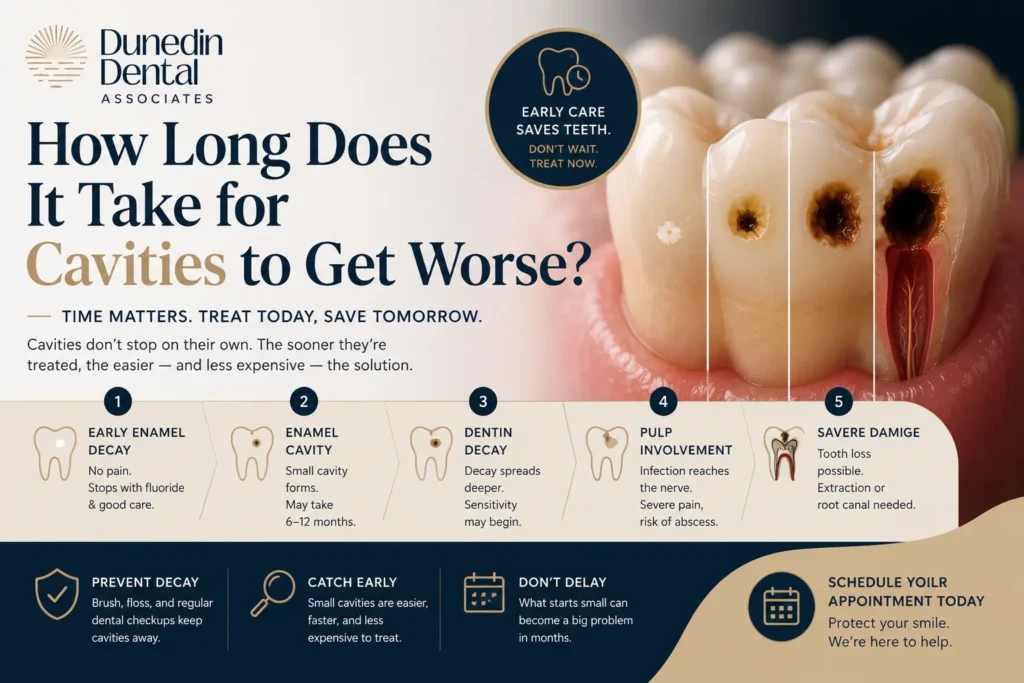
A cavity doesn’t stay the same size. From the moment decay begins eating away at your tooth enamel, it’s actively getting worse. The real question isn’t whether your cavity will progress—it will—but how quickly, and whether you can still save your tooth with a dental filling or other treatment before the damage becomes severe.
If you’ve noticed a dark spot on your tooth or felt a twinge of pain when you eat something cold or sweet, time matters. Early treatment can stop a cavity in its tracks and restore your tooth with a simple filling. Wait too long, and you’re looking at root canal therapy or extraction. At Dunedin Dental Associates, we’ve seen firsthand how quickly dental decay can advance. In this post, we’ll explain the decay process, what factors speed up cavity progression, and why scheduling an appointment sooner rather than later makes all the difference.
Do Cavities Get Worse Over Time?
Yes. Cavities always get worse over time without professional treatment. This isn’t a matter of “if”—it’s a matter of “when.” The decay process is predictable, relentless, and one of the most common reasons patients end up needing costly emergency dental care.
Here’s how it works: Acid produced by bacteria in your mouth eats into tooth enamel and dentin (the softer layer beneath the enamel). The hole gets bigger. The decay spreads deeper. If left untreated, the infection eventually reaches the pulp chamber—the center of your tooth where nerves and blood vessels live. When bacteria reach this point, you experience serious pain, infection, and potentially tooth loss.
The decay process accelerates because the cavity itself creates an ideal environment for bacteria to thrive. Plaque and food particles collect inside the hole, especially in hard-to-reach areas. These bacteria feed on sugar and starch, producing more acid as a byproduct. More acid means more decay. More decay means a bigger cavity. This is why even a small cavity can turn into a serious problem in months without intervention.
Your tooth cannot heal itself. Unlike your skin, which can regenerate after a cut, tooth enamel doesn’t repair once it’s damaged. The same goes for dentin. Once bacteria destroy these layers, they’re permanently gone. This is why early detection matters so much. A small white spot on your enamel might seem minor, but it’s a warning sign that the decay process has already started. Catch it now, and your dentist removes the decayed portion and places a simple dental filling that restores the tooth’s shape and function. Ignore it for six months, and that small spot has likely eaten through the enamel and into the dentin, requiring a much larger filling, a crown, or potentially more extensive treatment.
Why Untreated Cavities Progress
When bacteria colonize your tooth and produce acid, the damage accelerates exponentially. Enamel—the hard, protective outer layer—doesn’t regenerate. Once acid dissolves it, it’s gone for good. The same applies to dentin. When bacteria reach the dentin layer, decay spreads much faster than it did on the surface because dentin is softer and more porous than enamel.
This cascading effect is why timing is critical. In the earliest stage, when decay is still confined to the enamel, your dentist can often stop it with fluoride treatments or a simple preventive sealant. A fluoride treatment strengthens remaining enamel and can halt early decay before it becomes a cavity. But once a true cavity (a hole through the enamel and into the dentin) has formed, only a dental filling, crown, or root canal can save the tooth.
The Role of Acid and Bacteria in Cavity Progression
Tooth decay is an infection caused by bacteria in your mouth. These microorganisms feed on sugar and starch in the foods and drinks you consume throughout the day. Every time you eat a meal or snack, they produce acid as a byproduct. That acid attacks your tooth enamel for 20 to 30 minutes after each meal.
Normally, your saliva helps neutralize this acid and repair very early, microscopic damage to your enamel. This natural defense system is powerful, but it has limits. When a cavity forms, the decay happens so fast in that localized area that your saliva can’t keep up. The bacteria have created a protected pocket inside your tooth where they’re shielded from your toothbrush, floss, and saliva. Without professional intervention, the cavity gets worse day by day.
This is also why diet matters so much. People who consume sugary or acidic foods and drinks frequently face repeated acid attacks throughout the day. Each snack, soda, or energy drink feeds the bacteria and creates another window for acid damage. People who brush and floss regularly but have poor diet control often develop more cavities than people with decent oral hygiene but better eating habits.
How Fast Do Cavities Get Worse?
The speed of cavity progression varies, but most decay that starts in the enamel can reach the dentin layer within 6 to 12 months without treatment. From there, it can spread into the pulp and cause serious infection in as little as a few weeks. The exact timeline depends on several factors unique to your mouth and your specific cavity.
Some cavities worsen faster than others. A cavity on a back molar (where you chew the hardest) often progresses more quickly than one on a front tooth. Larger cavities—already past the enamel stage—worsen much faster than small, early-stage decay. The location of your cavity plays a huge role in how quickly it advances.
Factors That Speed Up Cavity Progression
Several factors determine how quickly a cavity gets worse and whether you’ll experience pain or other symptoms:
Cavity location matters enormously. Decay between teeth or on chewing surfaces spreads faster than decay on smooth surfaces. Your tongue and saliva can’t reach these hidden areas as easily, so bacteria thrive unchecked. Back molars are particularly vulnerable because they’re harder to clean with your toothbrush. If you have a cavity on a back tooth, it’s likely progressing faster than a cavity on your front tooth.
Cavity size is another critical factor. A small cavity in the early enamel stage progresses more slowly than a cavity that’s already eaten into the dentin. A small white spot might take months to become a problem. But a cavity that’s already dark and visible has probably breached the enamel and reached the dentin, meaning it can spread rapidly.
Your oral hygiene practices directly affect progression speed. Without proper brushing and flossing, bacteria thrive, plaque accumulates, and decay advances faster. If you’re brushing once a day or skipping floss entirely, cavities worsen more quickly than they do in people who maintain excellent daily oral hygiene. This is why routine dental checkup and cleaning appointments help catch cavities before they become severe.
Diet is a major accelerator. Frequent consumption of sugary or acidic foods and drinks accelerates cavity progression dramatically. The more often bacteria get fed, the more acid your teeth face. People who sip sugary drinks throughout the day or snack frequently are at much higher risk for rapid cavity worsening.
Saliva flow matters more than many people realize. If you have dry mouth (a condition called xerostomia), your teeth lose natural protection against acid and bacteria. Saliva has antimicrobial properties and helps neutralize acid. Low saliva production means cavities worsen faster. This is especially common in older adults and people taking certain medications.
Existing damage to your teeth can create pathways for bacteria. A cracked tooth, old filling that’s broken down, or exposed dentin creates an entry point for bacteria to reach deeper layers of your tooth. If you already have restorative dentistry that’s compromised, cavities can develop and worsen more rapidly in those areas.
Cavity Location and Size Matter
A cavity that starts at the gum line or between teeth progresses faster because these areas are harder to clean with your toothbrush. The bacteria have a clear highway to the dentin. A cavity on your front tooth’s smooth surface progresses more slowly because saliva can reach it more easily.
Size tells you a lot about stage and risk. A tiny white spot on your front tooth is still early-stage decay and typically advances more slowly than a cavity on your back molar. But a large, visible dark cavity is already deep and can reach your nerve in weeks or even days, causing severe pain and potentially requiring emergency dental treatment.
Stages of Cavity Development
Understanding how decay develops helps you recognize when it’s time to call a dentist and understand what’s happening inside your tooth.
Stage 1: Enamel Decay (White Spots)
The cavity starts here, often without any symptoms. Bacteria produce acid, which dissolves the mineral structure of your enamel. You won’t feel any pain, and you might not see anything obvious—just maybe a white or chalky spot where the enamel is weakening. These white spots indicate that demineralization has begun: minerals are being stripped from your tooth faster than your saliva can replace them.
At this stage, the cavity is entirely preventable. A dental exam using visual inspection or digital X-rays catches these early signs. If your dentist spots a white spot, fluoride treatments can stop decay in its tracks by remineralizing the weakened enamel. Some dentists apply a dental sealant over the area to prevent bacteria from accessing it. This is the ideal time to treat a cavity: it’s quick, painless, inexpensive, and you’re left with a completely healthy tooth. You can still save the tooth and avoid expensive restorative procedures down the road.
Stage 2: Dentin Involvement
Once decay breaks through the enamel and into the dentin, everything accelerates. Dentin is softer than enamel, and bacteria spread through it much faster. The cavity can widen and deepen significantly within weeks. You might start noticing sensitivity to sweet foods, cold water, or acidic drinks. Some people feel a slight ache when biting down on that tooth.
At this stage, brushing, flossing, and fluoride treatments won’t reverse the damage. Your dentist needs to remove the decayed portion and place a dental filling to restore the tooth’s shape and function. The filling seals the cavity and prevents bacteria from spreading deeper. Treatment is still straightforward, quick, and restores the tooth well. A filling typically lasts 5 to 15 years depending on the material used and how well you care for your teeth.
Stage 3: Deep Cavity (Pulp Exposure Risk)
The decay has reached deep into the tooth, approaching or touching the pulp chamber where nerves and blood vessels live. You’ll likely feel significant pain—sharp, persistent, or throbbing. Biting down might be uncomfortable or painful. Your tooth has become extremely sensitive to temperature, and drinking hot beverages or eating ice cream causes sharp pain.
At this stage, a simple filling won’t work. The damage is too extensive. Your dentist will likely recommend root canal treatment to remove the infected pulp, clean the root canals, and seal them with a rubber-like material. After root canal therapy, a crown usually follows to restore strength and function. While a root canal sounds intimidating, it actually relieves the pain you’ve been experiencing by removing the infected nerve tissue. The procedure is no more uncomfortable than having a filling placed.
Stage 4: Severe Infection or Tooth Loss
If decay reaches the pulp and you ignore the pain, infection spreads beyond the tooth into the jaw and surrounding tissues. You might develop an abscess (a pocket of infection at the root). Symptoms include facial swelling, fever, severe pain that radiates up your jaw or into your ear, or a bad taste in your mouth. At this stage, you might have difficulty opening your mouth or swallowing.
Your dentist will likely recommend root canal therapy as a last attempt to save the tooth. If the tooth is too damaged or the infection is too severe, extraction becomes necessary. Tooth loss creates significant problems—your other teeth shift, your bite changes, your jawbone resorbs (shrinks), and chewing becomes difficult. Replacing a missing tooth with an implant, bridge, or denture costs $3,000 to $6,000 or more. This is far more expensive than the simple filling that would have cost $150 to $300 if caught at stage two.
What Happens If You Leave a Cavity Untreated?
Every day a cavity goes untreated, the decay gets worse. The consequences escalate quickly, progressing from minor annoyance to serious health emergency.
Short-Term Risks (Weeks to Months)
In the first weeks or months, you might experience tooth sensitivity when eating or drinking. Cold, heat, or sweet triggers discomfort because the decay has exposed deeper layers of your tooth. You’ll notice visible staining or darkening where the cavity is. The hole might look dark brown or black. Bad breath is common because bacteria in the cavity produce odor-causing byproducts. You might feel mild pain, especially when chewing on that tooth.
At this stage, you still have simple treatment options. A filling stops the progression immediately and restores the tooth in one appointment. Cost is minimal—typically $150 to $300 depending on the filling material and location. Most insurance covers a significant portion of this cost.
Long-Term Consequences (Months to Years)
Ignore a cavity for six months or longer, and you face serious complications:
Severe pain becomes constant and intense. Once the pulp is involved, pain isn’t occasional—it’s persistent and can radiate into your jaw, ear, or temple. Some patients describe it as unbearable. Sleeping becomes difficult. Eating becomes difficult. It affects your quality of life significantly.
Infection and abscess develop. Bacteria spread into the jaw and surrounding tissues, causing facial swelling, fever, and serious systemic illness. In rare cases, untreated dental infections can spread to the sinuses, brain, or bloodstream—which is dangerous.
Tooth loss becomes inevitable. If the tooth is too damaged to save, extraction is the only option. The procedure itself isn’t painful (your dentist numbs the area), but losing a tooth creates cascading problems for your oral health.
Cost escalates dramatically. What started as a potential $150 filling turns into a $1,000 to $2,000 root canal. If extraction is necessary, replacing that tooth with a dental implant costs $3,000 to $6,000. Bone grafting, if needed, adds thousands more. The longer you wait, the more you’ll pay and the more invasive your treatment becomes.
Decay spreads to other teeth. Poor oral hygiene that led to one cavity often leads to more. Without early treatment and improved habits, bacteria compromise your other teeth. You might develop multiple cavities requiring multiple fillings or root canals.
Can You Stop Tooth Decay Once It Starts?
Once a true cavity forms—once decay has created a hole through your enamel and into your dentin—you cannot reverse it with brushing, flossing, or any home remedy. That damaged tooth structure must be professionally removed by your dentist and replaced with a filling, crown, or other restoration.
However, you can absolutely stop decay in its very earliest stages, before a cavity actually forms. If your dentist catches a white spot or very small area of decay before it reaches the dentin, fluoride treatments or dental sealants can halt the process. Fluoride therapy strengthens remaining enamel and prevents the decay from progressing. This is why regular dental exams are absolutely crucial: a cavity caught early is fixable with a simple filling; left undetected, it becomes a root canal or extraction.
Early Cavity Treatment Saves Teeth
The goal is always to catch decay before it becomes a cavity that requires invasive treatment. That means establishing good habits and regular professional care:
Brush twice daily with fluoride toothpaste. Brushing removes plaque and food debris, reducing the bacteria that produce cavity-causing acid. Fluoride in your toothpaste strengthens enamel.
Floss daily to remove plaque between teeth where your toothbrush can’t reach. This is where many cavities start because bacteria thrive in these hidden areas.
Limit sugary and acidic foods and drinks. Every time you consume sugar, you feed cavity-causing bacteria. Every acidic beverage weakens your enamel. If you do consume these foods or drinks, rinse your mouth with water afterward.
See your dentist every six months for professional cleanings and exams. At your dental checkup and cleaning appointment, your dentist uses digital X-rays and visual inspection to spot early signs of decay before they become cavities. They can apply fluoride treatments to strengthen your enamel. They remove tartar (hardened plaque) that your toothbrush can’t remove.
If your dentist catches a small cavity—a hole that’s started but hasn’t yet affected the pulp—a simple filling stops the progression immediately. No pain, no root canals, no complications. The tooth is restored in one appointment and remains fully functional for years.
Cavity Prevention Is Your Best Defense
The best way to handle cavity progression is to prevent cavities from forming in the first place. Daily brushing and flossing, combined with regular professional cleanings and fluoride treatments, reduce your risk dramatically. Studies show that people who follow this routine and limit sugar consumption rarely develop cavities.
For patients at higher risk—those with dry mouth, a diet high in sugar, a family history of cavities, or a previous history of multiple cavities—additional preventive measures help. Fluoride treatments applied by your dentist are more concentrated than store-bought fluoride toothpaste and provide stronger protection. Dental sealants create a physical barrier on your back molars, the most cavity-prone teeth.
If you’re concerned about cavity risk or have noticed signs of decay, don’t wait until pain develops. Call Dunedin Dental Associates today. Dr. Matthew Burton and Dr. William Spencer can examine your teeth, identify any cavities in their earliest, most treatable stages, and discuss a prevention plan tailored to your risk factors. Early intervention saves your teeth and saves money.
Frequently Asked Questions
How long does it take for a small cavity to get bad?
A: Most small cavities confined to the enamel stage progress to the dentin layer within 6 to 12 months without treatment. Once in the dentin, decay spreads much faster—potentially reaching the pulp (and causing severe pain) in weeks. Early treatment within the first few months of decay prevents this progression entirely.
Can a cavity get worse in a week?
A brand new cavity won’t typically cause severe damage in just one week. However, a cavity that’s already in the dentin stage can worsen noticeably in days or weeks, causing increasing pain and sensitivity. This is why urgent dental treatment matters when you have symptoms like sensitivity or visible decay.
Do cavities always get worse?
Yes, cavities always progress without professional treatment. Decay is an active process: bacteria and acid continue attacking your tooth until the cavity is treated. The only exception is if decay is caught at the very first stage (white spot stage) and sealed with fluoride or a sealant before a true cavity forms.
What happens if I leave a cavity untreated for years?
Leaving a cavity untreated for years leads to infection, abscess formation, severe pain, and eventual tooth loss. Beyond the tooth itself, a persistent infection can spread to your jaw and other teeth, potentially causing serious systemic illness. The cost of managing a severely decayed tooth—root canal, extraction, or implant—far exceeds the cost of early treatment. A simple filling costs $150 to $300. A root canal costs $1,000 to $2,000. An implant costs $3,000 to $6,000. Prevention and early treatment save both your teeth and your money.
Can you feel a cavity getting worse?
You might not feel anything at first. Very early decay often has no symptoms. As the cavity reaches the dentin, you’ll notice sensitivity to cold, hot, or sweet stimuli. Once the pulp is affected, you’ll feel sharp or throbbing pain, especially when biting down or chewing.
How do I know if my cavity is getting worse?
Signs include increasing sensitivity to temperature or sweetness, visible darkening or enlargement of the cavity, persistent pain, or swelling near the tooth or jaw. If you have any of these signs, contact your dentist immediately. Don’t wait for pain to become unbearable—early treatment is always easier and less costly.
Can fluoride treatments stop a cavity from getting worse?
Fluoride treatments can stop decay at the white spot stage, before a true cavity has formed. Once a cavity (a hole through the enamel and into the dentin) has developed, fluoride alone cannot reverse it. However, fluoride can help protect your other teeth from decay and strengthen the areas around a cavity. Professional treatment—a filling—is needed to stop a cavity that’s already formed.
Is a root canal necessary if I treat a cavity early?
No. If you catch a cavity in its early stages and have it treated with a filling, a root canal is not necessary. Root canal therapy is only needed if decay has reached the pulp chamber inside your tooth. Early treatment prevents the need for root canals entirely.
How often should I see a dentist to catch cavities early?
Most people should see their dentist every six months for checkups and cleanings. This allows your dentist to spot early signs of decay before they become cavities. If you’re at higher risk (due to diet, dry mouth, or history of cavities), more frequent visits—every 3 to 4 months—may be recommended.
Can brushing and flossing stop a cavity from getting worse?
Brushing and flossing prevent cavities from forming in the first place, but they cannot stop or reverse a cavity that’s already developed. Once decay has created a hole in your tooth, only professional dental treatment can remove it. However, excellent oral hygiene prevents new cavities and protects your remaining teeth from decay.
What’s the difference between a cavity and tooth decay?
Tooth decay is the process where bacteria and acid damage your tooth structure. A cavity is the hole that forms as a result of tooth decay. Early decay (white spots) can be stopped before it becomes a cavity. Once a cavity exists, professional treatment is required.
Don’t Let Dental Decay Steal Your Smile
Cavities don’t stay small. The decay process is relentless, and every day you delay treatment increases your risk of complications, pain, and tooth loss.
If you think you have a cavity, or if you’re experiencing tooth sensitivity or pain, don’t wait. Early treatment is quick, simple, and effective. A small filling stops the progression and restores your tooth. Your dentist at Dunedin Dental Associates can spot cavities in their earliest stages and address them before they become serious problems.
Call us today at (727) 734-3321 or schedule your dental exam online. We’re here to catch problems early and keep your smile healthy.