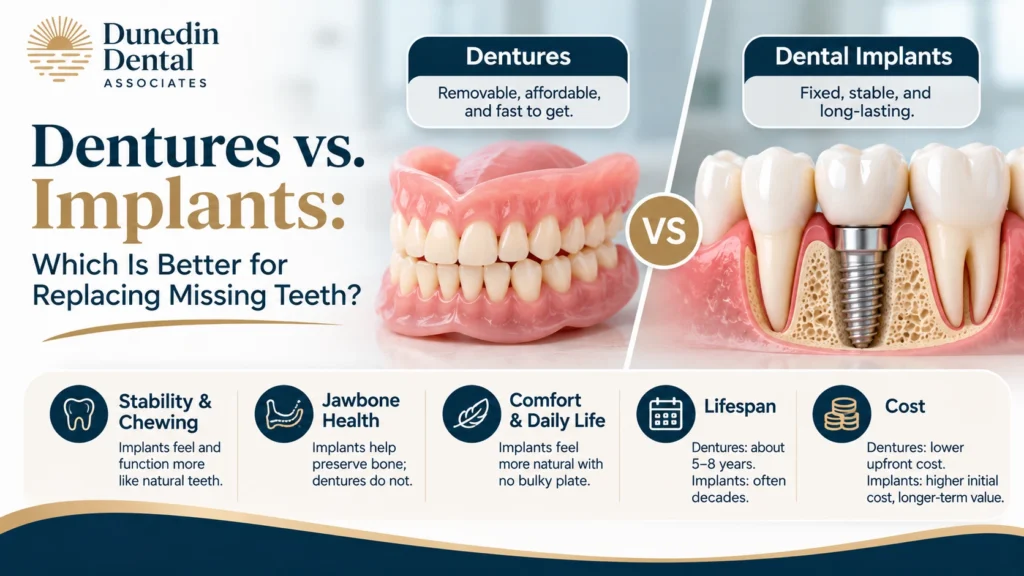
If you’ve lost several teeth, or all of them, the choice usually comes down to dentures vs. implants. Both replace missing teeth and restore your smile, but they work very differently. One rests on your gums and comes out at night. The other is anchored in your jawbone and stays put like natural teeth.
Below, we compare dental implants vs. dentures on stability, comfort, jawbone health, care, lifespan, and cost, so you can see which tooth replacement option fits your mouth and budget. At Dunedin Dental Associates, we offer both, plus options that combine the two.
Quick Answer: Dental Implants vs. Dentures at a Glance
| Traditional dentures | Implant-supported dentures | Dental implants | |
| How they stay in | Rest on the gums with suction or adhesive | Snap or screw onto 2 to 6 posts in the jaw | Each post holds a crown or bridge |
| Removable | Yes | Snap-on: yes. Fixed: no | No |
| Chewing strength | Limited | Much stronger | Close to natural teeth |
| Protects the jawbone | No | Yes, under the posts | Yes |
| Typical lifespan | 5 to 8 years, relines every 1 to 2 years | Posts for decades; teeth on top 5 to 15 years | Post often lasts decades; crown 10 to 15 years |
| Typical cost (2026) | $1,500 to $2,500 per arch | About $7,600 to $38,000 per arch | $3,000 to $6,000 per tooth |
What Are Dentures?
Dentures are removable replacement teeth made of acrylic, sometimes with a metal frame. They rest on your gums and are held in place by suction, a close fit, and sometimes adhesive. Modern dentures look far more natural than older versions, with shade-matched teeth and gum-colored bases.
There are three main types:
- Complete dentures are used when all the teeth in an upper or lower arch are missing.
- Partial dentures are used when some natural teeth remain. Clasps hook onto those teeth to hold the partial in place.
- Immediate dentures are placed the same day teeth are removed, so you’re never without teeth while your gums heal.
They’re a fast, lower-cost way to replace missing teeth, and for many people they work well. Their main weakness is that they sit on top of the gums instead of being anchored in bone.
What Are Dental Implants?
Dental implants are titanium posts surgically placed in the jawbone, where they act as new tooth roots. Over three to six months, the bone fuses to the post in a process called osseointegration. Once healed, the implant post holds a connector called an abutment and a custom crown.
Implants can support a single crown, a bridge across several missing teeth, or a full denture. Because each one is fixed in bone, implants offer the most natural feel and chewing strength of any tooth replacement option. Placement is a minor surgery done under local anesthesia, with IV sedation available for anxious patients.
What’s the Difference Between Dentures and Dental Implants?
Stability and Chewing
The stability of implants is the biggest difference. A traditional denture can slip when you eat, talk, or laugh, and many people avoid hard or sticky foods. Implants are anchored in the jaw, so you can bite into an apple or chew steak with confidence. People who wear full dentures often chew with a fraction of their original bite force.
Jawbone Health and Facial Appearance
After tooth loss, the jawbone that held the tooth starts to shrink because nothing stimulates it anymore. Dentures rest on the gums and don’t stop this bone loss. Over the years, the mandible and upper jaw shrink, the fit loosens, and the lower face can look sunken.
Implants stimulate the bone the way tooth roots do, which helps preserve the jaw and the shape of your face. For many patients, that difference matters as much for self-esteem as for chewing.
Comfort and Daily Life
Traditional dentures may cause sore spots where they rub, and an upper plate covers the roof of your mouth, which can dull taste. Implants have no plate, no adhesive, and nothing to remove at night. Most patients say their new teeth feel like their own within a few weeks.
Care and Maintenance
Dentures require nightly removal, brushing, and soaking. Dentures may need relining every one to two years as your gums change, and replacement every five to eight years.
Implants require the same care as natural teeth: brushing twice a day, flossing, and regular professional dental cleanings. Good oral hygiene and dental care matter, because gum infection around the post (peri-implantitis) is the main cause of problems.
Lifespan
A traditional denture usually lasts five to eight years. A dental implant often lasts for decades, and many are still working after 20 years with good care. That’s why implants are a more permanent solution. The crown on top may need replacing after 10 to 15 years.
Pros and Cons of Dental Implants and Dentures
Dentures: Pros and Cons
Pros
- Lowest upfront cost
- No surgery required
- Fast, often completed in a few weeks
- A good fit for patients who can’t have implant surgery
Cons
- Can slip, click, or cause sore spots
- Don’t stop jawbone loss
- Need relines and regular replacement
Limited chewing strength and food choices
Pros and Cons of Dental Implants
Pros
- Feel and function like natural teeth
- Protect the jawbone and facial shape
- Don’t rely on neighboring teeth for support
- Often lasts for decades
Cons of dental implants
- Higher upfront cost
- Requires a minor surgery and healing time
- Not every patient has enough bone without a graft
- Treatment takes several months from start to finish
Implant-Supported Dentures: The Middle Option
You don’t have to choose between a removable denture and one implant per tooth. Implants and dentures can work together: a full set of teeth attaches to multiple implants, usually two to six. Implant supported dentures offer far better stability than traditional dentures, at a lower cost than replacing every tooth individually.
There are two types. Snap-on versions click onto attachments and come out at night. Fixed versions, often called permanent dentures or All-on-4, stay in and are removed only by your dentist. Dr. Matthew Burton places implant-secured dentures for patients who want more stability and a more affordable path than replacing each tooth.
Dentures vs. Implants: What Each Option Costs
| Option | Typical U.S. cost (2026) |
| Complete dentures, standard | $1,500 to $2,500 per arch |
| Partial dentures | $1,000 to $2,800 |
| Snap-on implant dentures | About $7,600 to $13,300 per arch |
| Single dental implant | $3,000 to $6,000 per tooth |
Your final cost depends on how many teeth you’re replacing, any extractions or grafting, and the materials used. At Dunedin Dental Associates, you get a written estimate for every option before treatment.
Dental implants cost more upfront. But dentures need relines every one to two years and full replacement every five to eight years, and those costs add up. Over 20 years, the gap between the cost of dentures and the costs of dental implants narrows, especially when you factor in the bone loss they can’t prevent.
Most dental plans cover part of dentures and implants, with yearly limits. Our team checks your benefits before treatment.
For full pricing, insurance, and financing details, see our dental implant cost guide.
Dentures or Implants: Which Option Is Best for You?
Choosing dental implants or dentures comes down to your health, your bone, and your budget.
Dentures may suit you better if:
- You need the lowest upfront cost
- You have health conditions that make surgery risky
- You need teeth quickly, such as right after extractions
- You’ve lost a lot of jawbone and don’t want grafting
Implants may be the better choice if:
- You want teeth that stay in and feel natural
- You want to protect your jawbone and facial shape
- You’re tired of adhesive and sore spots
- You want the longest-lasting tooth replacement option
Who Is a Good Candidate for Dental Implants?
Dental implants may work for most adults in reasonable health. You need healthy gums, or a willingness to treat periodontal disease first, and enough bone or a bone graft to build it up. Smoking, uncontrolled diabetes, and some osteoporosis medications slow healing and need extra planning. Age alone isn’t a barrier. A 3D scan and an exam with your dentist tell you where you stand.
Can You Switch from Dentures to Implants Later?
Yes. Many of our patients wore dentures for years first. The sooner you switch, the more bone you’re likely to have, which can mean a simpler treatment. In some cases, your current set can even be converted to snap onto new posts. We’ll check its fit and condition at your consultation and let you know if it can be adapted or if a new set will work better.
Your Tooth Replacement Consultation at Dunedin Dental Associates
At your consultation, we:
- Talk about your goals, your current teeth, and your budget
- Take a Planmeca 3D scan to check bone height and density in your jaw
- Walk you through each option that fits your mouth: dentures, implant-supported dentures, or individual implants
- Give you a written estimate for each option side by side
We handle placement and restoration in our Dunedin office, so there’s no referral to a separate oral surgery practice. Dr. William Spencer has advanced surgical and IV sedation training.
Questions About Dentures vs. Implants
Which is better, dentures or dental implants?
For most patients with healthy gums and enough bone, implants are the better long-term choice. They’re more stable, protect the jawbone, and last longer. Dentures still make sense when budget, health, or speed matter most.
How much do dentures cost on average?
Standard full dentures typically cost $1,500 to $2,500 per arch in 2026. Economy sets can cost less, and premium sets up to about $3,600 per arch.
What happens to dental implants after 20 years?
With good home care and regular checkups, most are still working after 20 years. The crown on top may have been replaced once by then.
Can you switch from dentures to implants later?
Yes, and switching sooner usually means more bone and a simpler treatment.
Do dentures or implants feel more natural?
Implants feel more natural because they’re anchored in bone and don’t cover the roof of your mouth. Most patients stop noticing them within a few weeks.
Talk Through Your Options with Us
Still deciding which option fits you? Book a consultation and leave with a 3D scan, clear answers, and a written estimate for each option.
Book a Consultation or call or text (727) 734-3321.
Medically reviewed by Dr. Matthew P. Burton, Dunedin Dental Associates. Prices are typical 2026 U.S. ranges for general information and are not a quote.