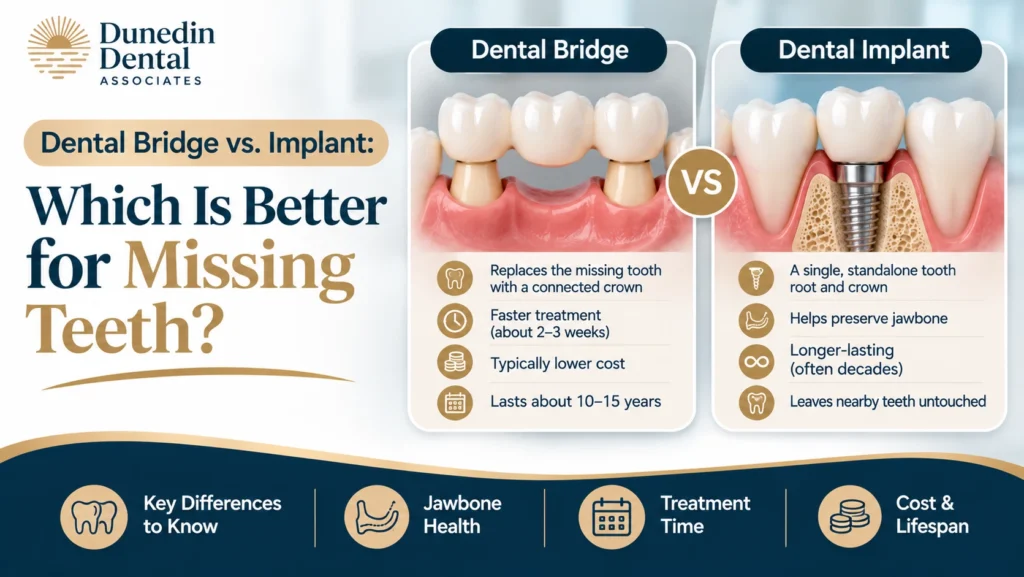
If you’ve lost a tooth, the two most common tooth replacement options are a dental bridge and a dental implant. Both fill the gap with a natural-looking replacement tooth. But they work very differently, and that changes what happens to your neighboring teeth, your jawbone, and your budget over the next 20 years.
If you’re choosing between a dental bridge and an implant, this guide compares a bridge vs. implant on cost, lifespan, comfort, and care, with the honest pros and cons of each treatment, so you can choose the best option for your smile.
Dental Bridge vs. Implant Comparison at a Glance
| Single implant | Traditional bridge (3-unit) | Maryland bridge | |
| How it’s held in place | Titanium post in the jawbone | Caps on the teeth on either side | Wings bonded to the back of nearby teeth |
| Effect on adjacent teeth | None | Filed down and crowned | Minimal |
| Protects the jawbone | Yes | No | No |
| Typical lifespan | Post often lasts decades; crown 15+ years | 10 to 15 years | Often shorter |
| Time to finish | 4 to 7 months | 2 to 3 weeks | 2 to 3 weeks |
| Typical U.S. cost (2026) | $3,000 to $6,000 | $2,000 to $5,200 | $1,500 to $2,500 |
What Is a Dental Bridge?
A dental bridge fills the gap left by a missing tooth with a false tooth, called a pontic, held between two crowns. Those crowns fit over the teeth on either side, which act as anchors. Bridges replace missing teeth by spanning one or more teeth in a row.
There are four main types:
- Conventional bridge: anchored on the teeth at both ends of the gap. This is the most common type of bridge.
- Maryland bridge: the artificial tooth has small metal or ceramic wings bonded to the back of the nearby teeth, so they barely need reshaping. It’s often used for front teeth.
- Cantilever bridge: anchored on one side only, used when there’s a healthy tooth on just one side of the gap.
- Implant-supported bridge: a row of artificial teeth held on implants instead of natural teeth, used when three or more teeth in a row are missing.
At Dunedin Dental Associates, we recommend the bridge design that fits your bite, the health of the nearby teeth, and your budget after an exam and X-rays.
A conventional bridge is a reliable dental restoration, especially when the teeth next to the gap already have large fillings or need a dental crown to protect a tooth that’s weak or cracked.
Overview of Dental Implants
A dental implant is an artificial tooth root. A small titanium post is placed in the jawbone, where it fuses with the bone over three to six months. Once it’s stable, an abutment and a custom implant crown are attached on top.
The finished tooth stands on its own, just like real teeth do. It doesn’t lean on neighboring teeth, and it keeps stimulating the bone the way a natural root does. That’s why many dentists consider a single dental implant the most durable replacement for one missing tooth.
What’s the Difference Between a Dental Bridge and an Implant?
Effect on the Teeth Next to the Gap
This is the biggest difference. A conventional bridge needs the adjacent teeth filed down to hold it. If those are healthy teeth with no fillings, you’re removing healthy tooth structure to replace one tooth. An implant leaves the surrounding teeth untouched.
Jawbone and Bone Health
After tooth loss, the bone under the gap slowly shrinks because nothing stimulates it. A bridge sits above the gum, so the bone under the pontic keeps shrinking. An implant replaces the root and helps protect bone health, which also keeps the gum line from sinking under the replacement tooth.
Lifespan
Most bridges last 10 to 15 years before they need replacing. Dental implants can last for decades with good care. The implant crown on top usually lasts 15 years or more, and replacing a crown is simpler than replacing a whole bridge.
Treatment Time
A bridge is faster: usually two visits over two to three weeks. Dental implants typically take four to seven months, mostly healing time while the post fuses with the bone. A temporary tooth can fill the gap while you heal.
Care and Hygiene
You brush and floss an implant like a natural tooth. A bridge needs a floss threader or water flosser to clean under the pontic. Poor hygiene under a bridge can hurt your oral health, leading to tooth decay or gum disease in the anchor teeth, which is a common reason bridges fail.
How Much Does a Dental Bridge Cost vs. an Implant?
| Option | Typical U.S. cost (2026) |
| Conventional 3-unit bridge | $2,000 to $5,200 |
| Maryland bridge | $1,500 to $2,500 |
| Single implant with crown | $3,000 to $6,000 |
Your final cost depends on the materials, the number of teeth involved, and any extractions or grafting needed. At Dunedin Dental Associates, you get a written estimate for each option before treatment.
A bridge usually costs less upfront. Over time, the math often changes. A bridge may need replacing once or twice over 30 years, and the anchor teeth can need root canals or other dental procedures along the way. An implant post rarely needs replacing, so an implant is often the lower total cost over the long run.
Insurance tends to treat both as major restorative work. Many plans cover part of a bridge, and more plans now cover part of implant treatment too. Our team checks your benefits before treatment.
For a full price breakdown, see our dental implant cost guide.
Pros and Cons of Each Treatment
Dental Bridge Benefits and Drawbacks
Pros
- Lower upfront cost
- No surgery
- Finished in two to three weeks
- A good fit for damaged teeth next to the gap
Cons
- Requires filing down adjacent teeth
- Doesn’t stop bone loss under the gap
- Harder to clean under
- Usually needs replacing every decade or so
Dental Implant Benefits and Drawbacks
Pros
- Doesn’t touch the surrounding teeth
- Protects the jawbone
- Feels and works like a real tooth
- Often lasts for decades
Cons
- Higher upfront cost
- Requires minor surgery and healing time
- May need a bone graft if bone is thin
- Not ideal for some people with uncontrolled health conditions
Bridge or Implant: Which Should You Choose?
A bridge is often the right fit if:
- The teeth next to the gap already have large fillings or need crowns
- You need the tooth replaced quickly
- You can’t or don’t want to have surgery
- You’ve lost a lot of bone and don’t want grafting
An implant is the better choice if:
- The teeth next to the gap are healthy and you want to keep them that way
- You want the longest-lasting option
- You want to protect your jawbone
- You’d rather brush and floss normally
Choosing Dental Implants for a Front Tooth
Implants are often the best choice for replacing a single tooth at the front of your smile, because the crown can be shaped and shaded to match perfectly and the gum line stays healthier over time. A Maryland bridge is a lower-cost alternative for front teeth when an implant isn’t possible, especially for younger patients or anyone worried about losing teeth next to the gap.
Can a Bridge Be Replaced with an Implant Later?
Often, yes. When an old bridge fails, many patients switch to an implant. If bone has shrunk under the old bridge, a bone graft may be needed first. That’s one reason some patients choose an implant from the start after they’ve lost a tooth.
Your Consultation at Dunedin Dental Associates
At your visit, your dentist will examine the gap left by your missing tooth or teeth, check your bone with Planmeca 3D imaging, and explain which option fits your mouth: a dental bridge or dental implant. You’ll get a written estimate for both, so you can compare dental bridges vs implants side by side. We place and restore implants, and make bridges and crowns, all in our Dunedin office.
Common Questions About Dental Bridges and Implants
Is a dental bridge or implant cheaper?
A bridge usually costs less upfront. Over 20 to 30 years, an implant is often cheaper because it rarely needs replacing.
What is the downside of having a dental bridge?
A conventional bridge requires filing down tooth structure on both sides, doesn’t stop bone loss under the gap, and usually needs replacing within 15 years.
Can teeth decay under a bridge?
Yes. Food and plaque can collect under the pontic and around the anchor crowns. Cleaning daily with a floss threader or water flosser and regular dental care lower that risk.
What happens after 20 years of dental implants?
With good home care and regular checkups, most implant posts are still working after 20 years. The crown on top may have been replaced once by then.
Does getting a dental bridge hurt?
No. The teeth are numbed while they’re shaped. Some patients have mild sensitivity for a few days.
Why would a dentist not recommend an implant?
A dentist may suggest waiting or choosing another option if there’s active gum disease, very thin bone without a graft, uncontrolled diabetes, or heavy smoking.
Talk Through Your Options with Us
Living with missing teeth and not sure what to do next? Book a consultation and leave with a clear recommendation and a written estimate for both a bridge and an implant.
Book a Consultation or call or text (727) 734-3321.