
1
Intake & Symptom Review
We ask about what you are feeling, when it started, and whether anything makes it better or worse. There are no wrong answers; this history helps us focus the exam.
A cracked tooth can go from a minor nuisance to a serious dental emergency faster than most people expect. At Dunedin Dental Associates, we treat cracked teeth quickly and carefully protecting the natural tooth wherever possible and giving you a clear plan when more involved care is needed. Patients throughout Dunedin, Palm Harbor, Tarpon Springs, and the surrounding communities in north Pinellas County trust our dental office for honest, attentive dental care.
Welcome to Dunedin Dental Associates, where experienced dentistry meets compassionate care. As your neighborhood dentist in Dunedin, we provide complete dental care that prioritizes your comfort, oral health, and beautiful smile.
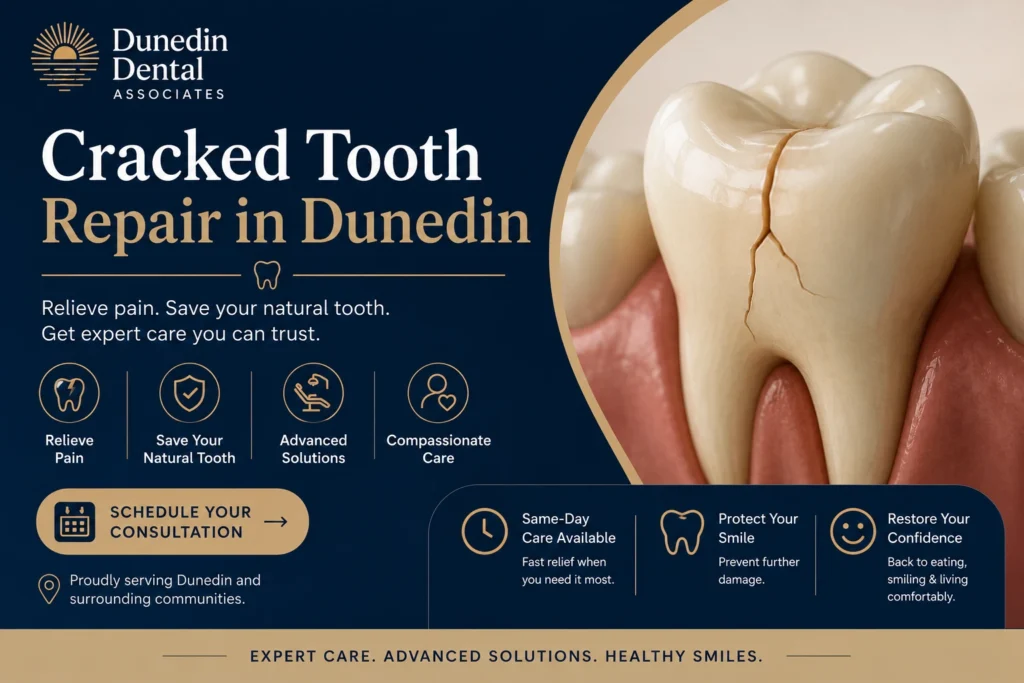
Cracked tooth repair is a category of restorative dentistry focused on diagnosing, treating, and stabilizing teeth that have fractured, chipped, or split — whether from an accident, biting down on something hard, temperature changes, or gradual tooth wear over time. A cracked tooth is not always visible to the eye. Some cracks are hairline fractures you can barely see on an x-ray. Others run deeper, affecting the inner pulp of the tooth and triggering significant pain or infection. The right treatment depends on the type and depth of the crack, and that requires a proper clinical assessment not guesswork.
Silver Smile Appointments Premium dental appointments for patients who value extra time and personalized attention. Perfect for comprehensive treatments or your first visit to our practice.
Cracked teeth do not always announce themselves with sharp pain. These are the most common signals our patients describe when they come in:
Pain or pressure when you bite or chew — especially if it comes and goes — is a classic indicator of a cracked tooth. It may only hurt on one side, or only on certain foods.
If hot or cold foods trigger a sharp, lingering ache rather than a brief twinge, the crack may be close to or reaching the pulp — the nerve-rich center of the tooth.
Cracked teeth can cause a diffuse, dull ache that is difficult to pin to one spot. Patients often describe it as a toothache that shifts around — that is the nerve responding to the fracture.
Edema or tenderness in the gum near a specific tooth can indicate infection has begun. This is a dental emergency that needs same-day attention — call us immediately at 727-734-3321.
Not all cracks are created equal. Our Dunedin dentist team distinguishes between fracture types because the type determines the treatment:
A hairline crack (craze line) affects only the outer enamel and is usually painless. It rarely requires treatment beyond monitoring, though teeth whitening and cosmetic polishing can minimize its appearance.
A fractured cusp occurs when a piece of the chewing surface breaks off — often around an old filling. This typically does not affect the pulp, and a dental crown restores the tooth structure reliably.
A cracked tooth (incomplete fracture) extends from the chewing surface toward the root but has not split the tooth. Early treatment — usually a dental crown — prevents the crack from deepening into the pulp.
A split tooth means the crack has progressed to the point where two distinct segments exist. Depending on how far the split extends, one portion may be saved; in other cases, extraction followed by dental implant placement is the best path forward.
A vertical root fracture originates at the root and extends upward. These fractures are often asymptomatic for a long time, discovered only when surrounding bone and gum tissue show signs of infection. Treatment typically involves extraction.
We understand that family members often play important roles in dental care decisions. Our dental team works closely with patients and their families to ensure everyone feels informed and comfortable with treatment options.
There is no single fix for every cracked tooth. The treatment your dentist recommends depends on the type of fracture, how deep it goes, and whether the pulp or root is involved. Here is a plain-language breakdown of the most common approaches:
The most common treatment for a moderate-to-severe crack. A dental crown caps the entire tooth, holding the cracked tooth structure together, stopping the crack from spreading, and restoring full chewing function. We match the crown to your natural teeth in color and shape.
For smaller chips or surface cracks that have not reached the pulp, a tooth-colored composite filling can rebuild the damaged area and blend seamlessly with the surrounding tooth. This is a conservative, effective option when the crack is caught early.
When a crack reaches the pulp — the soft tissue containing nerves and blood vessels — the pulp becomes inflamed or infected. A root canal treatment removes the damaged pulp, cleans the tooth's interior, and seals it. A crown typically follows to protect the treated tooth.
For a cracked or chipped front tooth where the damage is primarily cosmetic and the pulp is unaffected, a porcelain veneer may be the right solution — covering the visible surface of the tooth while preserving most of the underlying natural teeth structure.
When a crack splits a tooth below the gum line and the tooth cannot be saved, dental implant placement becomes the most stable long-term replacement. A dental implant anchors directly to the bone, preserving jaw structure and restoring full function without affecting adjacent teeth.
Dental anxiety should never prevent you from getting the care you need. We offer sedation options to keep you comfortable throughout any restorative procedure — from a filling to a crown placement. Talk to our team about what works best for you.
Don't let lack of dental insurance prevent you from getting the dental care you need. Our exclusive membership plan makes quality dental care affordable for every patient in Dunedin.
If you come in unsure about whether your tooth is cracked — or how serious it is — here is what to expect at your first appointment.
We ask about what you are feeling, when it started, and whether anything makes it better or worse. There are no wrong answers; this history helps us focus the exam.
Your dentist examines the tooth visually and with gentle bite pressure tests to localize the crack and assess its extent.
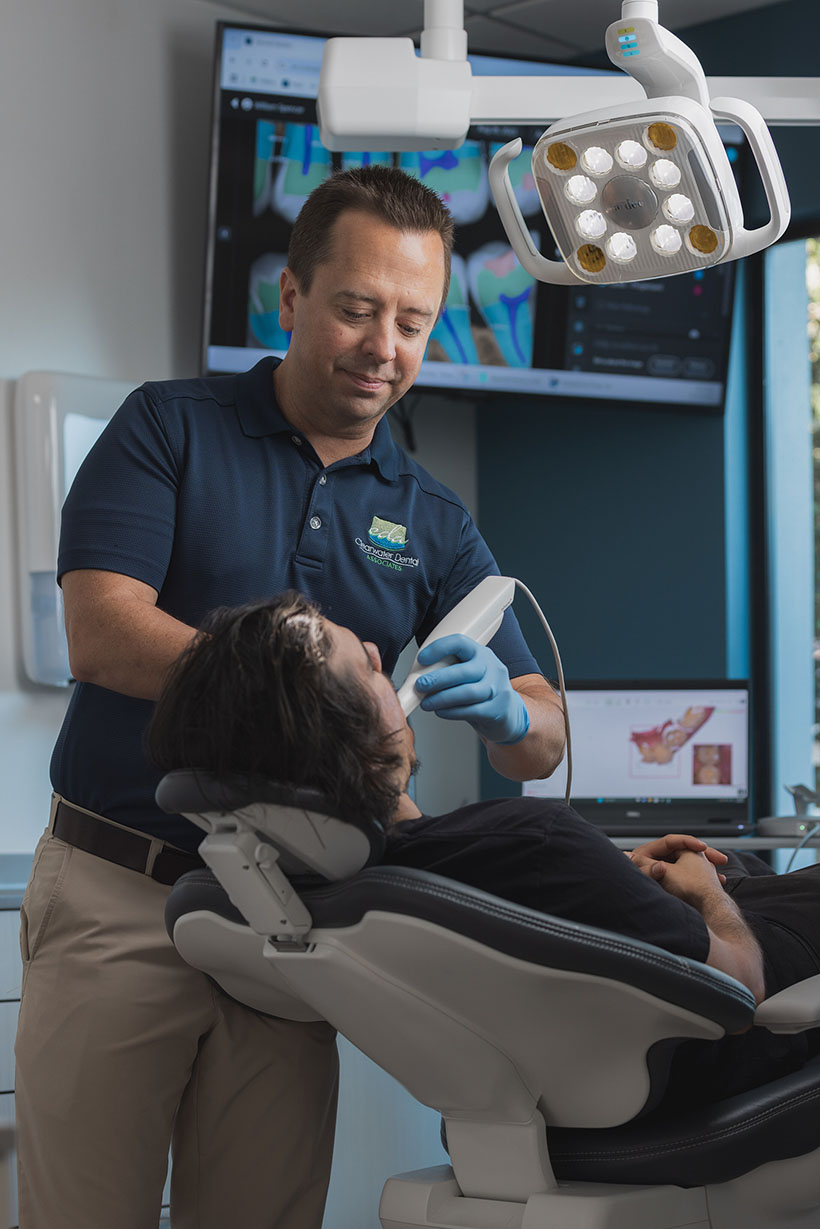
An X-ray — and Planmeca 3D cone beam imaging when needed — gives us a full view of the tooth structure, root, and surrounding bone.
We explain exactly what we found, what type of fracture it is, and what the options are. We give you the information you need to make a confident decision.
For straightforward cases, we can often place a temporary crown or filling the same day to protect the tooth while the permanent restoration is prepared.
Before you leave, we explain what to chew on, what to avoid, how to manage sensitivity, and when to contact us if something changes.
An early evaluation can help protect the tooth and preserve more treatment options before the crack progresses.
We are not a volume practice. Our dental office in Dunedin is built on the kind of care that takes time, where the dentist actually sits down with you, reviews your imaging, and explains exactly what is going on and what your options are.
Beyond providing dental care, we’re active members of the Dunedin FL community. We believe in giving back to the area we call home and supporting local organizations that make our community stronger.
Restoring a cracked tooth is not only about function. The appearance of your restored tooth matters too. When we place a crown or a filling, we match it to the color and shape of your natural teeth. When we discuss a veneer for a front tooth, we consider both structural protection and cosmetic outcome.
Once your oral health is restored, many patients also choose to continue with cosmetic dental care — professional teeth whitening, additional veneers, or a full smile review — to complete the picture. Restorative dentistry and cosmetic dentistry are not separate conversations at our Dunedin office; they are part of the same care plan.
If your cracked tooth is part of a larger picture — multiple damaged or missing teeth, significant decay, or bite problems — we will discuss full mouth reconstruction options during your consultation. Dental care at that level is built around a comprehensive, sequenced plan that prioritizes your long-term oral health and function.
Located at 1201 County Rd 1, Dunedin, FL 34698 | Monday through Friday appointments available
Clear answers to common questions about cracked tooth symptoms, treatment, recovery, emergencies, and insurance.
The most common signs are pain when biting or chewing, sensitivity to hot and cold that lingers longer than usual, and a dull ache that is hard to locate precisely. Some cracked teeth produce no symptoms at all until decay or infection sets in, which is one reason routine dental care and regular checkups matter. If something feels off, call our Dunedin dental office at 727-734-3321 and describe your symptoms. We will help you determine how quickly you should be seen.
No. Unlike bone, tooth enamel does not regenerate. A crack that exists today will not close or repair itself. At best, a hairline craze line in the outer enamel stays stable for years with no symptoms. At worst, a crack that is ignored deepens into the pulp, causing infection, and the tooth is eventually lost. Early dental care consistently leads to simpler, less expensive restorative treatment.
The treatment itself is not. Local anesthetic is used for any procedure that touches the nerve or requires drilling. The discomfort most patients experience is the tooth pain before treatment, not the treatment itself. For patients who experience dental anxiety, we offer sedation options that make the visit genuinely comfortable. Many patients tell us the appointment was much easier than they expected.
A well-placed dental crown typically lasts 10 to 15 years, and many last significantly longer with good dental care and regular checkups. Avoiding hard foods, not using teeth as tools, and wearing a night guard if you grind your teeth all extend the lifespan of a crown. Your dentist will review specific care instructions at your appointment.
Left untreated, a cracked tooth typically worsens. Bacteria enter through the crack and can reach the pulp, triggering infection. That infection can spread to surrounding bone and gum tissue. In advanced cases, the tooth may need to be extracted, and a dental implant or bridge becomes necessary to restore function and prevent surrounding teeth from shifting. Treating a crack early is almost always simpler and less costly than treating the consequences of waiting.
Yes. If you are in acute pain, have visible fracture damage, or notice swelling in the gum near a tooth, call us at 727-734-3321 and describe what you are experiencing. We will advise you on the level of urgency and get you scheduled as quickly as possible. Dental emergencies involving cracked teeth are something we take seriously — prompt treatment protects the tooth and prevents complications.
Most dental insurance plans cover restorative dental services such as crowns, fillings, and root canal treatment, though coverage percentages vary by plan. Cosmetic-only procedures like veneers are typically not covered. If you are unsure about your coverage, our front desk can help you understand your benefits before treatment begins. We also discuss payment options during your consultation so there are no surprises.
Our Dunedin dental team can evaluate the tooth, explain what we find, and help you understand the right next step.
Copyright © 2026