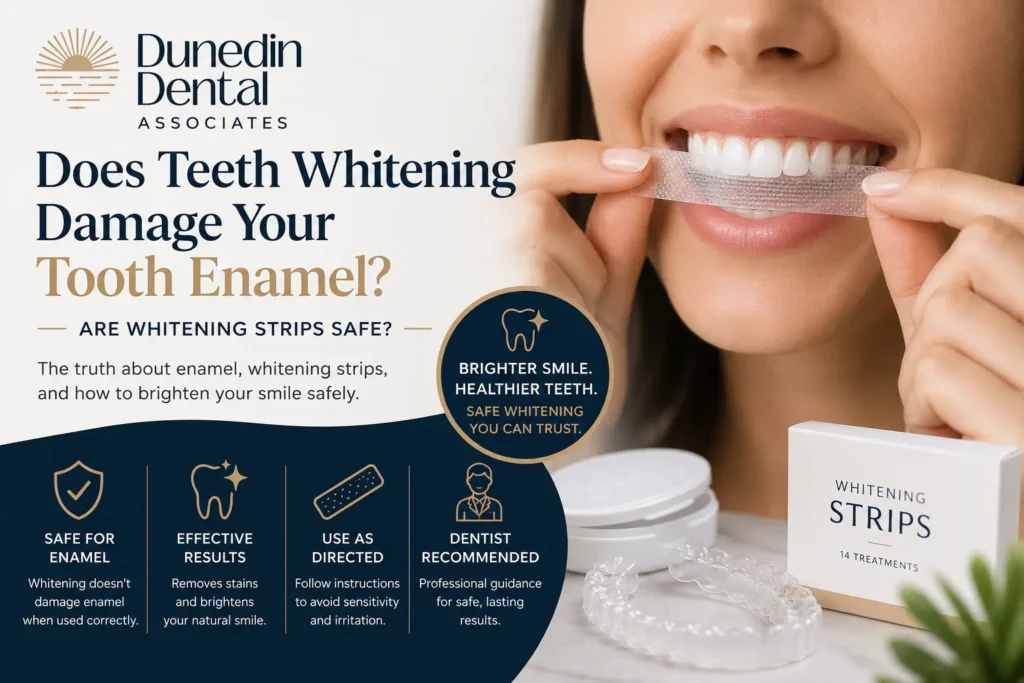
If you’ve ever hesitated before reaching for a box of whitening strips — or wondered whether a brighter smile might be coming at a hidden cost to your teeth — you’re asking exactly the right question. Teeth whitening damage is one of the most common concerns patients bring up at the dental chair, and the answer is more nuanced than the scary headlines suggest.
The short version: when used correctly, most tooth whitening methods are safe for healthy teeth. The longer version involves understanding what enamel actually is, how whitening products work, and when overuse becomes a genuine problem. Here’s what the science says, and what your dentist wants you to know before you whiten.
What Is Tooth Whitening and How Teeth Whitening Method Work?
Tooth whitening works by applying a bleaching agent — most commonly hydrogen peroxide or carbamide peroxide — to the surface of the tooth. The whitening agent penetrates the outer layer of the tooth and breaks up the molecular bonds that hold stain compounds together, allowing discoloration to be lifted from the tooth structure beneath.
Different whitening methods deliver this bleaching agent at different concentrations and for different lengths of time. Whitening strips use a relatively low concentration of hydrogen peroxide in a thin gel applied directly to the tooth surface. Whitening trays — both custom-fitted and over-the-counter — hold whitening gel against the teeth for a set period. Professional teeth whitening uses a higher-concentration bleaching agent administered by a dental professional in a controlled setting.
The enamel itself — the hard, mineralized outer layer of your teeth — is not dissolved or permanently altered by the whitening process when treatments are used as directed. What whitening does is change the color of the organic material within the enamel structure, not the structure itself.
Does Teeth Whitening Damage Enamel?
This is the question at the heart of the enamel and whitening debate, and the American Dental Association’s position is clear: professional whitening treatments and over-the-counter products that use hydrogen peroxide or carbamide peroxide are safe for tooth enamel when used correctly.
The outer layer of your teeth is composed largely of hydroxyapatite crystals — one of the hardest natural materials in the body. Research into the effects of teeth whitening on this mineralized structure consistently shows that hydrogen peroxide does not meaningfully erode or thin enamel at the concentrations used in standard whitening products.
Where the damage enamel concern becomes legitimate is with misuse. Overusing whitening products beyond their recommended frequency, using very high concentrations without dental supervision, or whitening over existing thin enamel or enamel that has already been weakened by erosion are all situations where cause damage is a real risk. The whitening solution itself isn’t the villain — the pattern of use is.
A Guide to Common Teeth Whitening Treatments: Strips, Trays, and Professional Options
Understanding the difference between whitening methods helps you choose the right one for your teeth and use it safely.
Whitening Strips
Whitening strips are thin, flexible strips coated in a peroxide-based whitening gel. They’re the most widely used at-home whitening product, and they’re generally safe for healthy teeth with intact enamel. Whitening strips are typically designed for daily use over a period of one to two weeks.
Are whitening strips safe? For most patients with healthy teeth and gums, yes. The key caveat is following the instructions exactly as written. Leaving strips on longer than directed, using them more frequently than recommended, or using them on teeth with existing sensitivity in your teeth from enamel wear will increase the likelihood of discomfort without meaningfully improving whitening results. Whitening strips are primarily effective at removing surface stains rather than dramatically changing the natural tooth color.
Whitening Trays
Whitening trays come in two forms: custom-fitted trays made by your dentist and over-the-counter trays. Custom whitening trays made from an impression of your own teeth fit precisely, which means the whitening gel stays where it should — on the tooth surface — and is less likely to come into contact with the gum tissue. Over-the-counter trays use a one-size-fits-all whitening design that doesn’t account for individual tooth anatomy, which can cause the gel to spread onto the gums and cause irritation.
A tray-based whitening treatment is generally effective and safe, but the custom tray option is meaningfully better for patients who want a more reliable result with less gum irritation.
Professional Teeth Whitening Treatment
Professional whitening treatments use a higher-concentration bleaching agent than any over-the-counter product, applied under controlled conditions by a dental professional. Because the concentration is higher, the whitening gel is applied for a shorter time and with protective barriers in place to protect your gums and surrounding tissue.
Professional options are the most effective whitening method for significant discoloration, and they’re administered by a dental professional who can assess whether your teeth and enamel are appropriate candidates before beginning. For patients with thin enamel, existing sensitivity, or significant dental work such as crowns or veneers, professional guidance is particularly important — because teeth naturally don’t respond to whitening agents the same way, and dental work won’t respond at all.
Potential Side Effects of Whitening Products
Being informed about the potential side effects of whitening doesn’t mean whitening is dangerous — it means you know what to watch for and when to stop.
Tooth sensitivity is the most common side effect associated with tooth whitening. The hydrogen peroxide in whitening products can temporarily increase sensitivity in your teeth by diffusing through the enamel and irritating the pulp inside the tooth. For most patients, this tooth sensitivity is mild and resolves within a day or two after treatment ends. Patients with pre-existing sensitivity may find it more noticeable.
Gum irritation is the second most common complaint, and it’s almost always related to the whitening product making contact with gum tissue. With whitening strips, this happens when the strip edge doesn’t align precisely with the gumline. With trays, it’s more common with over-the-counter designs that don’t fit the individual tooth anatomy. Proper application technique and custom-fitted trays both reduce gum irritation significantly.
Enamel erosion from overuse is a real but avoidable risk. Overusing whitening products — using strips more frequently than directed, or treating teeth back-to-back with multiple whitening cycles without rest periods — creates conditions where the enamel and gums don’t have time to remineralize and recover between treatments. This is where the sign of long-term damage becomes a concern: increased sensitivity, a translucent appearance at the tooth edges, or a chalky texture.
None of these effects are inevitable. They’re the result of misuse, not of whitening itself.
Baking Soda, Whitening Toothpaste, and Other Methods Worth Mentioning
Whitening toothpaste works differently from peroxide-based treatments. Most whitening toothpaste products remove surface stains through mild abrasives rather than through a bleaching agent — which means they’re effective at removing stains on the outer surface of the tooth rather than changing the intrinsic color of the tooth structure.
Baking soda is an ingredient in many whitening toothpastes, and it functions as a mild abrasive. Baking soda itself does not bleach teeth, but it does help remove stains on your teeth. The concern with any abrasive whitening method is that overuse over time can contribute to enamel erosion. Using baking soda-based products as directed — not as a daily replacement for regular toothpaste — keeps it in safe territory.
Charcoal, lemon juice, and oil pulling are also marketed as at-home whitening methods. None of these have evidence supporting their effectiveness for tooth whitening, and some carry real risks: acidic substances like lemon juice absolutely do cause enamel erosion with repeated use, and charcoal’s abrasiveness may damage the enamel layer over time.
Safe Teeth Whitening: How to Whiten Without Damaging Your Enamel
The principles of safe whitening aren’t complicated, but they do require attention to how you use the products you choose.
Follow the instructions. This is the single most important rule for at-home whitening. The manufacturer’s guidelines for wear time and frequency are calibrated to the concentration of hydrogen peroxide in the product. Exceeding them doesn’t deliver better whitening results — it just increases the risk of sensitivity and damage your enamel.
Don’t whiten over damaged enamel. If you’ve been told you have thin enamel, significant enamel erosion, or exposed root surfaces, at-home whitening is not the right starting point. Talk to your dentist first.
Space out treatment cycles. At-home whitening cycles should be followed by rest periods. Treat once per year, or as recommended by your dental professional. The teeth over time will maintain their whiteness more effectively — and more safely — with periodic maintenance rather than repeated intensive cycles.
Take sensitivity seriously as a warning signal. Mild sensitivity that clears up in 24 hours is a known and expected effect. Sensitivity that persists, increases, or is accompanied by other changes in tooth texture is a sign that the whitening treatment isn’t working safely for you, and is a reason to talk to your dentist before continuing.
Protect your gums. If using strips, apply them carefully to align with the gumline rather than overlapping onto gum tissue. If using trays, custom-fitted options from your dentist are substantially more protective than over-the-counter trays.
Manage stains from foods and drinks. The return of staining after whitening can be slowed by limiting red wine, coffee, and other heavily pigmented foods and drinks in the days following treatment — particularly during the re-staining window when the enamel is most porous. Following the recommended aftercare protocol after teeth whitening is an important part of making your whitening results last.
When Overuse Becomes a Problem
The concept of overusing whitening products deserves its own section because it’s where the real risks live. Healthy use of a whitening product looks like: one treatment cycle per year with a peroxide-based product used exactly as directed, combined with routine dental checkups to monitor enamel health.
Problematic use looks like: back-to-back whitening cycles, extending strip wear time, using multiple whitening methods simultaneously, or whitening as a frequent monthly habit to maintain color. Overusing whitening products is what turns a safe dental care tool into a source of damage the enamel — not the chemistry itself.
If you’ve been whitening frequently and are noticing increased tooth sensitivity, a translucent or chalky appearance at the tooth edges, or greater staining between treatments (a paradoxical sign that can indicate surface damage), those are reasons to stop and have your enamel evaluated before continuing.
Safe Whitening at Dunedin Dental Associates
At Dunedin Dental Associates, we offer professional teeth whitening as part of our cosmetic services — using a carefully administered professional whitening treatment designed for both safety and effectiveness.
Before any whitening treatment, we evaluate your dental health to confirm that your enamel and gums are appropriate for the whitening process. We’ll discuss the teeth whitening options that make sense for your situation, address any pre-existing sensitivity, and help you understand the safety and effectiveness of each approach — so you can brighten your smile without compromise.
If you’ve been using over-the-counter products and have questions about how they’re affecting your teeth, or if you want to understand whether professional options are a better fit, we’re glad to walk through it with you. The goal of at-home whitening and professional whitening alike is whiter teeth that stay healthy — and that starts with an honest conversation about where your teeth are now and what they can tolerate.
Schedule an appointment to discuss your whitening options with our team.
Frequently Asked Questions About Teeth Whitening and Enamel Safety
Q: Do whitening strips damage enamel permanently?
No — whitening strips used as directed do not cause permanent damage to enamel in healthy teeth. The peroxide in whitening strips temporarily increases sensitivity in some patients, but the enamel structure itself is not dissolved or permanently altered by standard over-the-counter concentrations. Permanent damage is a risk only with severe overuse or use on already compromised enamel.
Q: Is professional teeth whitening safer than whitening strips?
Professional teeth whitening is more controlled. Because it’s administered by a dental professional, it includes an assessment of whether your enamel is healthy enough for treatment, protective measures for your gums, and a concentration calibrated to your specific situation. It also produces more significant whitening results than strips. For patients with sensitivity, thin enamel, or dental work, the professional route is safer than unsupervised at-home whitening.
Q: How do I know if I have thin enamel before whitening?
Signs of thin enamel include increased sensitivity to hot and cold foods and drinks, a yellowish appearance to the teeth (the dentin beneath shows through more when enamel thins), and a translucent appearance at the tooth edges. Your dentist can evaluate enamel thickness and condition during a routine exam. If you’re uncertain, talk to your dentist before beginning any whitening treatment.
Q: Can whitening products remove all types of tooth staining?
Whitening products work well on surface stains caused by foods and drinks like coffee, tea, and red wine — as well as general yellowing from aging. They’re less effective on intrinsic staining (discoloration from within the tooth) caused by medications, trauma, or fluorosis. Tetracycline-related discoloration is particularly resistant to whitening. A dentist can tell you which type of staining you have and what results are realistic.
Q: How often can I safely whiten my teeth?
Most dental professionals recommend whitening no more than once per year for most patients, with individual variation based on enamel health and the whitening method used. At-home whitening strips used for their full recommended cycle once per year, combined with regular dental checkups to monitor enamel health, is a sustainable and safe approach for most healthy adults.
Q: Does baking soda in toothpaste damage enamel?
Baking soda is a mild abrasive and is considered safe in whitening toothpaste formulations at normal use levels. It’s significantly less abrasive than many other toothpaste ingredients. Using baking soda-based whitening toothpaste as your daily toothpaste is generally fine — the risk of enamel erosion arises when abrasive products are used excessively or in place of standard dental care rather than alongside it.