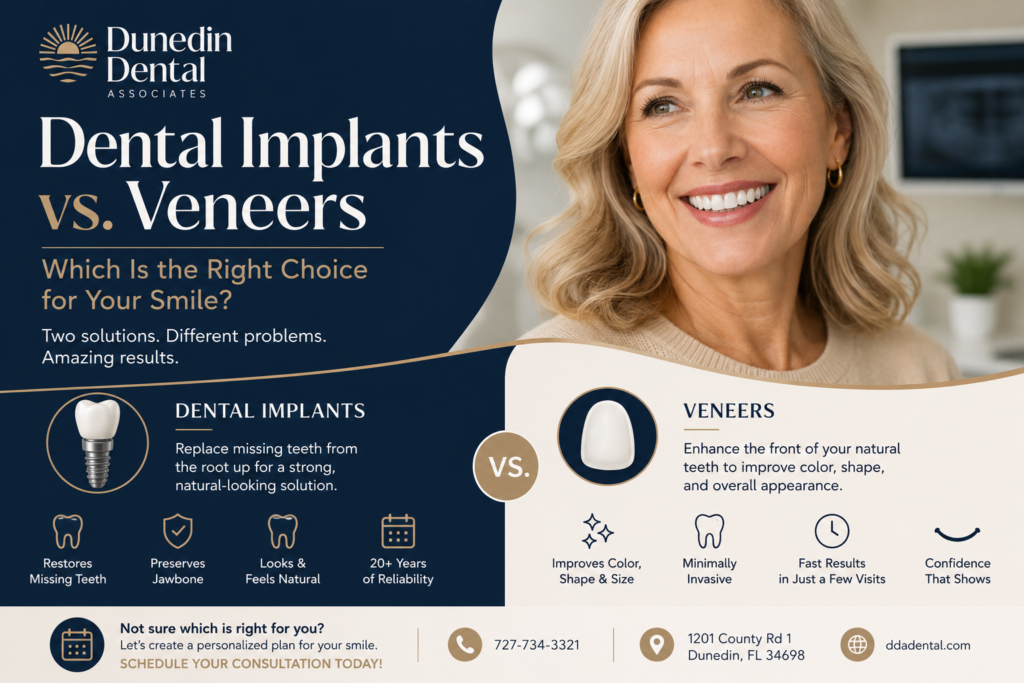
You have done the research. You have looked at before-and-after photos. You know you want a better smile — you just do not know whether you need an implant or a veneer, and the difference between the two is not as obvious as it might seem. Dental implants vs. veneers is one of the most common questions patients bring to their first consultation, and it is a reasonable one. Both dental procedures can produce a dramatic transformation. Both involve a custom restoration matched to your natural teeth. But they solve completely different problems, and choosing the wrong one for your situation can cost you time, money, and the result you actually wanted.
This guide gives you the honest breakdown — what dental implants do, what veneers do, where they overlap, how they differ on cost and longevity, and exactly which situations call for one versus the other. By the end, you will know whether to book an implant consultation or a veneer consultation — and what to ask when you get there.
Understanding Dental Implants — What They Are and How They Work
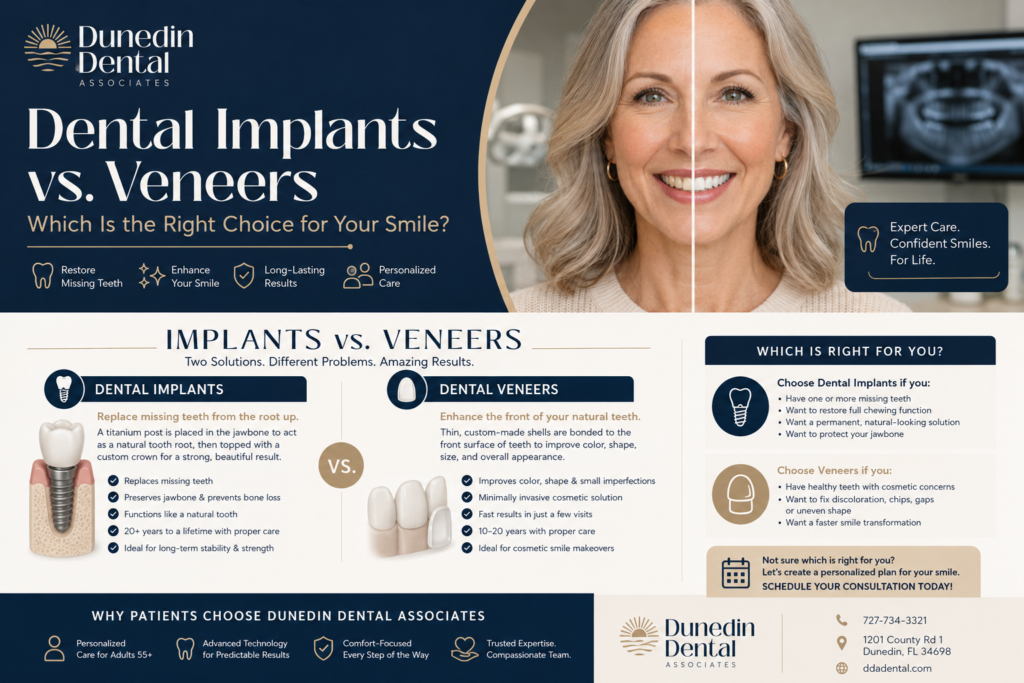
A dental implant is an artificial tooth root. Dental implants are titanium posts — small, precisely shaped screws — that are placed directly into the jawbone during a dental implant surgery. Once the titanium fuses with the surrounding bone through a biological process called osseointegration, the implant becomes a fixed, stable anchor. A custom crown is then attached on top, completing the restoration.
Dental implants are designed to replace missing teeth entirely. They replace the complete structure of a natural tooth — from the root below the gum line to the visible crown above it. This is the fundamental difference between implants and veneers: dental implants replace a tooth that is no longer there, while a veneer enhances a tooth that is.
Dental implants function like natural teeth in every practical way. You bite, chew, and speak normally. You brush and floss normally. Dental implants also help protect the jaw bone — implants stimulate the jawbone through the normal forces of chewing, which prevents the bone loss that begins almost immediately after a tooth goes missing. That bone preservation effect is something no other dental procedure can match.
Dental implants are typically recommended when one or more teeth are missing, when a tooth needs to be extracted, or when existing replacement options like dentures are no longer fitting properly. Dental implants are also available as a full-arch solution through implant-supported prosthetics for patients who have experienced extensive tooth loss.
Getting Dental Implants — The Dental Implant Process
Getting dental implants is a staged process. The dental implant process typically unfolds over 3 to 9 months, depending on whether preparatory work like bone grafting is needed. Here is how it progresses:
- Consultation and 3D imaging — Your dentist takes CBCT scans to map your jaw bone density and position. A treatment plan is created before anything clinical begins.
- Preparation if needed — If bone loss has occurred, bone grafting rebuilds the jaw foundation before implant placement. If a tooth needs extracting, that happens here.
- Dental implant surgery — The titanium post is placed directly into the jawbone under local anesthetic. Dental implant surgery is more straightforward than most patients expect — comparable to a tooth extraction in terms of post-op experience.
- Osseointegration — Over the next 2 to 6 months, the jaw bone fuses to the implant. This is passive healing time with minimal appointments.
- Crown placement — Once osseointegration is confirmed, a custom crown is attached. The implant is complete and functions like a natural tooth from this point forward.
| What Recovery from a Dental Implant Feels Like Most patients experience mild soreness and minor swelling for 2 to 3 days after the placement procedure. Standard over-the-counter pain relief is typically sufficient. Soft foods for a few days, and then back to normal eating as healing continues. The total dental implant process is measured in months, not days — but the large majority of that time is passive osseointegration. Active appointments are spaced out. Patients are not in the chair throughout the process. |
Understanding Dental Veneers — What They Are and What They Do
Dental veneers are thin shells made of porcelain or composite resin that are bonded to the front surface of your teeth. Veneers are thin — typically 0.5 to 1 millimeter — and they are designed to cover cosmetic imperfections on teeth that are structurally sound. A veneer sits on the front surface of your teeth, changing what the tooth looks like without replacing it.
Veneers are primarily used in cosmetic dentistry to address: discoloration that does not respond to whitening, minor chips and cracks, gaps between teeth, slightly uneven or misshapen teeth, and teeth that appear too small or short. Veneers can improve the overall uniformity of a smile quickly — when a patient has existing teeth with these kinds of cosmetic issues, veneers provide a fast, high-impact result.
Veneers are ideal for patients who have teeth that are intact and healthy but want to change how they look. A veneer does not address the underlying structure of a tooth, and it cannot replace missing teeth. What a veneer can do is change the entire visual presentation of a smile — color, shape, spacing, and symmetry — in a way that looks completely natural.
Porcelain Veneers vs. Composite Resin Veneers
Porcelain or composite resin — that is the primary choice when it comes to veneer material. Porcelain veneers are highly resistant to staining and they reflect light the way natural tooth enamel does, which makes them the most aesthetically natural option. Porcelain veneers typically last 15 to 20 years with proper care. Composite resin veneers are less expensive, require less enamel removal, and can be applied in a single appointment — but they are less durable and more prone to staining than porcelain over time. For patients who want the most natural-looking long-term result, porcelain veneers are the standard recommendation.
Applying Veneers — What the Veneer Process Looks Like
Applying veneers is far less invasive than getting dental implants, and the timeline is considerably shorter. Here is what the veneer process typically involves:
- Consultation — Your dentist evaluates your existing teeth and confirms that veneers are appropriate for your specific dental needs and goals.
- Enamel preparation — A thin layer of enamel is removed from the front surface of your teeth to make room for the veneers. This step is permanent — it is what makes the veneer procedure irreversible. The amount of enamel removed is minimal, but it cannot be restored.
- Impressions — Your dentist takes impressions or digital scans of the prepared teeth, which are sent to a dental lab to fabricate the custom veneers.
- Temporary veneers — Temporaries are placed while the permanent veneers are being made, which takes 1 to 2 weeks.
- Bonding — The permanent veneers are bonded to the front surface of your teeth. Once set, veneers are bonded firmly and function like a part of the tooth.
| What Veneer Preparation Actually Involves Veneers require the removal of a small amount of tooth enamel to make room for the veneer shell. This is necessary so that the final restoration does not look or feel bulky. The enamel removal is minimal — about the thickness of a contact lens — but the point stands: it is irreversible. Because of this, veneers are not the right choice for patients with weakened or heavily damaged teeth. Veneers are applied to teeth with adequate, healthy enamel. Your dentist will assess this during your consultation. |
Dental Implants vs. Veneers — Key Differences at a Glance
The key differences between dental implants and veneers come down to one central distinction: implants replace missing teeth, veneers enhance existing ones. Understanding that distinction resolves most of the confusion around implants vs veneers immediately. But beyond that core difference, there are several other factors that matter for long-term outcomes, cost, and suitability.
| Feature | Dental Implants | Veneers |
| Purpose | Replace missing teeth — full tooth root + crown | Enhance appearance of existing teeth — cosmetic overlay only |
| Procedure Type | Surgical — implant post placed into jawbone | Minimally invasive — thin shells bonded to front surface of teeth |
| Best For | Missing teeth, structural tooth loss, bone health | Discoloration, chips, gaps, mild misalignment on intact teeth |
| Longevity | Implants can last a lifetime with proper care | Veneers typically last 10–20 years before replacement needed |
| Preserves Bone | Yes — implants stimulate the jawbone to prevent bone loss | No — no root stimulation, bone loss continues if tooth is absent |
| Affects Adjacent Teeth | No modification needed | Adjacent teeth untouched; enamel prep on treated teeth only |
| Reversibility | Permanent — but implant can be removed if needed | Irreversible — enamel removed during prep cannot be restored |
| Natural Teeth Required | No — replaces missing teeth entirely | Yes — veneers are applied to existing teeth that are still present |
| Maintenance | Brush, floss, dental check-ups — same as natural teeth | Same daily care, avoid hard biting on veneer edges |
| Cost Range | $3,000–$5,000 per tooth | $900–$2,500 per veneer |
| Covered by Insurance | Partial coverage in some plans | Usually not covered — considered cosmetic |
| Addresses Missing Teeth | Yes — the primary purpose | No — veneers cannot replace missing teeth |
Veneers vs. Dental Implants — Cost, Insurance, and Long-Term Value
Implants are typically more expensive upfront than veneers. A single dental implant typically runs between $3,000 and $5,000 when the implant post, abutment, and crown are included. Dental implants are typically covered partially by some dental insurance plans — particularly the crown and any extraction or bone grafting involved — though the implant post itself is often not covered by dental insurance.
Veneers range from $900 to $2,500 per veneer. Most patients need 6 to 10 veneers for a full smile transformation, which can bring the total cost to $10,000–$25,000 for a full set. Veneers are typically not covered by dental insurance because they are considered a cosmetic dental procedure rather than a restorative one.
Veneers typically need to be replaced every 10 to 20 years — and each replacement involves re-preparing the tooth surface again. Implants can last a lifetime with proper dental care. Over a 25-year horizon, the cost comparison between the two treatment types depends heavily on how many units are involved and which approach avoids repeat replacement costs.
The best advice is to ask your dentist to walk through both short-term and long-term cost scenarios based on your specific dental health needs and the number of teeth involved. Third-party financing options are widely available for both dental procedures and can make either option more manageable monthly.
Can You Get Both? Veneers and Implants on the Same Patient
This is one of the most common questions patients have — and one that no competitor page currently answers. The short answer: yes, veneers and implants can absolutely be used together, and combining them is more common than people realize.
Consider a patient who has one or two missing teeth alongside cosmetic issues — discoloration, minor chips, uneven spacing — on the remaining teeth. Dental implants replace the missing teeth, and veneers enhance the existing teeth to create a unified, natural-looking smile across the whole mouth. The crown on the implant is color-matched to the veneers, and the entire result looks cohesive and intentional.
When veneers and implants are being combined, the sequencing matters. Dental implants are typically placed and fully healed first, since the implant crown will be matched to the final veneer shade. Applying veneers before the implant crown is placed allows the dentist to match the crown precisely to the veneers. Your dentist will plan the treatment sequence based on your specific dental needs.
Dental implants and veneers are complementary dental procedures in the right context — not competing ones. If you have a mix of missing teeth and cosmetic concerns on existing teeth, the best answer is often both.
Dental Implants or Veneers — How to Know Which One You Need
Choosing between dental implants and veneers depends on your specific dental needs, not on which treatment sounds more appealing. The choice usually becomes clear once you understand what each one actually addresses.
| Choose Dental Implants if: You have one or more missing teeth that need to be replaced A tooth has been lost to decay, injury, or extraction You currently wear a denture or bridge and want a permanent solution You want to prevent bone loss and maintain your jaw structure long-term You are considering dental implants to replace teeth on one or both arches |
| Choose Veneers if: Your teeth are structurally intact but you want to change how they look You have persistent discoloration, staining, chips, gaps, or irregular shape You want a faster cosmetic transformation without surgical recovery Veneers are ideal for patients whose dental health is sound and whose primary goal is aesthetic improvement |
| Consider Both if: You have missing teeth alongside cosmetic concerns on remaining teeth You want a comprehensive smile transformation that addresses both restoration and appearance together Dental implants and veneers can be planned as a coordinated treatment — your dentist will sequence them correctly |
Considering dental implants or veneers? The clearest next step is a consultation with a dentist who does both, so you receive an honest evaluation of your specific situation rather than a recommendation toward whichever one the practice specializes in exclusively. The right answer depends on your existing teeth, your dental health, your aesthetic goals, and your budget — and all of those are individual.
Frequently Asked Questions — Dental Implants vs. Veneers
These are the questions that come up most consistently in patient consultations. Straightforward answers, no padding.
Can veneers replace missing teeth?
No. Veneers are applied to existing teeth — they require a tooth to be present. Veneers cannot replace missing teeth. If you have a gap where a tooth once was, the only restorative options that fill that gap are dental implants, a bridge, or a denture. Veneers are purely cosmetic dental restorations for teeth that are already there.
Do veneers hurt?
The veneer procedure itself is done under local anesthetic, so there is no pain during the process. After the enamel preparation, some patients experience temporary sensitivity to temperature for a few days — this is common and resolves on its own. Once the permanent veneers are bonded, most patients find them indistinguishable from their natural teeth in terms of feel.
How long do veneers last compared to implants?
Veneers are durable but not permanent. Porcelain veneers typically last 15 to 20 years before needing replacement; composite resin veneers may need replacing sooner, around 7 to 10 years. Veneers may need multiple replacements over a lifetime. Dental implants, by contrast, implants can last a lifetime with proper care — the titanium post itself has no natural expiration point, and only the crown may eventually need attention after many years.
Are veneers reversible?
No. Because applying veneers requires removing a thin layer of enamel to make room for the veneer shell, the procedure is irreversible. The teeth will always require some form of restoration after this step. This is a key consideration when deciding between veneers and other cosmetic options. Composite resin veneers are less invasive and can be placed with minimal or no enamel removal in some cases, making them the less permanent option.
Can veneers be placed on implant crowns?
In most cases, no — and there is no need to. The crown placed on a dental implant is already custom-made to the shape, shade, and size desired, so it functions the way a veneer would on a natural tooth. If you are combining both treatments on different teeth, your dentist will color-match the implant crown to the veneers for a seamless result.
Which is better for a full smile transformation — implants or veneers?
It depends on your specific dental needs and goals. If you have mostly intact teeth with cosmetic concerns, veneers provide a full-smile transformation efficiently. If you have missing teeth, implants must be part of the plan. Many patients with a combination of both issues benefit from a coordinated plan using dental implants and veneers together. The right answer comes from a proper clinical evaluation — not a general preference for one dental procedure over another.
Dental Implants and Veneers at Dunedin Dental Associates in Dunedin Fl.
At Dunedin Dental Associates, we offer both dental implants and porcelain veneers under one roof — which means you receive an honest recommendation based on what your teeth actually need, not on which service a specialist happens to offer. Dr. Matthew R. Burton has placed so many implants and personally designed veneer cases for patients across Dunedin, Florida and the surrounding Tampa Bay area.
We take time in every consultation to walk you through your dental health, your cosmetic goals, and how they interact. If implants are the right path, we handle the entire dental implant process in-house. If veneers are the right choice, we work with a dental lab that delivers consistently natural-looking porcelain results. And if your specific dental needs call for both — a combination of implants on missing teeth and veneers on existing ones — we plan the full treatment so the final result looks like it was designed together, because it was.
We work with most major dental insurance plans and offer financing options so cost does not stand between you and the smile you want. Scheduling a consultation costs nothing and commits you to nothing — it gives you a clear, clinical picture of your options and what the path forward looks like.
| Schedule Your Free Consultation — Implants, Veneers, or Both Call: 727-734-3321 | Hours: [Mon–Thu 8am–5pm] Dunedin Dental Associates • 1201 County Rd 1, Dunedin, FL 34698 • ddadental.com |