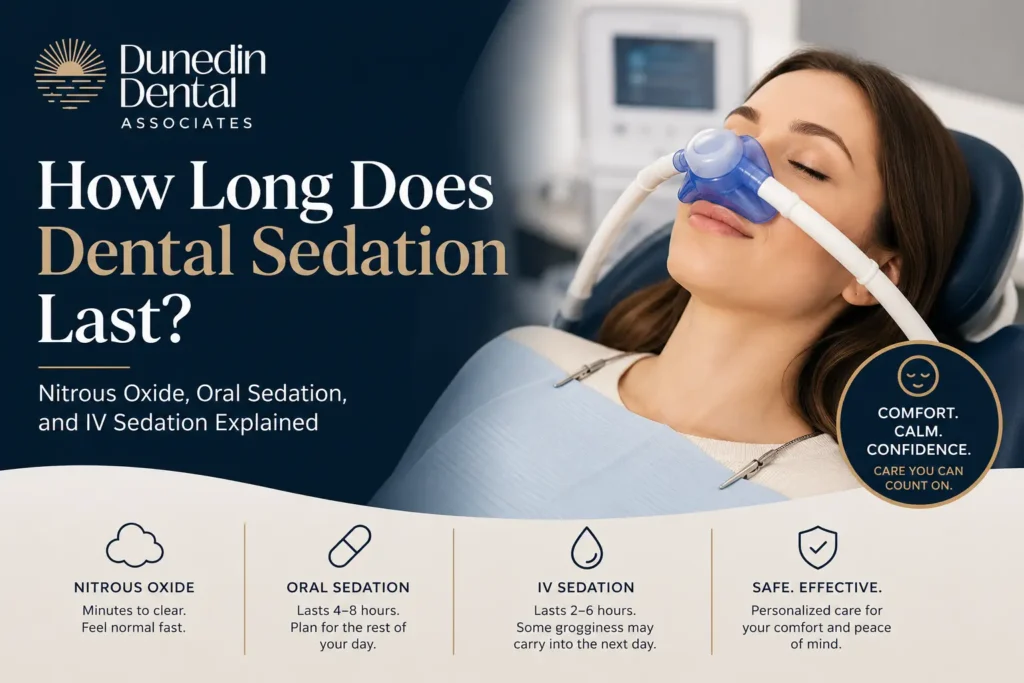
One question patients almost always ask before a sedation appointment is simple but important: how long does dental sedation last, and when will I feel like myself again? The answer isn’t one-size-fits-all — it depends entirely on which type of sedation your dentist uses, and the differences between options are more significant than most people realize.
Nitrous oxide clears your system within minutes. Oral sedation can leave you feeling drowsy well into the evening. IV sedation typically resolves within a few hours, though some effects may carry into the next morning. Knowing what to expect from each option helps you plan your day, arrange a ride, and walk into your appointment with realistic expectations.
This guide covers how long each type of dental sedation lasts, what shapes your personal recovery timeline, and what to expect as the sedation wears off.
What Is Sedation Dentistry?
Sedation dentistry uses carefully selected medications to help patients feel calm and comfortable during dental treatment. It’s commonly used for:
- Patients experiencing dental anxiety or dental fear
- Complex or lengthy dental procedures
- Patients with a sensitive gag reflex
- Anyone who finds it difficult to stay relaxed or still during treatment
Sedation dentistry is not the same as general anesthesia. In most cases, patients remain in a conscious or semi-conscious state throughout — relaxed, at ease, and largely free from anxiety, while still breathing independently and able to respond when spoken to.
Different sedation types work through different mechanisms, enter the bloodstream at different rates, and leave the body on very different timescales. That’s why there’s no single answer to how long dental sedation lasts — the range spans from a matter of minutes to nearly a full day, depending on which option is used.
Types of Dental Sedation
Understanding the main sedation options makes recovery expectations much clearer. The right type of sedation for any given patient depends on the procedure being performed, the patient’s level of dental anxiety, their medical history, and their dentist’s clinical judgment.
The four primary types used in modern dental sedation are:
- Nitrous oxide — inhaled through a nasal mask; the lightest form of sedation available
- Oral sedation — taken as a pill or liquid before the appointment; delivers moderate relaxation
- IV sedation (intravenous sedation) — administered directly into a vein for deeper, precisely controlled sedation
- General anesthesia — induces full unconsciousness; reserved for specific surgical or complex cases
Each method involves a different delivery route, a different sedation depth, and a different recovery profile.
How Long Does Nitrous Oxide Last?
Nitrous oxide — widely known as laughing gas — is the gentlest sedation option available and the fastest to clear. Delivered through a small nasal mask worn throughout the procedure, nitrous oxide typically begins working within two to five minutes of inhalation.
During treatment, patients experience a calm, warm, mildly euphoric feeling. Awareness remains intact — patients are fully conscious and can respond to their dentist — but anxiety fades noticeably, and many patients feel a mild tingling in their hands and feet.
So how long does nitrous oxide sedation last? Because the gas is delivered continuously during treatment and then switched off at the end, the effects dissipate quickly. Most patients feel the sedation wearing off within five to fifteen minutes after the mask is removed. Pure oxygen is given at the end of the appointment to flush any remaining gas from the lungs, which helps speed clearance.
The majority of patients feel completely back to normal within fifteen to thirty minutes. Unlike oral or IV sedation, nitrous and oral sedation with nitrous alone typically does not impair the ability to drive afterward — though you should always confirm this with your dentist before assuming you’re clear to get behind the wheel.
Nitrous oxide has the most convenient recovery profile of any sedation option, making it a popular choice for routine procedures and patients with mild anxiety.
How Long Does Oral Sedation Last?
Oral sedation involves taking a prescribed sedative — usually a benzodiazepine such as triazolam or midazolam — as a pill or liquid roughly one to two hours before the appointment, so the medication is active by the time treatment begins.
Oral conscious sedation produces a moderate level of sedation. Patients stay conscious and can follow simple instructions, but feel deeply relaxed and often have little or no memory of the procedure afterward. That amnesic effect is something most patients consider a benefit — they come through the appointment with the work done and no clear recollection of it.
How long does oral sedation last? Effects typically persist for four to eight hours, though this varies depending on the specific drug used, the dose, and the patient’s individual metabolism. Some patients feel groggy well into the evening after a morning appointment. Those who metabolize medication more slowly — including many older adults — may find effects lasting even longer.
Because of how oral sedation affects alertness, patients cannot drive themselves to or from the appointment under any circumstances. A trusted adult must accompany you, take you home, and remain available while the sedation clears.
Plan for oral sedation to affect your entire day, and possibly part of the morning after, particularly following a higher dose or a longer procedure.
How Long Does IV Sedation Last?
IV sedation is delivered directly into a vein, which means the sedative takes effect almost immediately and allows the dentist to adjust the sedation level in real time throughout the procedure. It’s used for more complex dental work, extended appointments, and patients whose dental fear isn’t adequately managed by oral sedation alone.
IV sedation can be calibrated to range from moderate conscious sedation — deeply relaxed but still responsive — to deep sedation near the edge of unconsciousness. The depth of sedation affects how long it takes to wear off.
How long does IV sedation last? Most patients begin to regain awareness within one to two hours after the IV line is removed. However, effects commonly continue for several hours beyond that point. Drowsiness, mild disorientation, and reduced coordination are normal for four to eight hours after IV sedation.
Comparing IV sedation versus oral sedation on recovery time: both typically clear within a similar four-to-eight-hour window, but IV sedation tends to follow a more predictable timeline because the dose is actively managed. Oral sedation recovery varies more widely because it depends on how each individual absorbs and metabolizes the medication.
A responsible adult must drive you home after IV sedation. Patients should avoid operating a vehicle, signing legal documents, or making important decisions for the rest of the day. Nausea is a common post-sedation side effect — eating lightly beforehand (following your dentist’s specific fasting guidance) and keeping clear fluids on hand at home can help.
Sleep Dentistry: What Does It Actually Mean?
Sleep dentistry is a term sometimes used — particularly by patients — to describe oral sedation or IV sedation, because the experience often feels like sleeping through the procedure even when the patient is technically conscious. It is not the same as general anesthesia, though the two terms sometimes get used interchangeably.
General anesthesia produces complete unconsciousness and requires an anesthesiologist and a higher level of medical monitoring. It’s used for specific oral surgery cases, full-mouth rehabilitation, or patients for whom conscious sedation isn’t appropriate. Recovery from general anesthesia takes longer than from IV sedation and can extend into the day following the procedure.
If you encounter the term sleep dentistry at a dental office, ask specifically which type of sedation is being offered and how it’s administered. Understanding the actual sedation method is the only reliable way to know what to expect afterward.
What Affects How Long Sedation Takes to Wear Off?
Individual factors play a meaningful role in how quickly sedation clears. Two patients receiving the same sedation type and dose can have noticeably different recovery timelines based on:
- Metabolism and body weight — sedation drugs are processed by the liver and cleared through the kidneys; faster metabolisms generally mean faster clearance
- Age — older adults tend to metabolize sedative medications more slowly, which can extend recovery beyond what a younger patient would experience
- Liver and kidney function — organ health directly impacts how efficiently the body clears sedation drugs
- Dose administered — a higher dose required for deeper sedation or a longer procedure takes more time to fully leave the system
- The specific sedation drug used — different drugs have different half-lives; triazolam, for example, clears faster than diazepam
- Alcohol consumption — alcohol intensifies sedation effects and significantly extends recovery; patients are advised to avoid alcohol for at least 24 hours before and after sedation
- Other medications — certain drugs interact with sedatives and can prolong their effects, which is why a thorough medication review before any sedation appointment is essential
These variables are exactly why your dentist reviews your full medical history before recommending a sedation approach — matching the right type and dose to your individual profile is central to both safety and a smooth recovery.
What Recovery Looks Like After Each Sedation Type
After nitrous oxide: Most patients feel completely back to normal within fifteen to thirty minutes. There’s minimal disruption to the rest of the day. Driving is typically permitted once the effects have fully cleared — confirm with your dentist beforehand.
After oral sedation: Expect drowsiness for most of the day. Effects commonly last four to eight hours, with some patients experiencing residual grogginess into the evening. Rest at home, avoid driving, and keep a trusted adult available. Nausea is possible. Staying hydrated helps the body process the medication.
After IV sedation: Alertness begins returning within one to two hours after the IV is removed, but full clarity takes longer. Most patients feel tired and mildly foggy for the remainder of the day. Nausea is common in the first few hours. Rest at home, avoid alcohol, and don’t drive or make significant decisions until the following day.
After general anesthesia: Recovery extends further, often into the next day. Nausea, fatigue, emotional sensitivity, and some confusion are more common. Arrange for rest and assistance at home in advance.
Your dentist will provide post-sedation care instructions specific to the drugs used, the dose, and your procedure. Follow those instructions — they’re not generic recommendations.
Planning Your Day Around a Sedation Appointment
For nitrous oxide:
- No fasting typically required (confirm with your dentist)
- Driving usually permitted after effects clear
- No special arrangements generally needed
For oral or IV sedation:
- Arrange a responsible adult to drive you both ways
- Plan to spend the rest of the day resting at home
- Avoid alcohol for at least 24 hours before and after
- Follow fasting instructions from your dentist
- Have clear fluids, soft foods, and any prescribed medications ready at home
- Avoid signing documents, making financial decisions, or caring for children alone until fully alert
For general anesthesia:
- All of the above apply
- Plan for recovery to extend into the following day
- Arrange childcare or home support in advance
Is Dental Sedation Safe?
For most healthy adults, dental sedation is a safe and well-managed component of modern dental care. Sedation is administered under active monitoring, with emergency protocols in place and dosing calibrated to each patient’s medical profile and the nature of the procedure.
Certain medical conditions — including cardiovascular disease, sleep apnea, respiratory issues, and specific drug sensitivities — affect which sedation option is appropriate and the level of monitoring required. Understanding the risks and side effects of sedation dentistry before your appointment helps you make an informed decision alongside your dental team.
Pediatric sedation follows different protocols and requires specialized expertise. If you’re considering sedation dentistry for a child, discuss the specific safety considerations with your dentist in detail before scheduling.
Frequently Asked Questions: How Long Does Dental Sedation Last?
How long does dental sedation last overall?
It varies by type. Nitrous oxide wears off within minutes. Oral sedation effects last four to eight hours. IV sedation effects typically continue for several hours after the procedure. General anesthesia can affect patients into the following day.
Can I drive after dental sedation?
Only after nitrous oxide — and only once effects have fully cleared, which usually takes fifteen to thirty minutes. Driving is not permitted after oral sedation, IV sedation, or general anesthesia. A responsible adult must take you home for any sedation other than nitrous oxide.
Will I remember my dental procedure after sedation?
With oral and IV sedation, most patients have little or no memory of the procedure due to the amnesic properties of benzodiazepine-based drugs. Nitrous oxide patients typically remember the appointment. General anesthesia produces no memory of the time under.
How long does it take for oral sedation to start working?
Oral sedation typically begins taking effect thirty to sixty minutes after the pill or liquid is taken. Your dentist will tell you exactly when to take the medication so the timing lines up with your appointment.
When will I feel completely normal after sedation?
After nitrous oxide: within thirty minutes. After oral sedation: most patients feel close to normal within six to eight hours, with some residual tiredness into the evening. After IV sedation: similar to oral sedation, with most patients feeling substantially recovered by the following morning. Give yourself more time rather than less.
What should I eat after dental sedation?
Start with clear fluids and soft, easy-to-digest foods — especially after oral or IV sedation where nausea is a common side effect. Avoid alcohol, which interacts with residual sedative medication still in your system. Your dentist will provide specific dietary guidance based on any treatment performed during the appointment.