You reach for your morning hot coffee and wince the moment it touches your teeth. Or maybe it’s the opposite — ice water or a cold drink sends a sharp jolt through your jaw. Either way, tooth sensitivity is hard to ignore. But here’s what most people don’t realize: sensitivity to hot and sensitivity to cold are not the same thing, and the difference between hot and cold tooth sensitivity can tell you a lot about what’s happening inside your mouth.
Understanding what’s behind sensitivity, and which temperatures trigger it — is the first step toward getting real, lasting relief. This guide breaks down hot and cold tooth sensitivity in plain language: what causes each one, how they differ, and what to do about them.
What Is Tooth Sensitivity and Why Do Teeth Feel Sensitive?
Tooth sensitivity, known clinically as dentin hypersensitivity, is a sharp pain or discomfort that occurs when your teeth are exposed to certain triggers. Sensitivity is often caused by temperature specifically hot or cold foods and drinks — but it can also be triggered by sweet, acidic, or even cold air.
At the core of every tooth, beneath the hard outer enamel, is a layer called dentin — a softer tissue filled with microscopic fluid-filled channels called dentinal tubules. Inside the tooth, even deeper, sits the tooth pulp: soft connective tissue containing the nerve endings that register pain. The layer of tooth enamel is what normally insulates those inner layers from the outside world.
When tooth enamel wears away or gums recede and expose the root surface, those sensitive layers lose their protection. Heat or cold can travel through the dentinal tubules directly to the nerve, and that’s exactly what causes the sensitivity you feel. Sensitive teeth are remarkably common — and most of the time, highly treatable once you identify what’s driving the problem.
What Are the Main Triggers for Tooth Sensitivity?
Understanding the triggers for tooth sensitivity helps you figure out what your teeth are reacting to and why. While hot and cold are the most common, sensitivity is often caused by more than one trigger at once.
Temperature triggers are the most recognizable. Cold food and drinks, ice water, hot coffee, and hot foods and drinks are the everyday culprits that most patients report first. When teeth are sensitive, even breathing cold air on a winter morning can set off tooth pain.
Acidic and sugary foods can also expose sensitive dentin and lead to tooth decay over time. The acid in sodas, citrus, wine, and vinegar-based foods gradually wears away enamel — and once that protective layer is gone, sensitivity is often what follows.
Pressure and brushing can be triggers too, especially when gum recession or a cracked tooth is involved. If your teeth feel sensitive to both touch and temperature, that pattern narrows down the potential causes significantly.
The key diagnostic question isn’t just “do my teeth hurt” — it’s “what sets it off, and how long does the pain last?” That answer is what separates cold sensitivity from hot sensitivity, and minor dentin exposure from a serious dental problem.
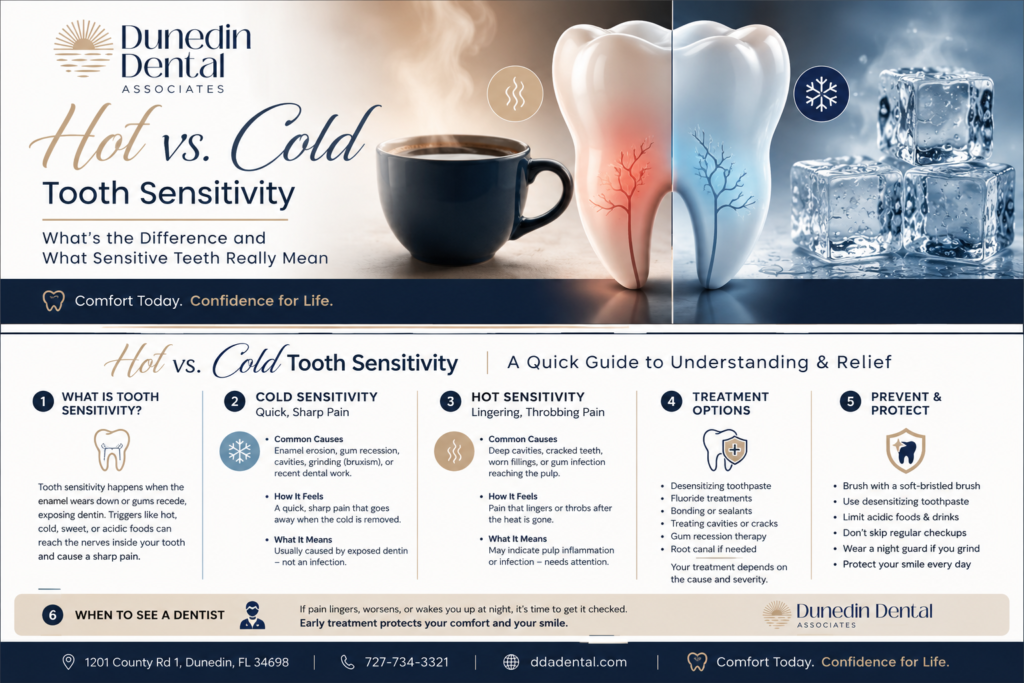
Cold Sensitivity: When Your Tooth Sensitive to Hot and Cold Temperatures
Cold sensitivity is the most common form of dentin hypersensitivity. When a tooth is sensitive to cold — ice water, cold drinks, cold food, or even cool air hitting the teeth — it typically means the outer protective layer has worn down enough to expose the tubules, but the inner pulp is usually still intact and healthy.
What Causes Cold Sensitivity?
Tooth enamel erosion. Acidic foods and drinks gradually wear down the surface of the tooth. Once the enamel thins, the dentin underneath becomes reactive to cold temperatures. This type of sensitivity is often caused by diet habits that expose the tooth surface to repeated acid contact.
Gingival recession. When gums pull back, they expose the root surface below the enamel line. Unlike the crown of the tooth, the root has no enamel covering — making it highly sensitive to cold stimuli. Cold food and drinks hitting an exposed root produce that sharp, immediate response cold sensitivity is known for.
Cavities and tooth decay. A cavity creates a physical break in the tooth where cold temperatures can reach the dentin directly. If one specific tooth is sensitive to cold in isolation, a cavity is frequently what’s behind sensitivity in that tooth.
Bruxism (teeth grinding). Chronic grinding wears down enamel progressively, thinning the biting surfaces and eventually causing sensitivity to cold temperatures. Bruxism is also a leading cause of cracked tooth syndrome — and a cracked tooth creates another direct pathway for cold to reach the nerve.
Recent dental procedures. It’s completely normal to feel sensitive to cold after a filling, crown, dental cleaning, or teeth whitening. This type of sensitivity is often temporary and usually subsides within days to a few weeks.
The Bottom Line on Cold Sensitivity
Cold sensitivity is generally a sign of exposed dentin. It’s uncomfortable and worth addressing, but it usually does not indicate that the tooth pulp is inflamed or infected. The key diagnostic indicator: does the sensitivity fade quickly once the cold is removed? If yes, it’s typically a dentin issue. If the pain lingers, the picture changes.
Hot Sensitivity: When Your Tooth Is Sensitive to Hot Temperatures
Hot sensitivity — when a tooth is sensitive to hot coffee, hot foods and drinks, or warm temperatures — is less common than cold sensitivity, and it carries a more serious clinical message.
When a tooth is sensitive to hot stimuli and the pain lingers after the trigger is removed, it often means inflammation or infection has reached the tooth pulp inside. This is a meaningful distinction. Tooth sensitivity to hot that lingers is one of the clearest signals that the nerve inside the tooth is under serious stress.
What Causes Hot Sensitivity?
Pulpitis. Pulpitis is inflammation of the pulp tissue inside the tooth. It can be reversible — where the pulp recovers once the cause is removed — or irreversible, where the pulp is too damaged to heal. Irreversible pulpitis typically presents as a tooth that is sensitive to hot temperatures, with the sensitivity persisting well after the hot stimulus is gone. This usually requires root canal treatment to resolve.
Advanced tooth decay. When a cavity goes untreated and bacteria reach deep inside the tooth, the resulting infection and inflammation make the tooth highly sensitive to heat. The deeper the decay, the more reactive the tooth becomes to hot foods and drinks.
Dental abscess. An abscess — a pocket of infection at the root tip — can cause severe tooth sensitivity to hot or cold temperatures. It often presents as a persistent, throbbing ache rather than a brief jolt. If swelling, a bad taste, or fever accompanies heat sensitivity, an abscess may be the cause. Learn more about the difference between a tooth abscess and a tooth infection.
Cracked tooth syndrome. A hairline fracture running through the tooth — sometimes too small to appear on an X-ray — can expose sensitive layers inside the tooth to temperature changes. Heat sensitivity that lingers after eating is a hallmark sign of a cracked tooth.
Gum disease. Advanced periodontal disease damages the bone and tissue that support your teeth, exposing root surfaces and making teeth feel sensitive to hot and cold temperatures alike. Preventing gum disease early is one of the most effective strategies for avoiding both heat and cold sensitivity down the line.
The Bottom Line on Hot Sensitivity
The clinical rule: if you feel sensitive to hot and the pain persists more than a few seconds after removing the trigger, the pulp is likely involved. Cold sensitivity that fades quickly is usually about dentin. Heat sensitivity that lingers is usually about the nerve. That difference between hot and cold sensitivity is what guides your dentist toward the right diagnosis and treatment.
Tooth Sensitivity to Hot and Cold: What It Means When a Tooth Reacts to Both
Some patients find their tooth is sensitive to cold and also sensitive to hot — a tooth that reacts to both hot and cold temperatures. This pattern, where a tooth reacts to both hot and cold, is one of the most informative diagnostic signals in dentistry.
When sensitivity to hot and cold temperatures occurs together, it usually indicates one of two things:
Widespread dentin exposure. If the sensitivity is brief with both hot and cold, fading quickly after each trigger, it likely means substantial enamel erosion or gum recession has exposed a large area of dentin. The tooth is highly sensitive and reactive but the pulp may still be intact.
Pulp involvement with generalized exposure. If you feel sensitive to hot or cold and one of those responses — typically the heat response — lingers for 30 seconds or more, the pulp is likely compromised. This situation calls for prompt dental evaluation. The heat and cold sensitivity that persists is a sign the tooth cannot manage the stress on its own.
If your teeth are sensitive across multiple teeth to both hot and cold temperatures, it typically points to systemic enamel erosion (from acid reflux, diet, or aggressive brushing). If it’s isolated to one tooth, a specific structural issue — cavity, crack, or pulp inflammation — is more likely behind sensitivity in that specific tooth.
Cause of Tooth Sensitivity: The Most Common Reasons Teeth Feel Sensitive
Understanding the cause of tooth sensitivity is what allows a dentist to select the most effective treatment. Here are the primary causes behind sensitivity to hot and cold temperatures:
Enamel erosion — Acid from food, drink, or acid reflux gradually strips the protective layer of tooth enamel, exposing dentin and causing sensitivity. This is one of the most widespread triggers for tooth sensitivity across all age groups.
Gingival recession — When gums recede, they expose the root surface, which has no enamel. Root surfaces are directly vulnerable to hot or cold temperatures, and sensitivity is often the first noticeable symptom of recession.
Tooth decay and cavities — A cavity creates a physical gap in the tooth where bacteria, temperature, and pressure can reach sensitive dentin. Cavities that lead to tooth decay deep inside can eventually cause sensitivity to hot temperatures as the pulp becomes involved.
Cracked tooth — Even a hairline crack can expose sensitive inner layers and create temperature sensitivity that a standard filling won’t resolve until the crack itself is treated.
Bruxism — Teeth grinding silently erodes enamel over months and years, and is a common underlying cause of tooth sensitivity that many patients don’t connect to their nighttime habits.
Dental procedures — Sensitivity after a filling, crown, or cleaning is completely normal. This type of sensitivity is often temporary and should reduce on its own within a short window.
Gum disease — Untreated periodontal disease leads to bone loss and gum recession that expose root surfaces. It can cause severe tooth sensitivity that worsens over time if the disease isn’t controlled. Preventing gum disease early protects both your gum tissue and your sensitivity levels long term.
Hot and Cold Tooth Sensitivity: A Direct Comparison
| Cold Sensitivity | Hot Sensitivity | |
|---|---|---|
| Primary Trigger | Cold food and drinks, cold air, cold temperatures | Hot coffee, hot foods and drinks, hot temperatures |
| Pain Duration | Brief — fades quickly after trigger removed | Often lingers — 30+ seconds after trigger removed |
| Likely Cause | Enamel erosion, recession, tooth decay, grinding | Pulpitis, abscess, cracked tooth, advanced decay |
| Pulp Involved? | Usually not | Often yes |
| Urgency Level | Moderate — evaluate and monitor | High — see your dentist promptly |
| Typical Pattern | Multiple teeth or one tooth with visible cause | Usually one specific tooth |
| Diagnostic Key | Sensitivity fades quickly with cold | Sensitivity is severe or lingers with heat |
Treatment Options for Hot and Cold Tooth Sensitivity
The right treatment depends entirely on what’s causing your sensitivity. Here’s how dentists approach the full range of treatment options:
At-Home Care to Reduce Sensitivity
Sensitive toothpaste.Products containing potassium nitrate or stannous fluoride work by blocking the dentinal tubules and calming the nerve response. Sensitive toothpaste is one of the most effective first-line options for mild to moderate cold sensitivity. Use it consistently — results build gradually over several weeks.
Soft-bristled toothbrush. Aggressive brushing erodes enamel and causes gum recession over time. Switching to a soft brush and using gentle circular strokes helps protect the tooth surface and reduce sensitivity caused by mechanical wear.
Fluoride toothpaste and rinse. Daily fluoride use helps strengthen enamel and remineralize early areas of erosion. This is one of the simplest ways to protect the tooth and prevent further sensitivity from developing.
Avoid acidic foods and drinks. Cutting back on sodas, citrus, and vinegar-based items slows enamel erosion. If you consume them, rinse with water afterward and wait 30 minutes before brushing to avoid spreading the acid across the tooth surface.
Mouthguard for bruxism.If nighttime grinding is contributing to sensitivity, a custom mouthguard protects enamel while you sleep and prevents further wear.
Dental Treatments to Treat Tooth Sensitivity
In-office fluoride therapy.Your dentist can apply high-concentration fluoride varnish or gel directly to sensitive areas — significantly more effective than at-home fluoride products at reinforcing enamel and reducing sensitivity.
Dental bonding.A tooth-colored resin applied over exposed root surfaces or eroded enamel covers the sensitive layers and protects the tooth from temperature triggers. Dental bonding is a minimally invasive option for localized sensitivity.
Dental sealants.Applied to vulnerable surfaces to block sensitivity triggers from reaching the dentin — particularly useful for patients with widespread enamel erosion.
Gingival grafting.When significant gum recession has exposed the root surface, a graft repositions tissue to cover the root — permanently resolving root sensitivity and protecting against further bone loss.
A filling or crown. When a cavity or tooth decay is the cause, restorative treatment is required. Depending on the extent of the damage, your dentist may place a filling or crown to rebuild the tooth and stop sensitivity. Know the signs that point toward a dental crown so you can recognize when sensitivity has progressed to that stage.
Root canal treatment. When a tooth is sensitive to hot temperatures and that sensitivity lingers — indicating irreversible pulpitis or infection — root canal treatment is the definitive solution. It removes the inflamed or infected pulp tissue, eliminates the source of heat sensitivity, and seals the tooth. Learn how to tell if you need a root canal before it becomes a dental emergency.
When Should You See a Dentist About Sensitive Teeth?
Not every twinge requires an emergency appointment, but there are clear situations where seeing your dentist promptly is the right call. Here’s when to stop waiting:
When sensitivity to hot temperatures lingers. If you feel sensitive to hot and the pain persists for 30 seconds or more after removing the hot stimulus, the pulp is likely involved. This is not something sensitive toothpaste will fix.
When sensitivity is severe. Severe tooth sensitivity — pain that’s sharp, intense, and disproportionate — suggests structural damage or pulp involvement rather than mild surface-level dentin exposure.
When only one tooth is involved. Isolated sensitivity in one tooth points to a specific problem in that tooth: a cavity, a crack, or pulp inflammation. It’s not generalized dentin hypersensitivity.
When you have other symptoms. Swelling, a bad taste, persistent bad breath, or fever alongside tooth sensitivity may indicate a dental abscess that needs immediate treatment.
When sensitivity keeps getting worse. If it’s progressing over days or weeks rather than staying stable, the underlying cause is advancing — not resolving on its own.
The general rule your dentist will tell you: cold sensitivity that fades quickly can be managed conservatively while being evaluated. Heat sensitivity that lingers needs to be seen soon.
How to Prevent Tooth Sensitivity From Developing
Preventing tooth sensitivity is largely about protecting enamel and maintaining healthy gums. The same habits that prevent gum disease and tooth decay are the same ones that prevent sensitivity.
- Brush gently twice a day with a soft-bristled toothbrush and fluoride toothpaste — aggressive brushing is one of the most underrated causes of enamel erosion and gum recession
- Floss daily to remove plaque along the gumline before it can lead to tooth decay or gum disease that exposes root surfaces
- Use a mouthguard if you grind your teeth — bruxism is a silent, slow form of enamel damage that directly causes sensitivity to hot and cold temperatures over time
- Schedule regular dental checkups — your dentist can detect early enamel erosion and gum recession before they’re far enough along to cause pain
- Limit acidic food and drinks that expose sensitive enamel to repeated acid contact
- Address acid reflux — gastroesophageal reflux disease can expose teeth to stomach acid repeatedly, and is a frequently overlooked trigger for widespread tooth sensitivity
Frequently Asked Questions: Hot and Cold Tooth Sensitivity
Q: What is the difference between hot and cold tooth sensitivity?
Cold sensitivity is typically caused by exposed dentin — enamel erosion, gum recession, or a cavity — and usually produces a brief pain that fades quickly when the cold trigger is removed. Hot sensitivity that lingers often indicates the tooth pulp is inflamed or infected. That lasting pain after heat exposure is the key clinical difference that separates a dentin issue from a nerve issue.
Q: Why does my tooth feel sensitive to hot but not cold?
When a tooth is sensitive to hot temperatures only — and that sensitivity persists — it suggests the problem is inside the tooth rather than at the surface. Pulpitis and early infection tend to produce heat sensitivity without a strong cold response. This pattern warrants a dental evaluation because it typically indicates pulp involvement.
Q: Can I reduce sensitivity at home without seeing a dentist?
Sensitive toothpaste and fluoride products can reduce sensitivity over time for mild cases caused by dentin exposure. But they don’t address underlying causes like tooth decay, a cracked tooth, or gum disease. If sensitivity is severe, getting worse, or isolated to one tooth, at-home products are not enough — you need a diagnosis.
Q: Is it normal to feel sensitive to hot and cold after a filling?
Yes, completely. Post-procedure sensitivity after a filling or crown is very common and is often temporary. The tooth may feel sensitive to both hot and cold temperatures for a few days to a couple of weeks as it settles. If sensitivity persists or worsens beyond that window, contact your dentist.
Q: How do I know if my tooth sensitivity needs a root canal?
The clearest signal is heat sensitivity that lingers for 30 seconds or more after the trigger is removed, combined with deep or spontaneous tooth pain. A filling or sensitive toothpaste won’t resolve this. This guide on knowing if you need a root canal walks through the key signs to watch for.
Conclusion: Don’t Let Tooth Sensitivity Go Unanswered
Hot and cold tooth sensitivity is your mouth’s way of flagging that something needs attention. The difference between hot and cold sensitivity isn’t just a matter of degree — it’s a meaningful diagnostic signal. Cold sensitivity that fades quickly usually points to exposed dentin. Heat sensitivity that lingers points to something deeper, inside the tooth, that no toothpaste will resolve.
Neither type should be managed indefinitely with over-the-counter products alone. The earlier sensitivity is evaluated by a dentist, the more treatment options you have — and the better your chances of protecting the tooth long term.
If you’re experiencing tooth pain or sensitivity in Dunedin, FL, the team at Dunedin Dental Associates is here to help you identify what’s behind it and find the right solution. Schedule your appointment today.