
Titanium Implant Placement
A precisely positioned titanium implant is placed into the jawbone to act as a stable artificial tooth root.
A missing tooth is never just a cosmetic dental concern. Within months of tooth loss, the jawbone beneath the gap begins to shrink — a process called resorption — because there’s no longer a tooth root stimulating it. Adjacent teeth shift. Bite pressure changes. Over time, one missing tooth can affect the structure and function of your entire mouth. Dental implants are the only tooth replacement option that addresses this at the root level — literally.
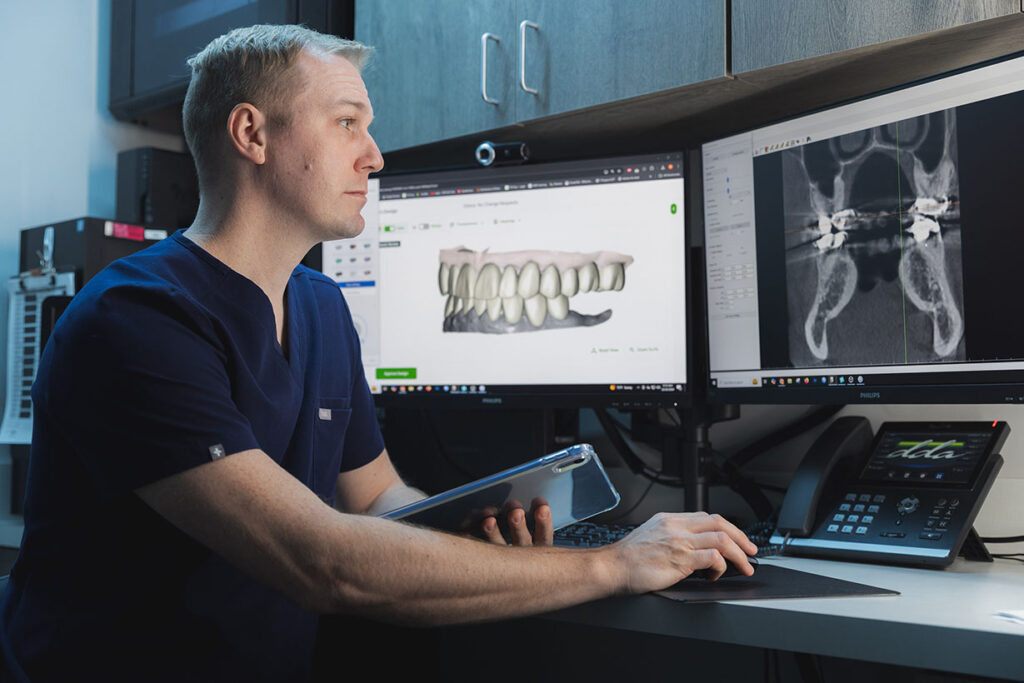
As your trusted dentist in Dunedin, we place and restore dental implants using our Planmeca 3D imaging system for precise planning and accurate implant placement. Every treatment plan is built around your specific anatomy, bone density, and dental health needs — not a one-size approach. You’ll know exactly what to expect before anything starts.
Dental implants can last a lifetime with proper care. They don’t rely on adjacent teeth for support, they don’t slip the way a partial denture can, and they feel natural because they’re designed to function exactly like a natural tooth root. If you’ve been living with missing teeth or worn-out dentures, it’s worth a conversation. Call our Dunedin office at (727) 734-3321) to schedule your initial consultation.
A dental implant is a small biocompatible titanium post placed into the jawbone to replace the root of a missing tooth. Over several months, the implant fuses with the surrounding bone in a process called osseointegration — creating a stable, permanent foundation for a crown, bridge, or implant-supported denture. The result looks natural, feels natural, and functions like a real tooth.
Tooth loss in adults is more common than most people realize, and the causes vary widely. Understanding what leads to missing teeth helps explain why replacing them promptly matters:
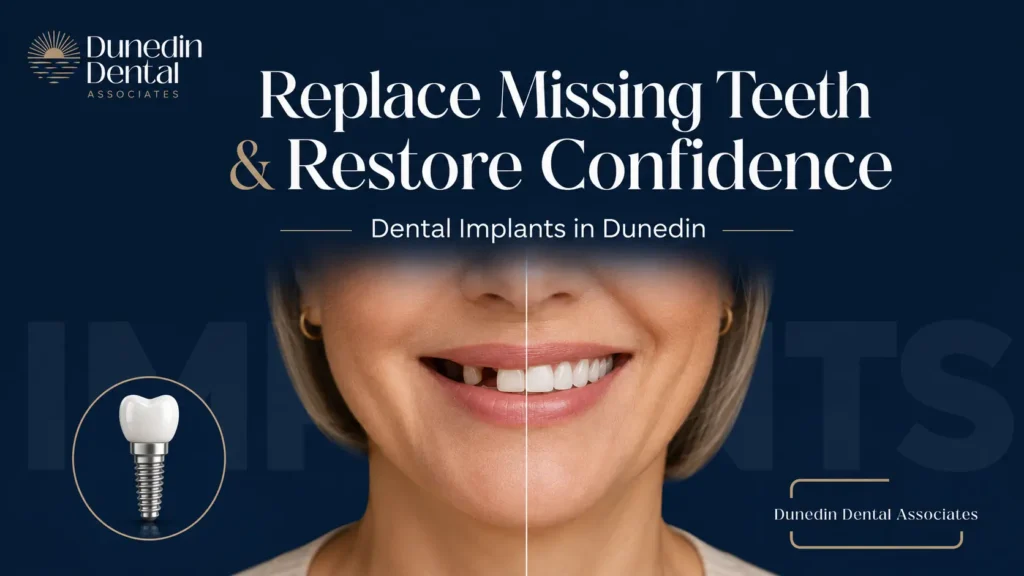
Bone loss in the jaw begins quickly after tooth loss — and it doesn't reverse on its own. Patients who wait months or years to replace missing teeth often require bone grafting before an implant can be placed. The sooner you act, the more straightforward the path to restoration.
Dunedin Dental Associates provides dental implant dentistry in Dunedin, FL. Call (727) 734-3321 or schedule your consultation online.
Whether you're missing one tooth, several teeth, or all of them, dental implants offer a solution that restores function and appearance without compromising the teeth around the gap.
A single dental implant replaces one missing tooth with a titanium post and a custom crown. Unlike a dental bridge — which requires shaping the two adjacent teeth to support it — a single implant stands independently and leaves neighboring teeth completely intact. It’s the most conservative, long-lasting solution for replacing one missing tooth.
When two or more dental implants are missing in a row, an implant-supported bridge fills the gap using two implant posts as anchors and artificial teeth in between. This eliminates the need to crown healthy adjacent teeth and distributes bite force through the implants rather than through the gum tissue — the way a traditional bridge or partial denture does.
For patients who have lost most or all of their teeth, implant-supported dentures provide a stable, secure alternative to conventional full dentures. Two or more dental implants anchor the denture in place — eliminating slipping, improving chewing ability, and preventing the bone loss that accelerates under a traditional removable denture. Patients describe the difference as life-changing.
Patients who are fully edentulous — or approaching it — have options beyond full dentures. Six dental implants or more can support a complete fixed arch of replacement teeth that functions like natural teeth. This full mouth implant solution restores chewing strength, speech clarity, and confidence in a way that no removable prosthetic can match. We’ll assess your bone density and discuss every option at your initial consultation.
When you’re missing one tooth, a single dental implant offers the most natural-looking and functional replacement option. The implant is placed where your tooth root once was, and a custom crown is attached to match your surrounding natural teeth perfectly.
An implant supported bridge is a restorative solution for spaces where three or more adjacent teeth are missing. Unlike traditional dental bridges that require grinding down healthy teeth on either side, implant-supported bridges use two or more dental implants as anchors for the bridge structure.
For patients missing many or all teeth due to severe decay, gum disease, or injury, implant retained or implant supported dentures offer a life-changing alternative to traditional dentures. These solutions simulate the look and feel of natural teeth while staying fixed in place with implants acting as anchors.
If you're in generally good health, don't have active gum disease, don't smoke, and have adequate bone mass in your jaw, you're likely a good candidate for dental implants. Our experienced dentist team will evaluate your oral health during your consultation to determine the best treatment plan for your situation.
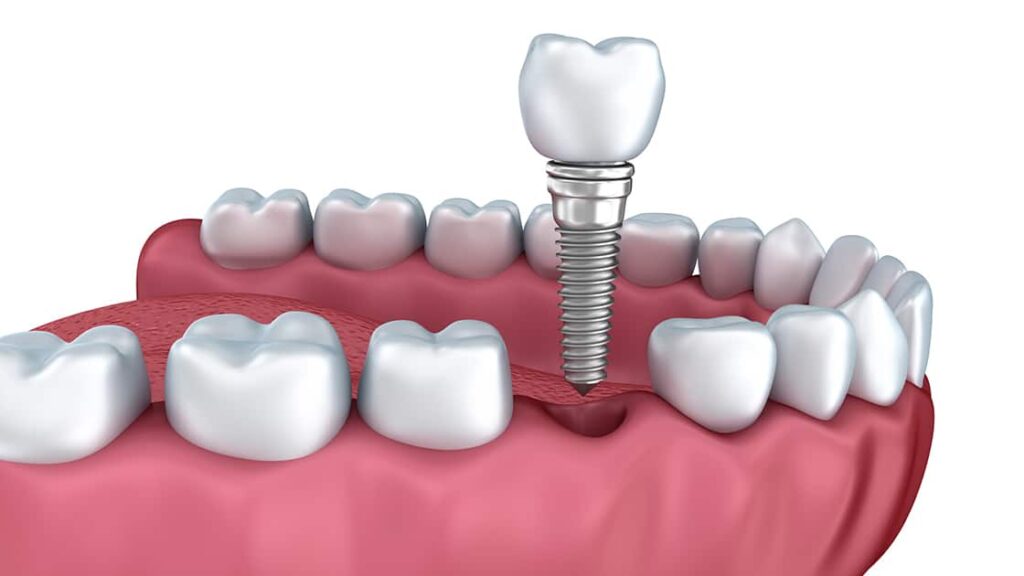
Dental implants are small anchors made of biocompatible titanium that are placed in the jawbone to replace missing teeth. After placement, the anchors fuse with the bone over a few months through osseointegration. Then abutment posts are inserted into the anchors, allowing permanent attachment of replacement teeth.
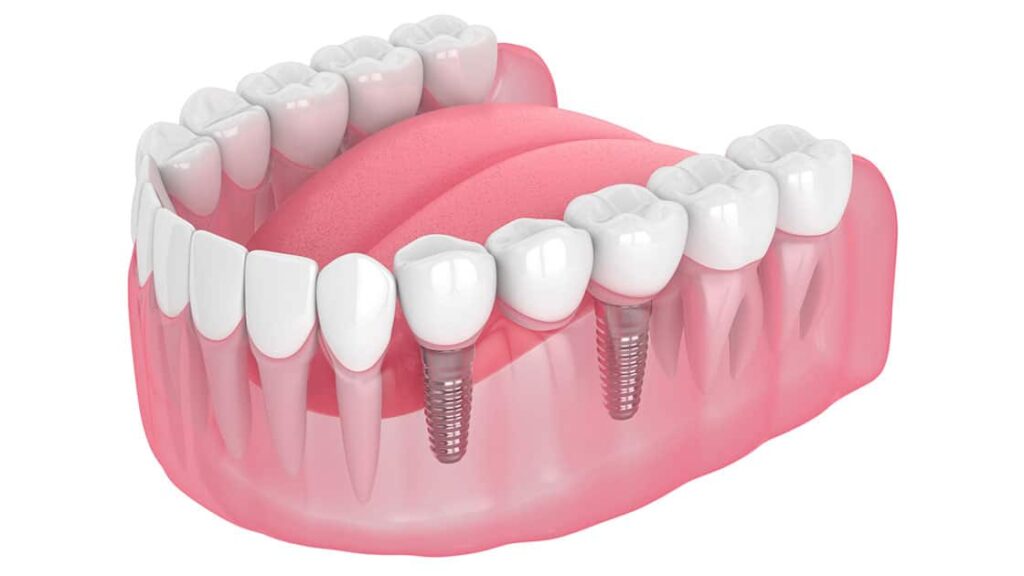
An implant supported bridge is a restorative solution for spaces where three or more adjacent teeth are missing. This restoration typically requires two implants to support the bridge that provides a functional and aesthetic replacement for a patient’s natural teeth.
For patients missing many or all of their teeth, implant retained or implant supported dentures may be an alternative to traditional dentures. These solutions can simulate the look and feel of natural teeth and stay fixed in place with the implants acting as anchors. Using implants for retention or the support of dentures allows for a smaller and more comfortable base and less shifting of the prosthesis during use.
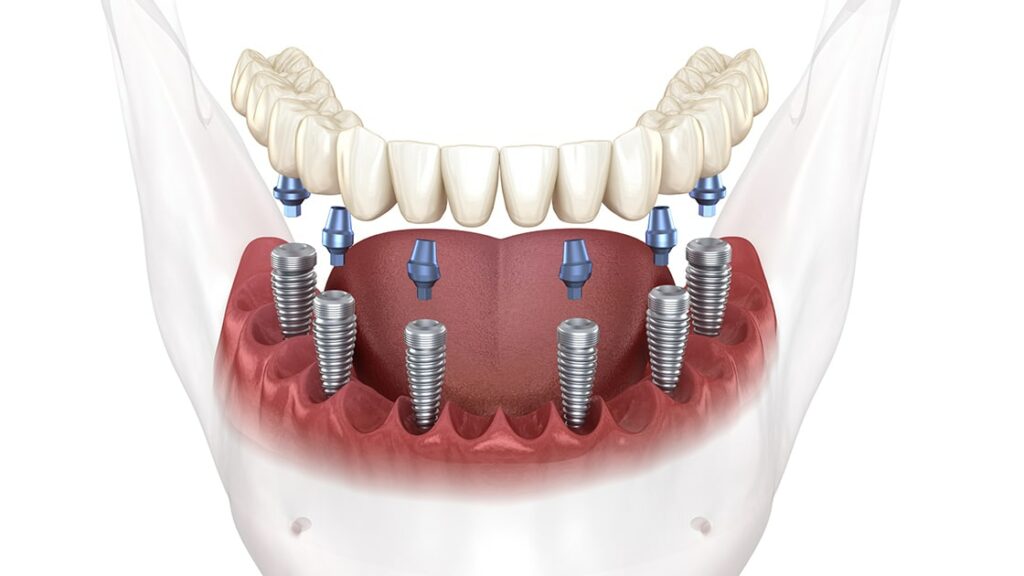
An implant supported denture requires the placement of four to six dental implants as “anchors” to provide a sturdier fit and minimal mobility for your denture. With implant supported dentures, there is no plate covering the roof of the mouth, so speaking and eating are more natural and comfortable than with traditional dentures. For qualifying patients, our doctors may be able to complete the removal of all teeth and the placement of a temporary arch on the same day.
Available for full or partial dentures, implant retained dentures require the placement of two or more dental implants to secure the dentures in the mouth. This type of denture will “snap” onto the implants and can be removed for cleaning at night.
The implant post is made from titanium — a biocompatible material that the body accepts without rejection. Once placed into the jawbone, the bone gradually grows around and bonds to the implant surface through osseointegration.
This process takes several months and is what gives the implant its permanent stability. Once complete, the implant becomes part of the jaw — fixed in place and providing dependable support for the final restoration above it.
A precisely positioned titanium implant is placed into the jawbone to act as a stable artificial tooth root.
Healthy bone gradually grows around the implant surface during the natural healing process.
Once osseointegration is complete, the implant becomes securely anchored and ready to support the final restoration.
Our Dunedin dental office uses Planmeca 3D cone beam imaging to map the precise dimensions of your jawbone before implant placement begins.
This three-dimensional imaging shows bone depth, width, density, and the exact position of nerves and sinus structures — critical information that makes implant placement accurate, safe, and predictable.
Patients who have had implant placements guided by 3D imaging experience fewer complications and faster healing than those placed without it.
Implants do more than restore your smile. They protect the structures that hold everything else together.
Every natural tooth root stimulates the surrounding jawbone through chewing pressure. When the tooth is gone, that stimulation stops — and the bone resorbs. A dental implant is the only tooth replacement that replaces the root function, preventing bone loss in the jaw and preserving facial structure over time. No other option — not a bridge, not a partial denture — does this.
Implants can last a lifetime with good oral hygiene and regular dental care. The crown above the implant may need replacement after 10 to 15 years, but the implant itself — once fully integrated — is designed to last for many years with proper care. Compare that to dental bridges, which typically require replacement every 10 to 15 years and involve the teeth on either side.
Missing teeth affect how you eat, which affects what you eat, which affects your overall health. Patients with implants report eating a full range of foods comfortably — allowing you to eat the foods you enjoy without restriction. Studies consistently link tooth loss to nutritional deficiencies in older adults. Restoring full chewing function with implants is a genuine health investment.
Replacement teeth that look natural and stay in place change how patients feel in social and professional situations. There’s no concern about a partial denture shifting while speaking, no visible gap when smiling, no self-consciousness about eating in public. Dental implants restore confidence because they restore function — and the two are inseparable.
Dental implant placement happens in stages. Here’s what the process looks like from your first consultation through the final restoration.
Your dentist reviews your dental and medical history, examines your teeth and gums, and uses our Planmeca 3D imaging to assess bone volume and density at the implant site.
If bone grafting is needed, it is identified here. You’ll leave this appointment with a clear treatment plan, a realistic timeline, and cost information for every stage.
The titanium implant post is placed into the jawbone under local anesthesia. The procedure is more comfortable than most patients expect, and many compare it favorably to a tooth extraction.
The site is then allowed to heal. Osseointegration — the process of bone fusing with the implant — takes place over the following weeks and months.
During the healing period, the implant integrates with the surrounding bone. This phase typically takes three to six months depending on the implant site and your bone density.
A temporary restoration may be placed during this period. Your dentist monitors healing at follow-up appointments to confirm integration is progressing correctly.
Once the implant has fully integrated, a small connector piece called an abutment is attached to the top of the implant post. The abutment serves as the base for the final restoration.
In some cases, the abutment is placed at the same time as the implant. Your dentist will advise which approach is appropriate for your case.
The final restoration — a custom crown, bridge, or implant-supported denture — is attached to the abutment and matched to the color and shape of your natural teeth.
At this stage, the implant looks natural, feels natural, and functions the way a real tooth should. Your dentist checks the bite, makes final adjustments, and reviews long-term home care.
When replacing one missing tooth, patients typically have three options. Here’s how they compare honestly:
Replaces the missing tooth from root to crown without modifying the healthy teeth beside it.
Uses the teeth on either side of the gap to support a fixed replacement tooth.
A removable appliance that fills the gap and must be taken out for regular cleaning.
| Comparison |
|
|
|
|---|---|---|---|
| Adjacent teeth affected | ✓ No | − Yes Nearby teeth must be crowned | ✓ No |
| Prevents bone loss | ✓ Yes | − No | − No |
| Feels natural | ✓ Yes | Mostly | Less so |
| Removable | ✓ No | ✓ No | − Yes |
| Expected lifespan | Lifetime Implant post with proper care | 10–15 years | 5–10 years |
| Maintenance | Normal brushing and flossing | Special flossing required | Daily removal and cleaning |
For most patients with adequate bone density and good oral health, a single dental implant is the most conservative and long-lasting solution available. It replaces the missing tooth without touching the teeth next to it and is the only option that preserves jawbone at the extraction site.
Conventional full dentures rest on the gum tissue and are held in place by suction and denture adhesive. They work — but they have well-known limitations. They can slip while eating or speaking, they require removal for cleaning, and because they don’t stimulate the jawbone, they accelerate the bone loss that changes the shape of the face over time.
Implant-supported dentures anchor to dental implants placed in the jaw. This eliminates movement, restores close to full chewing strength, and — because the implants stimulate the bone — slows the facial structure changes that accelerate with conventional dentures. Patients who make the transition from traditional dentures to implant-supported dentures consistently describe it as one of the best decisions they’ve made for their quality of life.
Our Dunedin dental office places and restores implants in-house — meaning fewer referrals, fewer appointments at separate offices, and a single dental team managing your care from initial consultation through final restoration. Dr. Matthew P. Burton and Dr. William P. Spencer III bring years of clinical experience in implant dentistry and restorative care to every case they treat.
We’re a best dental care provider for patients who want clear explanations, gentle treatment, and a dental team that treats them like a person, not an appointment slot. New patient forms are straightforward, wait times are reasonable, and every visit ends with a clear picture of where your oral health stands and what, if anything, needs attention.
We use Planmeca 3D cone beam imaging for every implant case — not as an upsell, but because accurate 3D imaging is what makes implant placement predictable and safe. Every treatment plan is personalized to your anatomy, your bone density, and your goals. Expert dental care in Dunedin means you get a plan that’s built for your mouth, not adapted from a template.
Our front desk team coordinates scheduling across all stages of your implant process so nothing falls through the cracks. Office hours are designed to accommodate patients who work or have caregiver responsibilities. And if you have questions between appointments, our dental team is reachable by phone at (727) 734-3321. Quality dental care in Dunedin means being available when patients need us — not just when it’s convenient.
Most adults with missing teeth are potential candidates. The key factors are adequate bone density at the implant site, controlled oral health (no active gum disease), and overall health that supports surgical healing. Conditions like diabetes or osteoporosis don’t automatically disqualify you — they require more careful planning. Your dentist will evaluate everything at your initial consultation and give you an honest assessment.
From initial consultation to final restoration, the process typically takes between three and nine months depending on whether bone grafting is needed and how quickly osseointegration progresses. The implant placement surgery itself is usually completed in under two hours. Most of the timeline is healing time — not active treatment.
The procedure is performed under local anesthesia. Most patients report that it’s more comfortable than they expected — often comparing it to a tooth extraction. Post-procedure discomfort is typically managed with over-the-counter pain medication and resolves within a few days. Your dentist will give you clear post-operative instructions before you leave.
A well-placed implant that integrates fully can last a lifetime with proper care. The crown attached to the implant typically lasts 10 to 15 years before replacement is needed due to normal wear. Maintaining good oral hygiene, keeping regular dental appointments, and avoiding habits like grinding or chewing ice extend the life of both the implant and the restoration.
Bone grafting can build up the implant site before placement. This is a routine procedure in implant dentistry and is performed at our Dunedin dental office. The graft material — which may come from your own bone, a donor source, or a synthetic material — integrates with your existing jaw over several months before the implant is placed. Your dentist will recommend grafting only when it’s genuinely necessary.
Dental insurance coverage for implants varies significantly by plan. Some plans cover a portion of the crown or the surgical placement; others exclude implants entirely. Our team will verify your benefits before your appointment and give you a clear breakdown of what’s covered and what isn’t. For patients without insurance, our DentalHQ membership plan and flexible payment arrangements help make dental implant care in Dunedin accessible. Ask our front desk team for details when you call.
Copyright © 2026